


Last week, we determined everybody that should be considered for a list of the game industry's most important/influential people. All the people who have changed the face of videogaming.
Starting last Thursday, we began voting for who on that list was MOST influential.
Now, we have our results. The final count is in, and we know now who YOU think influenced the videogaming industry the most. Remember - YOU GUYS made these decisions. If you didn't vote, it's only your fault that things turned out against your wishes. :p
The Top 30 placers each will be listed, complete with a writeup defending their position on the list. But you're not going to find out the results THAT easy. Oh, no. I'm going to post the list one by one, four people a day, until we've seen the whole list. Now, 30 isn't divisible by four. We know that. The final day, you will be getting only TWO people - the final two placers.
So, are you ready? Without further ado, here's THE GAMING INDUSTRY'S MOST IMPORTANT EVER.
30: Goichi Suda
Ah, Suda51. He got three votes, placing him at 10 points overall. He's the CEO of Grasshopper Manufacture. While Grasshopper's games haven't sold phenomenally, they've been peculiar games that have thought well outside the box and showed people just how much videogames can be art and not just entertainment. Yet, his games are still lots of fun. He's particularly known for killer7 and No More Heroes, but those games are just a tip off the iceburg. Stay tuned - we can expect to see lots more "outside the box" thinking from this dev!
29: Nobuo Uematsu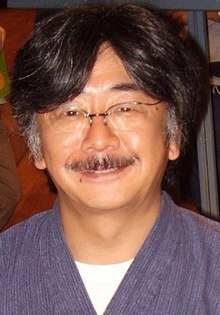
Uematsu also received ten points, however, his were through four votes. So, why did he place above Suda51? Allow me to explain. Uematsu has been working in the videogame industry since 1985, when he composed the music for Square's game Genesis. He continued working for Square for a few more years, until Square nearly went bankrupt. Finally, one of the developers he was working with decided to put together one last game for Square, a fantasy RPG. This game would be, if you will, his "final fantasy". This developer chose Uematsu to compose the music for this game as well. So began a legend. Uematsu has since done the soundtracks for every mainstream Final Fantasy title, as well as a variety of other RPGs like Chrono Trigger and Blue Dragon. Dozens of titles have his musical talents behind them, and dozens more are likely to come. Uematsu has surely composed some wonderfully memorable tunes, and he has yet more to come.
28: Peter Moore
The legendary Peter Moore. Also placing with ten points, however, he only received two votes at all. Former COO of Sega of America, it was made HIS decision as to whether or not the Dreamcast should continue production... and he discontinued it, turning the monster Sega company into a third-party developer. It's due to him that we now see Virtua Fighter and Sonic, among others, on Sega's former competitors' systems. He eventually left Sega, moving on to Microsoft to help the Xbox brand compete against Sony and Nintendo. It's thanks to his work that the Xbox eventually rose to prominence above the Nintendo Gamecube. Finally, he now works for Electronic Arts as president of their EA Sports division, spearheading their many sports franchises that earn a majority of the profit EA now enjoys. Good for you, Peter.
27: Kazuo Hirai
Kaz Hirai, the now CEO of Sony Computer Entertainment, Incorporated. Finishing with twelve points through four votes, this man is the spearhead of the Playstation brand name today. In the past, he was president of SCEA, Sony's American entertainment branch, and he was key behind leading the Playstation against Nintendo, bringing it to sales levels never before enjoyed by a videogame system. It was he that decided how the Playstation name would be marketed in America, and it was he that helped videogaming begin its trek towards recognition as "not just for kids". With the Playstation 2, he continued this legacy, managing to promote it to the point of the best-selling videogame console ever, to date. He now heads the entire Sony Computer Entertainment branch of Sony, and is fundamental in the Sony brand.
26: Warren Spector
Warren Spector, finishing off with two votes at 13 points, he's your twenty-sixth placer. Spector has been a game developer for over two decades. His videogame credits began in 1990 when he helped work on the classic hit Wing Commander and its expansion, The Secret Missions. After that, he began working in the Ultima series, in which he developed six titles. He also worked on System Shock, the spiritual ancestor to Bioshock. He's been credited in almost two dozen games, nearly all in formidably well-known franchises. His most praised work is likely that on Deux Ex, the cyberpunk first-person RPG that later earned a sequel, Deus Ex: Invisible War, which Spector also developed. If it weren't for many of the titles Spector worked on, it can be said that much of the gaming scene in the past twenty years would have been worlds different. Today, he's the lead designer for the heavily anticipated Epic Mickey, coming out for Wii next year.
25: Shinji Mikami
Mikami comes in 27th with fifteen points, collecting four votes to place there. Shinji Mikami has been working with Capcom for nearly twenty years. He first began with making a trivia Gameboy title, then he moved on to movie-to-game adaptations, Who Framed Roger Rabbit?, Aladdin, and Goof Troop. After that, he decided to move on to develop a horror title for the Playstation and Sega Saturn. With this was born Resident Evil, moving on to become the first game to be classified a "survival horror". Since then, Mikami has worked on nearly every Resident Evil title (all except RE5), as well as Viewtiful Joe , P.N.03, killer7, and the Dino Crisis series. He is now working on an unknown title with Goichi Suda.
24: Gabe Newell
Ol' Gabe, also receiving fifteen points in four votes, snuck in just above Mikami for having created one of the most influential and well-known gaming companies today. Newell created Valve, the developers behind the acclaimed Half-Life series and creators of the Steam online service. Newell had worked for Microsoft for thirteen years, becoming a millionaire off of the work he did for Microsoft (heck, he produced three versions of Windows). Eventually, he decided to leave Microsoft to start a gaming company. He created Valve in 1996, releasing their hit Half-Life just two years later. Half-Life became an instant hit, and Valve is now credited with twenty games, including Counterstrike, Team Fortress, Portal, and Left 4 Dead, as well as their respective sequels/to-be-released sequels. Additionally, Valve released Steam, their online content delivery service, in 2003. Originally, it was only any good for obtaining Valve titles, but over time, it began collecting non-Valve games, and today is the largest content delivery service in the world, massing a library nearly 900 titles strong and over 20 million accounts. It also has moved well beyond merely a content delivery service, containing a community messaging system and even a web browser, as well as launcher-functions for games outside the Steam name. Currently, Newell is overseeing production of Valve's next three titles, all heavily anticipated - Half-Life 2: Episode 3, Portal 2, and the soon-to-be-released Left 4 Dead 2.
23: Bill Gates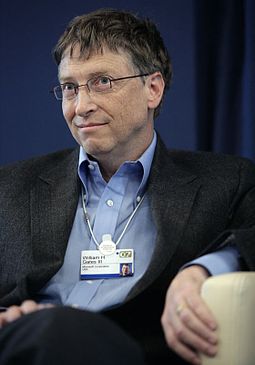
The richest man in the world. Bill Gates. Gates also finished off with 15 points, this time only in three votes. Gates placed above Newell because, well, Newell wouldn't have started Valve had it not been for the millions of dollars he made... working for Gates! Gates began Microsoft in 1975, creating boring software nobody really cares about anymore. In the early '80s, however, they created the MS-DOS operating system and became an instant success. They then continued to create the graphical user interface, Windows, to operate over top of MS-DOS, and Windows ultimately continued on to surpass MS-DOS as the world's most popular operating system. Today, Bill Gates is the wealthiest man in the world, and Microsoft is one of the biggest companies in the world. Microsoft was already to thank for a huge chunk of the gaming industry, then they entered it themselves. Microsoft's gaming branch first rose to prominence in 1996 with Flight Simulator, but they gained more recognition the following year with Age of Empires, then continued releasing dozens of hits over the next couple years. They also entered the videogame console wars in 2001, releasing the Xbox. Today, they produce the Xbox 360, now the most successful American videogame console ever. Gates is no longer the CEO of Microsoft - he's since retired from that position. But he's still a chairman, and he's still the wealthiest man in the world, so he definitely still moves a lot of the gaming industry.
22: Yuuji Horii

Yūji Horii comes in today at #22 with sixteen points collected in two quick votes. Horii began working for Enix in 1982 after he won a programming contest that they sponsored. He designed two games for them early on before moving on to create Dragon Warrior (Dragon Quest in Japan). Dragon Warrior was the very first ever top-down role-playing videogame, thus effectively becoming quite possibly the most important release in RPG videogaming history, as every RPG released since then pretty much is either influenced by that, or influenced by another game that was influenced by that. Whether directly or indirectly, if you've ever enjoyed an RPG, you probably have Horii to thank for it. Anyways, Dragon Warrior was an instant success, becoming wildly popular in Japan and a significant success in America. Today, the series has seen a variety of sequels, as well as a few spinoffs, and is still regarded as one of the best RPG franchises ever. The ninth main installment recently released on the Nintendo DS, and Horii is currently working on the tenth to be released next year on the Nintendo Wii.
21: Alexey Pajitnov

Алексей Пажитнов. The Russian that changed gaming forever. Finished also with 16 points, but in five votes. In 1984, he was working for the Soviet Academy of Sciences when he decided to put together a little puzzle game. Expecting just to be making a little mind exercise, Pajitnov never expected the storm that would ensue. He released Tetris on the Elektronika 60, then it was ported to the IBM PC shortly after. It traveled outside the Soviet Union rather quickly, when it was quickly discovered by the outside world. From here, lots of legal issues and a whole mess took place, but the game quickly became extremely popular. And through all of it, Pajitnov initially had zero rights to the game anyways, given that he created it under Soviet control. Finally, Nintendo got control of the game, releasing it for the NES and the Game Boy in 1989, and it reached worldwide recognition, becoming one of the most popular games of all time. Over the years, dozens of Tetris clones and imitators were released, until in 1996 when Pajitnov finally formed The Tetris Company because he regained rights to the title from Russia. Pajitnov is now involved in all Tetris releases yet again, and he has helped develop a number of other puzzle games, Tetris-related or not. Tetris is now by far the most well-known and best-selling puzzle game of all time, and the grandfather of most "traditional" puzzle games today - so much so that many consider "Tetris-like" to be a subgenre within puzzle games themselves!
20: Tetsuya Nomura

Nomura. Yet another RPG guy. This one finished with seventeen votes, placing him at #20 on our list. Nomura began working with Square in the early '90s as a debugger for Final Fantasy IV. Apparently he made an impression, because he quickly climbed up the development ladder and has now been highly influential in most Final Fantasy titles, main series or spinoff, since then, as well was every Kingdom Hearts title so far. Mainly designing characters, he also directs and produces a number of the titles he works on. Besides the Final Fantasy and Kingdom Hearts series, he worked heavily on Chrono Trigger, Super Mario RPG, the Parasite Eve series, and a handfull others. Today, he's working on pretty much everything that SquareEnix has announced, and probably a few titles that they haven't.
19: Gary Gygax

If you're an RPG fan and you don't know Gygax, you're a disgrace to the seventeen points he amassed. Gygax is the father of the role-playing game. Around 1948, at the simple age of ten, he began playing what we now know as "live-action RPGs" with his friends, helping decide the rules and oftentimes playing as referee. Quickly beginning to love wargaming and the realm of fantasy, he would play a variety of board games, then design variants off of them and mold them into new games. He began utilizing different types of dice to further randomize the outcome, sometimes only four-sided dice, sometimes as much as twenty-sided. In 19687, he organized a gaming meet in his basement, now retconned as "Gen Con 0" as the next year, he hosted the first official Lake Geneva Convention. It was through this gaming convention that he met some friends who inspired him to continue developing rules for his games, starting to give stats to each of the pieces of armor and weaponry that the figurines they used were "wielding". From this point, the cogs fell into place one at a time, until in 1972, he created Dungeons and Dragons. From here, the role-playing game became an instant smash-hit - most finding the only downside being that you have to do all the calculations yourself. The game became a multi-million dollar endeavor, earning fandom across the globe. Quickly, the idea of converting the gameplay mechanics to computerized form became popular, and role-playing videogames suddenly became all the rage. Today, the RPG is one of the most important videogame genres ever to exist, with elements spread throughout nearly every other genre to some degree. RPGs number in the thousands, with some of the bestselling game series, like Final Fantasy, Dragon Quest, Pokemon, Deus Ex, Ultima, and hundreds of other series all having Gygax and his Dungeons and Dragons brainchild to thank for their existence.
18: Dan & Sam Houser
Funny that the ONLY picture I could find of Dan and/or Sam Houser was in the art style of their acclaimed series. The Houser Bros. finished off this time with eighteen points, collected between six votes. The Houser Bros. founded Rockstar Games in 1998. They worked to help create the Grand Theft Auto series, and were particularly influential in the creation of Grand Theft Auto III, transforming the series into one of the best-selling series ever and and forever changing sandbox-style gameplay. Today, the series has sold more than 80 million units, placing it as the seventh best-selling game series of all time. The Bros. themselves have directly worked on nearly every Grand Theft Auto title in some way, as well as some work on a few other titles. Indirectly, through having created Rockstar Games, they've has influence over dozens more games and series, including Manhunt, Midnight Club, Bully, Max Payne, and more. Today they're working on the GTAIV expansion The Ballad of Gay Tony.
17: Koji Kondo
Koji Kondo. Inarguably the most influential videogame composer of all time. Mr. Kondo finished off with 19 points, amassed through seven total votes. Koji began working for Nintendo as a composer in 1984, composing the music for Duck Hunt, Golf, Famicom BASIC, and Devil World all in his first year there. In 1985, he made his breakthrough legendary composition with Super Mario Bros - the title that singlehandedly makes his music more well-known than any other videogame composer ever. The first three notes alone of the Super Mario Bros. World 1-1 theme song are enough for nearly any youth in America to tell precisely what song you're talking about. Kondo continued after Super Mario Bros. to go directly into working on the Legend of Zelda music - his second most legendary work (no pun intended :p). He has since composed music for every main-series Mario and Zelda title, as well as the wonderfully relaxing music of Pilotwings, the thrilling music of Star Fox, and much of the music for the Super Smash Bros series. His videogame compositional mastery is only rivalled by Nobuo Uematsu, but for the sheer superiority of the various Nintendo franchises' sales, Kondo is today vastly more well-known. Currently, it hasn't been officially announced what he is working on, but we can assuredly know that we will be hearing his work many more times within the next year or so, as New Super Mario Bros. Wii, Super Mario Galaxy 2, and the unnamed Zelda Wii all are expected to release within these time slots. Click the picture of Kondo for a treat, by the way.
16: Masahiro Sakurai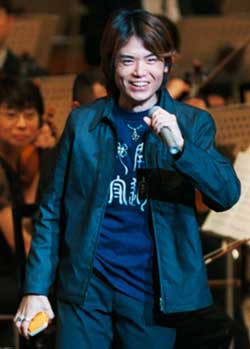
The legend behind Sora, Ltd. comes in today with 26 points collected throughout a quick four votes. Sakurai is initially known as the legend behind the creation of Kirby, Nintendo's famed pink fluffball. Besides creating the character of Kirby, Sakurai also designed most of Kirby's original games, from Kirby's Dream Land on the GameBoy in 1992 to Kirby Air Ride on the GameCube in 2003. But Kirby isn't all that Sakurai is to thank for. Oh, no. He additionally is the designer behind all three Super Smash Bros. games, having brainstormed most of the concepts used in all three titles. Thanks to their being featured in the Smash Bros. series, many classic Nintendo franchises have seen tremendous new releases. Various characters that, for a rather long time, had never seen the light of day have since had their own game releases.. He also created the 2005 Tetris-esque puzzle game Meteos, considered one of the best games ever released on the DS and, personally, the best unique puzzle game I've seen released in years. Currently, Sakurai is working with Nintendo through Project Sora, a Nintendo first-party developer also partially owned by Sora Ltd. I've got another minor treat for you guys hidden in the image.
15: Yuji Naka
Naka-san comes in today at #15 with thirty points in seven votes. You probably don't know this guy, but you know his brainchild all too well. He's fast. He's blue. He's a hedgehog. He's Soooooniccc the Heeeedgehog. He can really move! He's got an attitude! He's the fastest thing aliiiiiiive! Anyways, Naka essentially is the man that transformed two other men's ideas into playable genius. One guy designed the Sonic character, another designed the Sonic levels, and Naka took those ideas and made them gold. This game changed gaming forever. It proved once and for all that Nintendo didn't have to reign the gaming scene - a concept further enhanced a few years later with the PlayStation - and it helped create the "cooler, more mature gamer" image with its advertisements that attacked Mario. Upon its formation later, Naka became the head of Sonic Team. Besides heading up creation of most Sonic games, Naka is also responsible for production of Nights into Dreams..., Burning Rangers, and Phantasy Star Online. Naka left SEGA later to form Prope, a SEGA-funded but ultimately independent studio that, as of yet, has released two titles for Wii and two titles for the iPhone. As usual now, check the image.
14: Masayuki Uemura
Uemura finishes today at number fourteen with a total of thirty-two points in six votes. Decades ago, Uemura was a toy maker. As he continued making toys more and more complex, he decided he wanted to know more so he could better understand how to make them particularly complex. He went to college in the 1960s, and upon graduating, Sharp Corp. hired him immediately. He worked for Sharp for a few years, until one day Sharp sent him to attempt selling solar cells to Nintendo in 1971. He spoke to Gunpei Yokoi, who was particularly interested in using these solar cells in Nintendo's toys and games. Eventually, Yokoi called him back and hired him directly into Nintendo, stealing him from Sharp. Uemura later used these solar cells to create Nintendo's light-guns. Early on, these guns were mainly the Beam Gun games, games where you'd have a light-emitting gun that would shoot light at a target, which had said solar cells installed on it. Uemura would later become the head of Nintendo R&D2, the team primarily responsible for developing Nintendo peripherals, as well as some games. In the late '70s, Uemura suggested to Nintendo president Hiroshi Yamauchi that they team up with an electronics company to create videogame chips - thus moving Nintendo into videogame development. Later, it was Uemura's solar cell designs that led to creation of the famous NES Zapper, then later the SNES Super Scope. Uemura later oversaw the creation of a variety of games at R&D2, most notably the Super Mario Advance series and the port of The Legend of Zelda: A Link to the Past to Gameboy Advance. Uemura finally retired from Nintendo after thirty-three years of work with them in 2004, and he now relaxes at his home in Kyoto, enjoying the spoils of his decades of hard, fantastic work. If you'll notice, again, there's an orange border on the image...
13: Satoshi Tajiri
Tajiri-san finishes today at thirty-six points in a total of nine votes. Tajiri is, as you can probably tell, responsible for the creation of Pokémon, the series probably responsible for many of you RPG lovers for even knowing what an "experience point" is. Most "Pokéfreaks" are today familiar with the story of why Tajiri created Pokémon, but I'll tell you anyways. When Tajiri was a child, he would go into the forests near his village to chase and collect insects and other small creatures. He was fascinated with collecting more and more unique varieties. However, in the late 1970s - when Tajiri was about twelve or thirteen years old, the forests and fields were torn down and paved over to build a variety of shopping centers. Tajiri saw this and felt sorry for the children later to come, feeling they would never be able to experience the joys of collecting bugs as he once did. Decades later, he finally found a way to share this experience with the children of today's generations - videogames! Tajiri had been working in videogames for some time now, having developed a couple games for Nintendo consoles already. However, in 1991, when he saw a GameBoy with link cables, he instantly thought of insects crawling along the cables, and immediately began work on Pokémon. He received funding from Creatures, Inc, the company best known for creating the Mother (Earthbound) series (under its original name, Ape). Creatures, Nintendo, and Tajiri's newly-formed game company Game Freak each took an equal share in ownership of the new game franchise, and it became a tremendous smash hit. Though Nintendo was in no way in danger of going out of business, many believe Pokémon is today responsible for Nintendo remaining in the gaming business, as it was such a huge hit. Today, the Pokémon franchise is the second most-valuable franchise in gaming history, second only to another Nintendo franchise, the legendary Mario. It has sold almost 200 million units, and continues to sell well today.
12: Yu Suzuki
Mr. Suzuki finished with 42 points, given to him by four voters. Once called the "Miyamoto of SEGA", Suzuki obviously did for SEGA what Miyamoto did for Nintendo. Suzuki created the majority of SEGA's greatest arcade (and non-arcade) hits, most notably the Out Run, Virtua Fighter, Virtua Cop, and Shenmue franchises. His production history spans over thirty titles, most of which are available in arcades today. One of the earliest designers to seek out 3D gaming, his work has influenced most of what we play today. He originally tried 3D concepts as early as 1985 with Space Harrier. Though not actually 3D, it gave an absolutely fantastic "3D feel" that was unsurpassed in any other games at the time. He continued toying with 3D gaming throughout the years, with titles such as the massive hit Out Run, Space Harrier 3D, Hang-On, Enduro Racer, and many, many others. He finally entered true 3D gaming in 1992 with Virtua Racing, the first 3D racing game ever and what was considered the "most realistic" racing game of its time. Continuing with the "Virtua" theme, he later released the first 3D fighting game ever, Virtua Fighter, creating one of the most popular fighting series' to date. Particularly popular for arcades, Virtua Fighter 1 can still be found in arcades today, let alone its various sequels. Although the graphics quickly became obsolete, the game still revolutionized the fighting genre forever, effectively being the spiritual ancestor to a variety of other popular fighting franchises, most notably Tekken, Soul Calibur, and Dead or Alive. It is unknown what Mr. Suzuki is working on today, but it's believed he is currently at work on a new Shenmue MMO, as well as the next iteration in the Virtua Fighter franchise.
11: Will Wright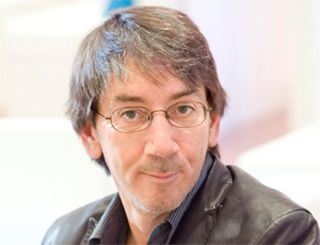
Will Wright comes in at eleventh today with 47 points, from eleven total voters. Wright released his first game in 1984, called Raid on Bungeling Bay, and it was a mild success. Wright continued developing for the game, not for the game's success, but simply because he absolutely enjoyed it. He realized part of what he enjoyed was designing the various maps and factory/warehouse layouts, and decided other people may enjoy designing similar concepts. A couple years later, he and Jeff Braun formed Maxis in 1986 so Wright could bring this concept to fruition. A few years later, they released their massive breakthrough hit, Sim City. Sim City came to be known as one of the most important PC game releases of all time, giving Maxis the funds and the encouragement to continue development. Wright moved on to design a variety of other games based on the "simulation" concept, including SimEarth and SimAnt, as well as a number of sequels to SimCity. SimCity 3000 began involving the city's citizens more, effectively leading Wright to try out a game in which players actually control the lives of individuals, instead of the city as a whole. This resulted in the release of The Sims, Wright's masterpiece series, becoming the bestselling PC videogame of all time and one of the bestselling videogame franchises of all time (currently fourth behind Mario, Pokémon, and Tetris). Wright and Maxis recently released Sims 3 and Spore, Wright's two biggest projects ever. He is currently working to expand the Spore franchise, extending beyond the "Sim" brand bubble.
10: Sid Meier

Sid Meier enters our Top Ten today with 54 total points, spread across ten votes. Meier is perhaps one of the most well-known videogame developers... but could that possibly be due to his tacking of his name onto the title of many of his games? Who knows. Either way, Meier began developing games in the early 1980s when he began Microprose with Bill Stealey. He started with a variety of flight simulators - Spitfire Ace, F-15 Strike Eagle, NATO Commander, and more. He continued developing a variety of games, releasing his famed Pirates! in 1987, Railroad Simulator in 1990, and his most well-known game, Civilization, in 1991. He continued producing game after game, until in 1996, MicroProse had been taken over by another game company, and he left to form Firaxis Games. He later regained control of all his most popular franchises through Firaxis, continuing to develop them over the years. Meier is now responsible for the development of over four-hundred videogames, most being incredibly influential in the progress of the PC gaming scene, and it is unknown what he is currently working on.
9: Hironobu Sakaguchi

Mr. Sakaguchi completed this with 54 points as well, his through a quick seven votes. Sakaguchi began working for Square in the early 1980s, originally part-time but he shortly became a full-timer in charge of Planning and Development. Through Square, he helped develop a variety of titles throughout the early and mid 1980s, but they continued to prove unsuccessful. Square's future became dim. Sakaguchi began working on one final project, a fantasy RPG. He decided to give it a somewhat ironic name given these circumstances, naming it Final Fantasy. He approached Nobuo Uematsu to compose music for his game, and it was released in 1987. The game became a runaway hit, the sole reason Square survived as a company. Under Sakaguchi's supervision, he guided Final Fantasy into a successful franchise with dozens upon dozens of releases. Additionally, the series has seen a wide number of spinoff franchises, including the SaGa series, Crystal Chronicles, Seiken Densetsu (the Mana series), and Kingdom Hearts. In 2004, after overseeing the creation of nearly two-dozen Final Fantasy titles and a variety of others, including hits such as Chrono Trigger, Parasite Eve, Xenogears, and Super Mario RPG, Sakaguchi resigned from Square and began operations at a new studio of his own, Mistwalker. At Mistwalker, he helped with the production of new RPG games, namely Blue Dragon and Lost Odyssey. Today, Sakaguchi is at work on a new secret project that he claims is huge, saying he's "betting a lot on this project". No other details have yet surfaced.
8: Satoru Iwata

Iwata, presently the President of Nintendo, finished with 58 points in a total of twelve votes. Iwata began working in videogames nearly thirty years ago, through Nintendo's subsidiary HAL Laboratory. Iwata helped develop all of HAL's famed titles, including the Kirby series, Earthbound, and more. He was eventually promoted to the president of HAL Labs, which he continued to work for the next seven years. He then took a position working at Nintendo in 2000, as part of their Corporate Planning division. He continued working in that position for an additional two years, until Hiroshi Yamauchi retired from his position as Nintendo's president and named Iwata as his successor. Nintendo had been struggling with complacency in the gaming industry for some time now, incapable of moving forward or becoming more financially successful. They were slowly becoming "the last big thing", just as they had forty years prior. Iwata saw this and determined that the company needed to stop just doing improvements on the same old formula. He decided they needed to do something new. Two years later, the Nintendo DS was released, entirely changing how people originally knew handheld gaming. Another two years after that, Iwata led Nintendo to release the Wii, now known today as the fastest-selling game console to date, with the DS coming in a close second. Besides working to have Nintendo do what hasn't been done before, Iwata has also helped work on some of the company's most successful franchises, including The Legend of Zelda, Mario, and Animal Crossing. Presently, Nintendo has become one of the most profitable companies in worldwide history through Iwata's guide, its average profit per employee being over one million dollars. He is now working to guide Nintendo into the next age, undoubtedly deciding what is to succeed the DS and the Wii and when.
7: John Carmack

Carmack finishes off today's updates with fourteen votes amassing to 62 points. One of the most well-known and successful developers of all time, Carmack began work in the late 1980s, when he developed a new side-scrolling game engine that had never been done before on the PC. It worked so well, he and a friend spent the entire next night creating a near-perfect port of the original level of Super Mario Bros. 3 to the PC. They eventually ported the entire game, then tried licensing it to Nintendo. Nintendo turned them down, however, saying they had zero plans to expand into the PC market, so they began work on a new sidescrolling series utilizing the same engine. This series was called Commander Keen, which they created three titles for. These games became a hit, so Carmack and friends left their employer and founded iD Software, then creating the next three Commander Keen titles and effectively developing a legend. They did a few other games, before creating Wolfenstein 3D, the first major first-person shooter in videogame history. Wolfenstein was pseudo-3D, though, and it wouldn't be until iD's next major hit, Doom, that they would release a truly 3D title (albeit still using sprites, though). Wolfenstein was a hit, but Doom became a legend. iD became the most important company in the PC gaming market, releasing hit after hit after hit. In 1996, they released Quake, which was finally their first genuinely 100% three-dimensional title utilizing 3D models instead of just sprites. Each of iD's releases continued to be massive hits, and today, iD continues to pioneer the FPS genre, though perhaps not at the level of distinction they enjoyed in the 1990s.
 SW-5120-1900-6153












 ).
).