


BTFeather55 on 07 March 2009
@fumanchu, i think i predictd kz2 would sell 750,001 units week one. wasn't too far off was I?
Heavens to Murgatoids.










@fumanchu, i think i predictd kz2 would sell 750,001 units week one. wasn't too far off was I?
Heavens to Murgatoids.


Slimebeast said:
Quit dodging. If I set a goal to run 100 meters under 13 seconds, and I manage to do it, I'm more successful than Usain Bolt if he fails to set a new world record in the next Olympics?
|
To directly answer your questions. The xbox was not as successful as the ps2 at selling systems, or software, just as you are not as successful at running 100 meters as Usain Bolt. This does not mean that the xbox was not successful in it's own right. You are talking about success at a shared criteria that allows companies to be measured agaist one another. This allows for simple judgements of who is the most successful.
The reason I did not want to directly answer you question was because you framed it as success of one console verses another, which requires shared criteria, and is therfore at a tangent to my point which was that the criteria for success depends upon what the manufacturer set out to achieve.










| RolStoppable said: Not just for current gen consoles, but for all: 1. The system must have achieved overall profitability at the end of its lifecycle. 2. The system must have meet the sales expectations of its manufacturer. By these metrics the 360 is a failure (so far, can still change), the PS3 is a failure (will remain one) and the Wii is a success. Applied to last generation the only successful console was the PS2. |
These are pretty close to my own standards of success.
(P.S, does agreeing with Rol make me a collaborater with the dirty Australians?)
Tease.


^so the total sales numbers don't reflect success that much to you Squill?


Well on a quarter by quarter basis the Xbox 360 has been doing pretty well for itself. Its looking more and more like a success, but overall I wouldn't classify it as a success yet.
Tease.



Whether or not I like it. If I like it, it must be of incomparable success and capability of restructuring civilization.
flames_of - "I think you're confusing Bush with Chuck Norris."
 Wii: 80-85 Million end of 2009 (1.1.09)
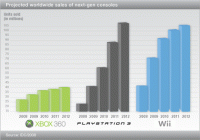


Outsell last generation console sales and increase market share in console generation. Wii and XBox 360 have both increased significantly upon GC and XBox respectively. The same can not be said of PS3 sales improving on the PS2 sales.
BTW: Competition in video game market makes it better for everyone quality of games improve due to competition.


| numonex said: Outsell last generation console sales and increase market share in console generation. Wii and XBox 360 have both increased significantly upon GC and XBox respectively. The same can not be said of PS3 sales improving on the PS2 sales. BTW: Competition in video game market makes it better for everyone quality of games improve due to competition. |
Exactly.
Evan Wells (Uncharted 2): I think the differences that you see between any two games has much more to do with the developer than whether it’s on the Xbox or PS3.


It depends what you mean by success. I think that there are at least six main measures.
First, you must sell enough hardware to create a viable market for games on the platform. This is the baseline for success. If you don’t do that you have real problems.
At some level, all three consoles have achieved this, though there is room for argument as to whether Microsoft and Sony have each created enough of a market for high-budget games, hence the plethora of multi-platforms.
Second, you must achieve your collateral targets.
Nintendo has done this, in expanding the market. Sony has done this in winning the HD format war. It is not clear what, if any, collateral targets Microsoft had.
Third, you must not sully the brand. There is room for lots of argument here, but arguably all three have failed to some extent.
Nintendo – in ‘alienating the hardcore’.
Microsoft – with hardware unreliability.
Sony – in going too far upmarket to cater for the mass mainstream.
Fourth, you must sell games and continue to sell them. All three have succeeded to about the same extent here, averaging about one game sold per console per two-and-a-bit months.
Fifth, profitability. This is not as easy as the other metrics, as raw profitability in the gaming arena is the whole story only for Nintendo. Sony appears to have changed tack here, previously relying on high-end tech development to bolster the PS3 and now more profit-focused. Microsoft really doesn’t seem particularly focused on profit, it takes second place to market penetration.
Sixth, you must whup the competition. Nintendo has done this. Sony and Microsoft haven’t.

About Us |
Terms of Use |
Privacy Policy |
Advertise |
Staff |
Contact
Display As Desktop
Display As Mobile
© 2006-2026 VGChartz Ltd. All rights reserved.


