
By using this site, you agree to our Privacy Policy and our Terms of Use. Close

Forums - General - My New, New Deal for the economy.

Jackson50 said:
To say the war ended the Great Depression is ill-founded. It reminds me of the broken glass theory. In fact, government spending on the war effort actually made life worse for Americans. It led to a shortage in many resources. No, it was the end of the war that brought about the end of the Depression. The end to rationing and the influx of cheap labor, amongst other things, gave rise to conditions that were ripe for an economic boom.

I would also disagree that the New Deal ended the Great Depression. I would say that it prolonged the Depression. If you truly think there will be a depression, the last thing you should advocate is to copy the policies of Hoover and Roosevelt. The cause of our current economic turbulence is the same thing that caused the Great Depression...the inflationary monetary policies of the Federal Reserve.

The war caused a shortage of resources because over 50% of our economy was devoted to war production.  Compare that to Vietnam were less than 5% of our economy was devoted to the war.  You cannot blame world war II for having an effect on the economy when it was essentially an all out, total war.

The Federal Reserve is a great economic tool.  Looking back on the what the Federal Reserve has done compared to unaltered economies, the Federal Reserve has successfully lessened the effects and time of recessions, which is why they were created in the first place.

Hoovers policies of an unregulated economy helped lead to the disaster that was the Great Depression.  Roosevelts New Deal gave Americans jobs they otherwise wouldn't of had (large construction projects), and those workers spent their money in the domestic economy which turned it around.

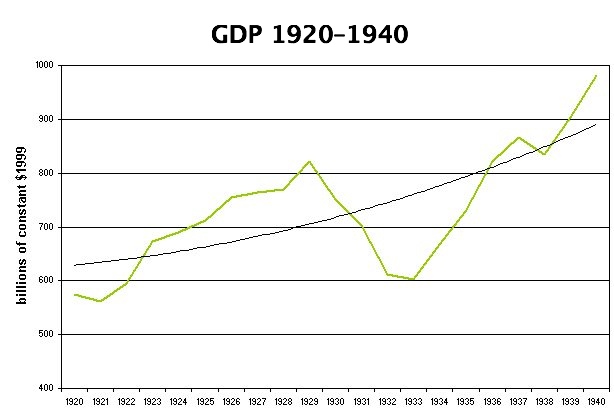
Blaming Franklin Roosevelt's economic policies for anything is absolutely obsurd.  Franklin Roosevelts New Deal started in 1933, and then America's economy has a huge increase in GDP.


Around the Network


The Federal Reserve's monetary policies led to the GD because it kept interest rates so astoundingly low during the 20s. This created a credit-driven boom that popped when the fed began to tighten the money supply in the late 20s. It is similar to the Fed's astoundingly prolonged low interest rates during the earlier part of this decade. Does anyone else remember a credit-driven bubble that burst in the near past? Anyways, that is neither here nor there.

GDP did increase after 1933, but that is mostly attributable to the massive increase in government expenditures. The massive increase in government spending also had many negative effects. I know it appears as if the government had to provide jobs because the private sector was unable to, but that can also be attributed to the government's failed policies. Had the government not intervened to keep wages artificially high, the private sector would have been able to hire more workers. It is simple supply and demand. When the government creates a price floor for wages above the equilibrium (as it did during the 30s), it will create a surplus of labor. If the government provides jobs, unemployment will decrease as it did for the first few years after 1933. But when the government can no longer sustain defecits to provide jobs, which is what happened in 1937, the economy is in basically the same boat as it was beforehand.

That the government increased spending by such exponentially large amounts and consumed much of the capital was a negative. Net private investment during the Depression was atually negative in some years. Roosevelt's agricultural policies were also a failure. Why is it that when many Americans were losing jobs and income, did Roosevelt want to decrease farm production? Not only was the AAA unconstitutional, but it was unfair to most Americans. When food shortages are common and many families cannot afford the price of food, the last thing that should be done is to cut production.

I know FDR is a beloved figure by many Americans, but I think it is clear that his policies did not end the GD...they actually prolonged it.


You're dead wrong.  Roosevelt's policies brought a quick end to the Great Depression the same year he entered office and enacted his polices.  After the New Deal, the American economy experienced some of its greatest economic growth in history.  To claim that Roosevelt's policies didnt cause this growth, or even to say it hurt the economy, is obsurd.

This reminds me of some fanboys on this site, including myself at times, sticking by their illogical arguments no matter how hard the facts hit them in the face.  PS3 is a bubble and Wii is a fad, XBox 360 is undertracked and sales will explode next year. I can wish all I want but it doesnt make it so.


I can understand why you cling to the view that Roosevelt's New Deal ended the Depression and brought unparalleled economic success. Many people are fond of FDR. Unfortunately, the New Deal never brought long-term economic success. The minute he stopped spending, the unemployment went up and the economy contracted again. The massive consumption of capital and other policies only impinged upon the private markets. Had Roosevelt kept to his campaign promises in 1932 to balance the budget and remove the barriers to free trade that Hoover supported, then I would have a more positive view of his legacy.


ManusJustus said:
HappySqurriel said:

Although the New Deal was popular, there are many who believe that the government involvement in the ecconomy was one of the reasons why the American ecconomy took so much longer to recover from the Great Depression than other countries (many of which were harder hit) around the world.

Those people would be wrong because Roosevelts economic polices brought about one of the best times in American economy.  And yes, Germany and the Soviet Union did better during the Great Depression, but Germany was a fascist war industry and the Soviet Union's command economy wasn't even touched by the market.


 First off,  Great post Steven!  You seem to always have sound discussion points and I really enjoy your posts.  This is great with a clear observation.


Secondly, Happy Squirrel in relation to Germany/Deutschland, I think I understand your post to reflect the way they recovered from the great depression, until of course being crushed in 1945.  However, the Great Depression hit them the hardest and they were the most destitue of any nation in 1932.  Not sure as to whether or not that was to be reflected in your response.  Also I would like to point out that I feel the word fascist is misused here.  I think people generally refer to the term totalitarion or something of this nature.  I say this because Hitler and the NSDAP were Socialists and Anti-Fascists.  Also, militarily they fought against the fascists in Spain in 1936.


"Let justice be done though the heavens fall." - Jim Garrison

"Ask not your horse, if ye should ride into battle" - myself

Around the Network

Thanks Commando, I am glad you think I defended my point well.

The funny part: I don't really believe that we are going to a New Depression. Recession, yes. Longest, roughest in the last 50 years, yes. The good thing is that either party we elect is willing to look past ideology and look at the real accepted role of American Government.

Life, liberty, and property depend on a stable market (not necessarily stock market, I mean "the" market. Market failure correction and prevention are a role of government. I may not like it in my heart, but I know it's one of those things that just needs to be done some times.

Republican Tax Rebates saved the retail industry in the 2nd quarter. I'll admit it. But we needed a longer term answer two that would put money in the hands of the consumers, that wasn't a Republican version of a welfare check. They should have created some gov't jobs - instead of letting states cut payrolls they should have subsidized them.

Workers with money spend, and keep other people employed - making up for gov't spending by the third or fourth time it circulates.

When a big company gets a tax cut, the money is profit and is either used to by capital (products used to make other goods and services) or is paid out in dividends. This is okay too when the market is good, the company will invest in more product when times are good (putting the money back into circulation and increasing production capacity). However, when times are bad, that money would either stay in reserve or paid out. Either way the money just reenters the p2p markets and not the broader market of new goods and services.

Not including spending; assuming a balanced or low deficit budget:

Corporate tax cuts when times are good. Income taxes should go up.
Personal Income tax cuts when times are bad. Corporate taxes should go up.


I would cite regulation, but I know you will simply ignore it.

I just have to add.

If the government had acted 6 months ago to save some people's homes by offering the difference on adj. rate mortgages and gov't backed refi, than they wouldn't need to spend 100's of billions on bail outs.

Why is one considered welfare for irresponsible borrowers and the other necessary to save the foundation of our economy?

That's funny, I thought consumers were the foundation of our economy and that rational borrowers would follow the advice of the president and the federal reserve. While banks were supposed to be responsible lenders.

This whole thing is f'd up.


I would cite regulation, but I know you will simply ignore it.

Commando said:

   I think people generally refer to the term totalitarion or something of this nature.  I say this because Hitler and the NSDAP were Socialists and Anti-Fascists.  Also, militarily they fought against the fascists in Spain in 1936.


Huh. Not really, they were National Socialists. They combined a racist nationalism with some borrowed bits of socialism, as well as anti capitalistic claims. That way they differed from the conservative und left/socialdemocratic sides.

And they sure as hell weren't 'Anti-Fascists'.


@steven: That was pretty well thought out, but i noticed one thing, that i need to comment; If the banks would give the people a couple of years free from payments, someone would need to bail the banks out until then, you suggest it would be the government, but all the money would be away from the public services.
Also, if the government creates more jobs artifically, the number of jobs would need to be so low, that it could be sustainable for extensive periods of time, if not, it will backfire (and this is the excact thing Jackson50 was talking about).
Now, what the US government is doing, is effective way, although not something you'd wish for, to bail out the banks by creating the trash bank, which only purpose is to get as much of the borrowed money back, no matter the cost.
The real problem has been the growth, when the economy grew beyond sustainable. What basically solves the issue, is devalvation and/or recession.


Ei Kiinasti.

Eikä Japanisti.

Vaan pannaan jalalla koreasti.


Nintendo games sell only on Nintendo system.

bdbdbd said:
@steven: That was pretty well thought out, but i noticed one thing, that i need to comment; If the banks would give the people a couple of years free from payments, someone would need to bail the banks out until then, you suggest it would be the government, but all the money would be away from the public services.
Also, if the government creates more jobs artifically, the number of jobs would need to be so low, that it could be sustainable for extensive periods of time, if not, it will backfire (and this is the excact thing Jackson50 was talking about).
Now, what the US government is doing, is effective way, although not something you'd wish for, to bail out the banks by creating the trash bank, which only purpose is to get as much of the borrowed money back, no matter the cost.
The real problem has been the growth, when the economy grew beyond sustainable. What basically solves the issue, is devalvation and/or recession.


Actually if you go back and read the OP more carefully I say it would be a government buyout of mortgages with deferred payments, funded by Bond sales that the rich can buy to avoid higher graduated taxes (I explain this in the end portion on how to pay for it.)

The premise is government solutions, and it's implied.  I do say to shift from Hooverish bailouts to bailing out individual homeowners.

---------------------------------

  • Misunderstanding the problem.  People's homes are losing value, people are not paying their mortgages, and losing their homes.  This hurts everyone, the homeowners, banks, and the whole country because the domino effect of tightening credit supply and less demand for credit.  The government is pretending it's a liquidity problem.  The bailouts are reminicent of Hoovers failed RFC, where they lent money to failing businesses. 

    • Stop the bull shit.  Refinance homes, not big companies.  If the company is still failing after all the buyouts, let it fail.  But once the bad debt is bought, they won't fail.  Give the homeowners a 2-3 year period not to make payments, and then collect them like student loans.  If they don't pay for a few months, start taking from the paycheck.

------------------------

This is from the finance section.

-------------------------

Raise taxes on all people above poverty(~18k/yr) but increase the standard deduction so people on the lower end will be paying the same.

Offer tax write offs for good investment. (This is how the middle and upper class will save on taxes)  This will include U.S. bonds set up specifically to front the money for the mortgage buy back and student loans.

------------------------


The problem is very few people are willing to buy property, very few companies are willing to invest in expansion, and neither is willing to take on more debt.


I would cite regulation, but I know you will simply ignore it.