

| Jackson50 said: To say the war ended the Great Depression is ill-founded. It reminds me of the broken glass theory. In fact, government spending on the war effort actually made life worse for Americans. It led to a shortage in many resources. No, it was the end of the war that brought about the end of the Depression. The end to rationing and the influx of cheap labor, amongst other things, gave rise to conditions that were ripe for an economic boom. I would also disagree that the New Deal ended the Great Depression. I would say that it prolonged the Depression. If you truly think there will be a depression, the last thing you should advocate is to copy the policies of Hoover and Roosevelt. The cause of our current economic turbulence is the same thing that caused the Great Depression...the inflationary monetary policies of the Federal Reserve. |
The war caused a shortage of resources because over 50% of our economy was devoted to war production. Compare that to Vietnam were less than 5% of our economy was devoted to the war. You cannot blame world war II for having an effect on the economy when it was essentially an all out, total war.
The Federal Reserve is a great economic tool. Looking back on the what the Federal Reserve has done compared to unaltered economies, the Federal Reserve has successfully lessened the effects and time of recessions, which is why they were created in the first place.
Hoovers policies of an unregulated economy helped lead to the disaster that was the Great Depression. Roosevelts New Deal gave Americans jobs they otherwise wouldn't of had (large construction projects), and those workers spent their money in the domestic economy which turned it around.
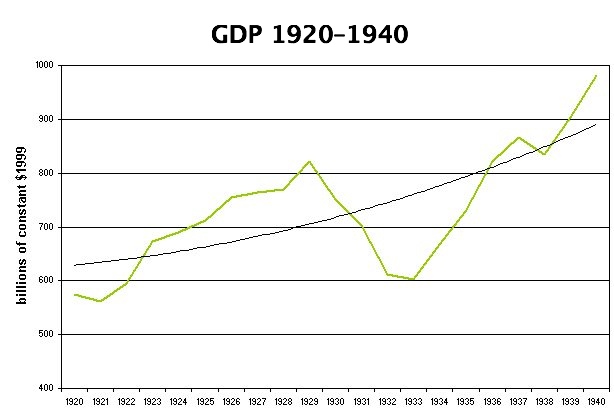
Blaming Franklin Roosevelt's economic policies for anything is absolutely obsurd. Franklin Roosevelts New Deal started in 1933, and then America's economy has a huge increase in GDP.