
By using this site, you agree to our Privacy Policy and our Terms of Use. Close

Forums - PC - NVIDIA Shows Interactive Ray Tracing on GPUs

We just received some breaking news out of SIGGRAPH 2008 that we thought many of you would be very interested in. If you recall, one of the capabilities Intel is touting in regard to their upcoming Larrabee architecture is the ability to perform real-time ray tracing. In the graphics space, ray tracing is a technique used to generate an image by tracing the rays or paths of light as they bounce through and around the objects in a scene. When done right, ray tracing can produce photorealistic imagery because shadows are cast correctly, water and other materials show proper reflections with correct coloring, and lighting in general just looks more realistic. The problem with ray tracing is that the algorithms necessary for producing photorealistic imagery are very complex and require much more compute power than is available in today's PCs, if the imagery is to be rendered in real-time, at a high enough frame rate to produce fluid motion, i.e. for gaming.

To date, a number of real time ray tracing projects have been shown on the PC. Intel's Daniel Pohl, for example, has showcased customized versions of Quake 3 and Quake 4 running on Intel hardware that use ray tracing with impressive results and ATI has recently shown ray tracing demos running on Radeon HD 4800 series hardware at their Cinema 2.0 event. But today, it's NVIDIA's turn.

 http://www.hothardware.com/image_popup.aspx?image=big_nvidia_rt_demo1.jpg&articleid=7483&t=n','hothardwareimage',%20600,600);">
   http://www.hothardware.com/image_popup.aspx?image=big_nvidia_rt_demo2.jpg&articleid=7483&t=n','hothardwareimage',%20600,600);">
NVIDIA's GPU RayTracing Demo In Action


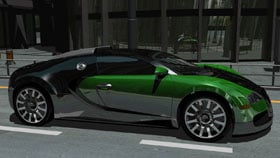
During SIGGRAPH 2008 in Los Angeles NVIDIA is demonstrating a fully interactive GPU-based ray tracer. The demo is based purely on NVIDIA GPU technology, and according to NVIDIA the ray tracer shows linear scaling while rendering a complex, two-million polygon, anti-aliased automotive styling application. Screenshots from the actual demo are shown here.

 http://www.hothardware.com/image_popup.aspx?image=big_veyron_2560_adaptaa.jpg&articleid=7483&t=n','hothardwareimage',%20600,600);">
   http://www.hothardware.com/image_popup.aspx?image=big_veyron_2560_2x2.jpg&articleid=7483&t=n','hothardwareimage',%20600,600);">
NVIDIA GPU Ray Tracing at 2560x1600


At three bounces, performance is demonstrated at up to 30 frames per second (fps) at HD resolutions of 1920x1080 for an image-based lighting paint shader, ray traced shadows, reflections and refractions running on four next-generation Quadro GPUs in an NVIDIA Quadro Plex 2100 D4 Visual Computing System (VCS). Some of these screenshots, however, were taken with the resolution increased all the way up to 2560x1600. Frame rates at that resolution weren't available though.

If we can speculate for a bit here, let's assume that the next-gen Quadros NVIDIA is using for the demo are based on the company's GTX 200 series GPU architecture. That means, potentially, a 3-way GeForce GTX 280 SLI configuration may offer approximately 75% of the performance of Quadro Plex 2100 D4 VCS being used in the demo. If history is an indicator, sometime within the next 18 months or so, NVIDIA is likely to double the performance of their current GPUs. So, by sometime next year or maybe in the early part of 2010, we'll likely have the necessary horsepower in a high-end gaming PC to handle some level of real-time ray tracing with adequate performance for fluid motion. Over the next few months to a year, expect to hear much more on this front.

http://www.hothardware.com/News/NVIDIA-Shows-Interactive-Ray-Tracing-on-GPUs/

The demos have probably been 'cooked' to make it look (much) better than can be achieved in game, but when you start to think about what 5 years of hardware development will do to this ...



Around the Network

hmm.. I see aliasing , that's a letdown :(

I'm pretty sure I read somewhere, that aliasing problems would solve themselves with ray-tracing, but it seems that wasn't correct after all *sigh*.

The screenshots and especially the lighting looks quite nice though.


Lafiel said:

hmm.. I see aliasing , that's a letdown :(

I'm pretty sure I read somewhere, that aliasing problems would solve themselves with ray-tracing, but it seems that wasn't correct after all *sigh*.

The screenshots and especially the lighting looks quite nice though.

Aliasing is actually very difficult to solve in a ray-tracing system, and the reason you (typically) don't see it in ray-traced images is because those images are super-sampled ... The side effect of that is it can take minutes (or hours) to render an image.


This is only doing 3 bounces, which is nowhere near the number required for good looking ray tracing.


Leo-j said: If a dvd for a pc game holds what? Crysis at 3000p or something, why in the world cant a blu-ray disc do the same?

ssj12 said: Player specific decoders are nothing more than specialized GPUs. Gran Turismo is the trust driving simulator of them all. 

"Why do they call it the xbox 360? Because when you see it, you'll turn 360 degrees and walk away" 

sieanr said:
This is only doing 3 bounces, which is nowhere near the number required for good looking ray tracing.

I took several graphics courses in university, and have built several raytracers in my life, and the ammount of benefit you see from tracing past 3 reflections is fairly tiny.

Realistically, you're going to see the reflection of the environment in the car (or the reflection of the car off of a window) but you're probably not going to see the reflection of the car off of the reflection of the window in a car unless you're looking at a still image.

I doubt most hollywood movies use more than a algorithm that is 6 rays deep, although they probably use a far more advanced algorithm (photon-mapping) for their diffuse lighting.


Around the Network

I don't see anything THAT good looking. What is Ray Tracing? :/


.:Dark Prince:. said:
I don't see anything THAT good looking. What is Ray Tracing? :/


In rasterization you (essentially) do a mathematical projection of objects onto the screen and then calculate the lighting of that object base on its relationship to the lights in the scene. This means that the contrabution from other objects (like shadows and reflections) are not handled and you have to produce hacks to get these effects.

In recursive ray tracing you trace a line from the screen into the environment to trace the light from the environment throug the screen; as a result you get very high quality reflections and shadows. In general it is a much (MUCH) better simulation of light which results in much higher image quality.


HappySqurriel said:
sieanr said:
This is only doing 3 bounces, which is nowhere near the number required for good looking ray tracing.

I took several graphics courses in university, and have built several raytracers in my life, and the ammount of benefit you see from tracing past 3 reflections is fairly tiny.

Realistically, you're going to see the reflection of the environment in the car (or the reflection of the car off of a window) but you're probably not going to see the reflection of the car off of the reflection of the window in a car unless you're looking at a still image.

I doubt most hollywood movies use more than a algorithm that is 6 rays deep, although they probably use a far more advanced algorithm (photon-mapping) for their diffuse lighting.

What about the sharp shadows?


Leo-j said: If a dvd for a pc game holds what? Crysis at 3000p or something, why in the world cant a blu-ray disc do the same?

ssj12 said: Player specific decoders are nothing more than specialized GPUs. Gran Turismo is the trust driving simulator of them all. 

"Why do they call it the xbox 360? Because when you see it, you'll turn 360 degrees and walk away" 

not a huge difference than GT5P, at least not much seen in those tiny pics.


sieanr said:

What about the sharp shadows?


I think you mean soft shadows, because you get pretty sharp shadows by default in a ray tracer ...

You don't generally go deeper with your recursive raytracing algorithm to produce soft shadows though, people generally favour a distributed 'diffuse' ray approach. Regardless, if you want soft shadows or other caustics it is best to choose a different global illumination algorithm.

not a huge difference than GT5P, at least not much seen in those tiny pics.

The article has full sized images ...

In terms of geometry it isn't that much different from what is on the HD consoles, but the lighting effects and texture details blows them out of the water.