By using this site, you agree to our Privacy Policy and our Terms of Use. Close

Forums - General - Is there a god?

@Timmah. 'Design' is referring to the design of evolution, when an animal becomes more likely to survive than the rest of its species through mutation then it becomes more likely to survive, thus over time evolution can shape and change a creature to become different than what it was. Evolution can 'design' something.

Also DNA wouldnt have existed in the first creatures, something far more simple would have existed, DNA as with everything else in life, would have occured with evolution over time.
The first life on this planet we probably wouldnt even recognize as life, just a little bag of chemicals with the nifty ability to reproduce.


Around the Network
Timmah! said:

No, but a high level of ORDERLY complexity does. That's my point. The universe is complex, but generally chaotic. The climate system of the earth is incredibly complex, but there's also a very high level of chaos and unpredictability associated with it. Just ask any weatherman.

I said nothing about mutations. Survival of the fittest is something that is very common. This is called Micro-evolution, or adaptions & changes within a species. This is a well documented and tested phenomenon. The point is not that living things can't undergo some changes from generation to generation, but that life cannot spontaneously form from a puddle of goo- that's what I'm saying.

Edit: The earth's ecosystem & climate are complex and chaotic, but there is also some order to it that points to intelligence. The moon is the exact size and distance from the earth to create the tides, keeping the oceans clean. Without that, life wouldn't be possible. The combination of temperature, the correct mix of gasses, the correct amount of particles in the air to create clouds, tilt of the earth to create seasons, etc all work together to form a perfect 'bubble' for life in a very inhospitable universe. The chance of one of these factors being correct by natural means alone isn't that far fetched- it's when you calculate the probability that ALL of them would be so exact in ONE place that chance begins to look very unlikely.


A high level of orderly complexity?  You've provided absolutely no proof of that.


Rath said:
@Timmah. 'Design' is referring to the design of evolution, when an animal becomes more likely to survive than the rest of its species through mutation then it becomes more likely to survive, thus over time evolution can shape and change a creature to become different than what it was. Evolution can 'design' something.

Also DNA wouldnt have existed in the first creatures, something far more simple would have existed, DNA as with everything else in life, would have occured with evolution over time.
The first life on this planet we probably wouldnt even recognize as life, just a little bag of chemicals with the nifty ability to reproduce.

I was just about to post something similar in a reply to his "design" statement.  I think Timmah was equating
"design" to "intelligent design", I doubt that in the vast majority of the comments of "design" that the person making them was referring to "intelligent design".

As for your second paragraph Timmah is talking about a theory by Richard Lathe that life couldn't have come into existance on Earth without the moon.  Richard Lathe has never given any credit to a "God" or anything else in his theory though.  The fact that there is absolutely no proof that the moon was ever artificially put into a position to jumpstart life on this planet seems to indicate to me that people shouldn't be using it as evidence for one.  To be honest I've never seen or read about *anything* that requires there to have been a "God" present or that was proof of one.

I think the problem with people who try to prove there is a God is that no matter how much science they attempt to use inevitably there comes a point where faith enters the picture.  People have the right to either believe in a God, gods, etc or not but anyone attempting to explain one using science should expect to have their argument torn apart and proven unscientific.


Taken from evolutionoftruth.com:
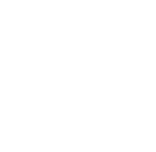

1, 2, 3, 5, 7, 11, 13, 17, 19, 23, . . .
( Prime numbers, for example)

So, while radio astronomy seeks for years to find a  non-random signal from space that shows intelligence,

genetics tries to decipher the most complex code known to man and we chalk it up to chance.


DNA

And thus we come to the brilliant "scientific" (?) conclusion:

A simple
non-random code,

if discovered with a
radio telescope,
will prove another intelligence.

It's just a matter of time until we find it.


A complex
non-random code,

already discovered with an electron microscope, must be due to
chance
.

No need to look for intelligence here!

Unfortunately, many scientists today use science to PROVE what they already want to believe (whatever their pet theory is), not to look for real answers.

And legend11, my point is that the word design, by definition implies intelligence- I even posted the definition.

I never said that Richard Lathe as trying to prove God, I wasn't even citing his theory. I don't see why that was even relevant. I was making the point that the vast number of factors that work together to create a hospitable environment for life are HIGHLY UNLIKELY to all happen at the same time by chance, and that it is HIGHLY UNLIKELY for life to form without intervention. I'm not saying anything PROVES the existance of intelligent design, just that it strongly suggests intelligent design. Nothing of this complexity that happened before anyone was around to record it can be definitively proven. We all offer no more than educated guesses. Because of that, it takes some level of faith no matter how you belive the world came about.

There are inherent errors in science because there are inherent errors in human logic. We will never have all the answers.



Legend11:

Here's the Merriam-Webster definition of Design

1 : to create, fashion, execute, or construct according to plan : DEVISE, CONTRIVE
2 a : to conceive and plan out in the mind <he designed the perfect crime> b : to have as a purpose : INTEND <she designed to excel in her studies> c : to devise for a specific function or end <a book designed primarily as a college textbook>
3 archaic : to indicate with a distinctive mark, sign, or name
4 a : to make a drawing, pattern, or sketch of b : to draw the plans for <design a building>
intransitive verb
1 : to conceive or execute a plan
2 : to draw, lay out, or prepare a design

Which one of these definitions does not imply intelligence?


Around the Network


"I was making the point that the vast number of factors that work together to create a hospitable environment for life are HIGHLY UNLIKELY to all happen at the same time by chance, and that it is HIGHLY UNLIKELY for life to form without intervention."

From earlier post...

If there are an infinate number of stars in our universe, and only one in a billion have planets rotating around them. And of the stars that have planets rotating around them, if only one in a billion have the right variables for life. And of the planets that have the right variables for life, if only one in a billion actually have life. Then there are still an infinate number of planets with life within our universe.


Timmah. Design isnt used in a literal context, its used to show the way evolution works to make living things better. The fact that scientists are using incorrect English doesnt prove there is a god.

Your DNA point makes sense IF and ONLY IF scientists claimed DNA happened by chance. Which they dont. Evolution is more complicated than pure chance, its like how the chances of flipping 1000 coins in a row and getting all heads is pretty much infinitesimally small but evolution is the process that discards all the tails flipped.


Timmah! said:

Legend11:

Here's the Merriam-Webster definition of Design

1 : to create, fashion, execute, or construct according to plan : DEVISE, CONTRIVE
2 a : to conceive and plan out in the mind designed the perfect crime> b : to have as a purpose : INTEND designed to excel in her studies> c : to devise for a specific function or end designed primarily as a college textbook>
3 archaic : to indicate with a distinctive mark, sign, or name
4 a : to make a drawing, pattern, or sketch of b : to draw the plans for <design a building>
intransitive verb
1 : to conceive or execute a plan
2 : to draw, lay out, or prepare a design

Which one of these definitions does not imply intelligence?

See the second definition (The purposeful or inventive arrangement of parts or details) and you'll realize that they're talking about the purposeful arrangement of those parts in animals, and also note that it in no way implies "intelligence" was behind those arrangements.  Evolution explains it without the need of bringing in a "God".

http://education.yahoo.com/reference/dictionary/entry/design 

de·sign    (d-zn) KEY  

(Verb definitions deleted)

NOUN:

    1. A drawing or sketch.
    2. A graphic representation, especially a detailed plan for construction or manufacture.
  1. The purposeful or inventive arrangement of parts or details: the aerodynamic design of an automobile; furniture of simple but elegant design.
  2. The art or practice of designing or making designs.
  3. Something designed, especially a decorative or an artistic work.
  4. An ornamental pattern. See Synonyms at figure.
  5. A basic scheme or pattern that affects and controls function or development: the overall design of an epic poem.
  6. A plan; a project. See Synonyms at plan.
    1. A reasoned purpose; an intent: It was her design to set up practice on her own as soon as she was qualified.
    2. Deliberate intention: He became a photographer more by accident than by design.
  7. A secretive plot or scheme. Often used in the plural: He has designs on my job