haxxiy said:
SvennoJ said:
Data centers operate day and night though.
By 2026, the electricity consumption of data centers is expected to approach 1,050 terawatt-hours. (which would bump data centers up to fifth place on the global list, between Japan and Russia).
Assuming AI is right (I used to do these kind of calculations myself, yeah it's easy to use AI, but losing some of my math skills and udnerstanding in the process...)
To produce 1,000 TW of power, a massive area of solar panels is needed, requiring an estimated 2 billion to 4 billion panels depending on their wattage, estimated at roughly 10,000 square kilometers or about 3,861 square miles. This estimate is based on an assumption that each square meter of panel can generate about 200 watts of power under ideal conditions, but in practice, the required area will be larger to account for real-world inefficiencies like weather and panel orientation.
AI is expected to use 500 times as much by next year.
[...] |
It takes ~800 GW worth of solar panels to generate roughly ~1,000 TWh in a year. So it's not 500 times as much electricity, is ~0.4 times as much. Anyway, believe it or not, thousands of km² of manufactured solar panels a year are a reality. That's economics of scale for you. It may seem excessive to power the entire world with solar, but it'd be less than the area we've paved over with concrete in the past few decades alone. Since the number of people employed in photovoltaics seems to grow at the square root of installed capacity, it'd probably take about 20 million people to service the entire world's electricity from solar panels (vs. ~12.5 million people working in power generation today, which seems an acceptable increase in total workforce given how much cheaper solar power is), and without accounting for further automation. |
Yeah I figured it was probably wrong on the solar panels as well
I can't get a straight answer with AI lol
To produce 1,000 TWh annually, it would require approximately 114 to 154 gigawatts (GW) of installed solar power capacity. This estimate is based on an average solar capacity factor of around 24.5%, meaning that 1 GW of solar panels can generate approximately 2,146 GWh (or 2.146 TWh) of energy per year.
Divide it down
A single solar panel can produce an estimated 730 to 895 kilowatt-hours (kWh) of energy annually
1,050 TWh annually = 1,050,000,000 kWh
Thus 1.2 to 1.5 million solar panels to produce 1,050 TWh annually.
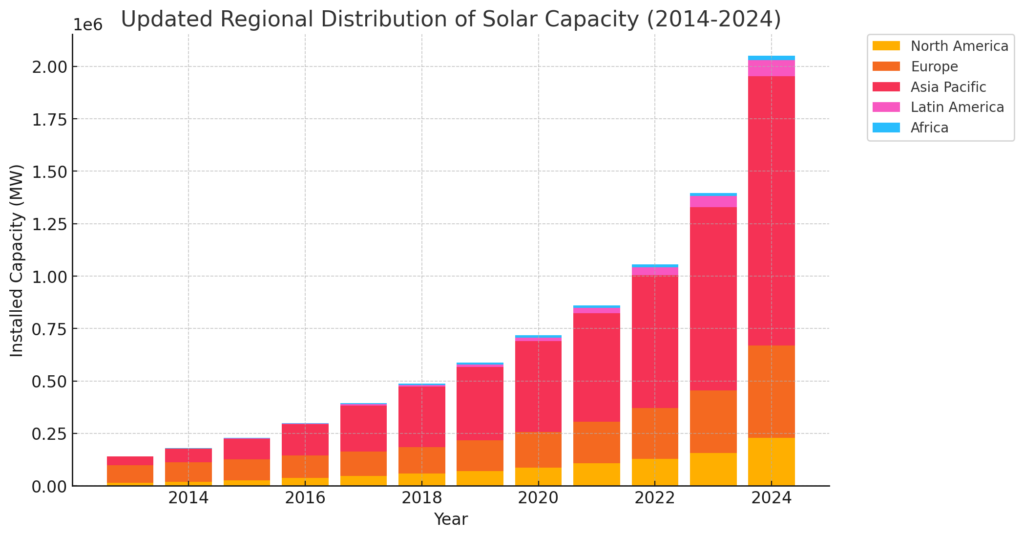
It's basically the capacity that's already here. 2024 produced 2 Twh of solar power
In 2024, solar power generated approximately 2,132 TWh of electricity globally
In 2024, utility-scale solar power generated 218.5 terawatt-hours (TWh) in the United States. Total solar generation that year, including estimated small-scale photovoltaic generation, was 303.2 TWh
That's the USA, so 2,132 Twh for the world seems correct. (US was responsible for about 16% of world solar power in 2022, right ballpark)
I don't understand this graph though:
https://www.solarinsure.com/how-much-solar-energy-does-the-world-generate
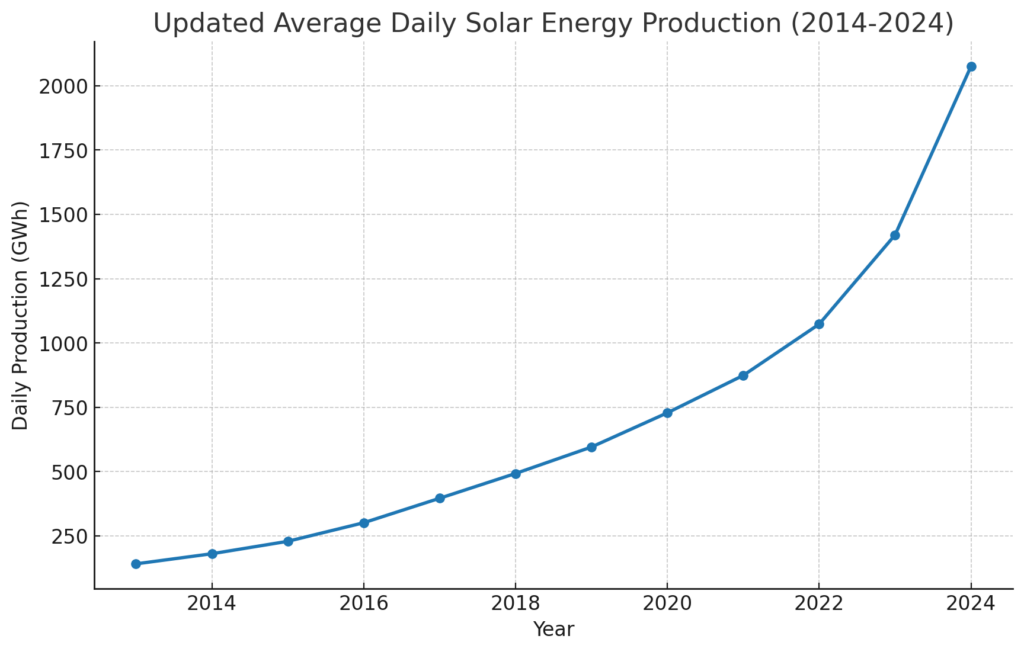
global capacity surpassing 2,000 GW in 2024 and daily production reaching 2,075 GWh.
2,075 GWh daily = 757 TWh annually, not 2,132 TWh. (There are still only 365 days in a year right lol)
https://www.solarpowereurope.org/press-releases/new-report-world-installed-600-gw-of-solar-in-2024-could-be-installing-1-tw-per-year-by-2030

After the world crossed the milestone of 2 terawatts (TW) total solar in late 2024, the annual report predicts the world could be installing 1 TW of solar per year by the end of the decade.
Two terawatts ((2text{ TW})) of solar power could produce approximately 3,500 terawatt-hours (TWh) of electricity annually.
Fun with AI not lol.
https://www.freeingenergy.com/math/solar-pv-gwh-per-mw-power-energy-mwh-m147/
1 megawatt (MW) of solar panels will generate 2,146 megawatt hours (MWh) of solar energy per year.
So 2 TW (2,000,000 MW) of solar panels will generate 4,292,000,000 MWh of solar energy per year = 4.3 TWh
I don't like it when answers keep varying like this! But at least it's no order of magnitude difference.
Of course the 2,132 TWh of 2024 were not produced by the 2 TW total solar power at the end of 2024. But there's efficiency loss as well, maintenance, older panels etc.
So yeah it's possible. 50% increase needed if looking at what the world produced in solar power in 2024.
33% increase in capacity this year, wouldn't even take that long to add that capacity.
Let's do it!
But getting straight answers with AI isn't easy! AI can't be trusted :p (or rather blindly relied on)