













haxxiy said:
Interestingly, these are some of the concerns raised by Ted Kaczynski in his manifesto, that you can't take the good of technology without the bad, and that when machines come to make most decisions to keep industrial society going, turning them off would be tantamount to suicide (because no one would even be able to understand how they're doing it at that point). But unless we're going for a Butlerian jihad (spoiler: no one will, since any nation automating labor will have massive economic advantages over the others, no matter how many datacenters and power plants they have to build, even after accounting for increased welfare spending), that's something we'll have to find a way to contend with somehow. At least photovoltaics are becoming and will continue to be the cheapest way of generating electricity in most of the world, so the carbon footprint should fully decouple from economic growth and be less of a concern going forward. |
Data centers operate day and night though.
By 2026, the electricity consumption of data centers is expected to approach 1,050 terawatt-hours. (which would bump data centers up to fifth place on the global list, between Japan and Russia).
Assuming AI is right (I used to do these kind of calculations myself, yeah it's easy to use AI, but losing some of my math skills and udnerstanding in the process...)
To produce 1,000 TW of power, a massive area of solar panels is needed, requiring an estimated 2 billion to 4 billion panels depending on their wattage, estimated at roughly 10,000 square kilometers or about 3,861 square miles. This estimate is based on an assumption that each square meter of panel can generate about 200 watts of power under ideal conditions, but in practice, the required area will be larger to account for real-world inefficiencies like weather and panel orientation.
The administrative region of Basilicata is 9,992 square kilometers.

However we're only just over 2 Terrawatts of solar power worldwide
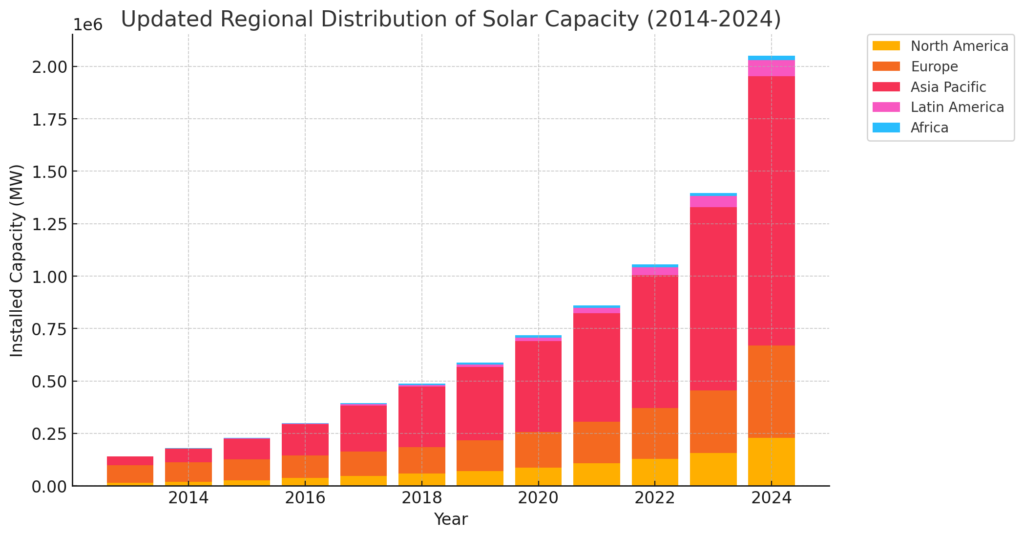
AI is expected to use 500 times as much by next year.
And that's all under ideal conditions. (And how is going to keep 4 billion solar panels clean and serviced, new jobs!)
Plus distribution transmission loss, room for access roads, factories to produce replacements every 25 to 40 years.
It's also about 625 thousand large nuclear power plants to reach 1,000 Terrawatts (large plants generate about 1 Gw)
And here is an example AI gets it wrong sometimes:
It takes about 1,000 nuclear power plants to produce 1,000 terawatt-hours of electricity,
A typical nuclear power plant produces about 1 gigawatt (GW) of power.
Therefore, to generate 1,000 terawatt-hours (1,000,000 GWh) of electricity, you would need 1,000,000 GWh / 1 GWh/plant = 1,000,000 nuclear power plants.
Factor 10 wrong, but also on capacity
Some newer plants reaching 1,600 MW or more, hence 625 thousand.
And there it all falls apart as there aren't even that many power plants in the world...
Japan consumes over 1,000 TWh of electricity per year, with recent data from 2023 showing consumption of approximately 1,013 TWh.
Japan has 151 coal power plants, 33 operable nuclear reactors, 98 geothermal power plants, and 1,198 small hydropower plants.
So I'm using AI wrong somewhere.
The pitfalls of relying on AI for answers...
Ask AI the full question then
The exact number of nuclear power plants needed for AI in 2026 is not precisely calculable, but the energy demand is projected to grow significantly. One estimate suggests the power required for AI could be equivalent to that of up to 10 to 50 large nuclear power plants by 2026,
To provide context, an estimate suggests the entire world could be powered with about 51 billion solar panels, which would cover an area roughly half the size of France.
So looks like the solar panel equation is correct or at least consistent compared to world needs, yet the nuclear plants required for the same amount goes belly up.
A plant with a 1 GW (1000 MW) capacity operating for 365 days a year at 100% output would generate (1000text{ MW}times 24text{ hours/day}times 365text{ days/year}=8,760,000text{ MWh}) per year. (8.76 terrawatt per year)
So that's 114 1 GW plants / 71 1.6 GW plants. Not 625 thousand.
A common mistake between peak usage and yearly usage (hours) but see how easily AI gets tripped up. Why does it get it right with the solar panels, but wrong on the nuclear power plant question.
I've see this before where AI blatantly states incorrect math in its answers. Always need to verify!


