By using this site, you agree to our Privacy Policy and our Terms of Use. Close

Forums - Politics - Israel-Hamas war, Gaza genocide

An unmarked yellow line along Gaza’s eastern edge is, according to residents, steadily expanding, placing swathes of land effectively off limits and compressing an already displaced population.

Nearly two million people have been forced from their homes and are being pushed into denser areas with limited services, with some reporting bullets penetrating tents.


Prominent UK pro-Palestine activists guilty of breaching protest conditions

https://www.theguardian.com/uk-news/2026/apr/01/prominent-uk-pro-palestine-activists-guilty-of-breaching-protest-conditions

Campaigners call verdict on Ben Jamal and Chris Nineham ‘grotesque’ and part of attempt to ‘undermine civil liberties’

Two prominent leaders in the Palestine solidarity movement in Britain have been found guilty of breaching protest conditions, in what campaigners called a “grotesque” and “shocking” decision.

Ben Jamal, 62, the director of the Palestine Solidarity Campaign (PSC), and Chris Nineham, 63, vice-chair of the Stop the War Coalition, were accused of failing to comply with conditions imposed on a protest on 18 January 2025. They were subsequently charged with public order offences.

The 18 January protest was one of 34 national pro-Palestine demonstrations held since the start of the war on Gaza in October 2023.

...

The Metropolitan police have faced significant criticism over their handling of the protest in central London, at which more than 70 people were arrested.

Trade union leaders, legal experts, MPs and peers were among those calling for an independent inquiry into what they described as “repressive and heavy-handed policing” at the 18 January demonstration.

...

The Met said it placed conditions on the protest after factoring in “the cumulative impact” on Jewish Londoners, adding that the march was in the vicinity of synagogues. Officers said they believed there was a coordinated effort to breach those conditions.


A number of critical letters were sent to the force alleging it falsely accused protesters carrying flowers – including the former Labour leader Jeremy Corbyn and his former shadow chancellor John McDonnell – of forcing their way through police lines, when video footage appeared to show they had initially been waved through by officers.

...

Speaking outside the court, McDonnell said he had been with Jamal and Nineham on the day of the protest. He said Jamal went on stage to say they would assemble speakers, walk to police lines and ask if a delegation could go to the BBC. If refused, they would lay flowers at officers’ feet.

“This is a grotesque decision today. But it is all part and parcel of trying to undermine our civil liberties,” he told the crowd. “You’ve got to recognise that this is an assault on our civil liberties, and there’s more coming down the road.”

Corbyn also addressed supporters, saying: “I’m absolutely appalled, disgusted, that they’ve been found guilty of doing no more than standing up for the rights of the Palestinian people, and very importantly, the right to protest within our society.”

Jamal and Nineham left the court to cheers from the crowd.

“We think this is an extraordinary and shocking decision, and a huge setback for civil liberties in this country,” Nineham said. “It is an attempt to send a chilling message across society that people shouldn’t be protesting. It is an attempt that will not stop us.”

He described the conditions of the march as a step change. “A refusal to march in the vicinity of the BBC has simply not happened before, and it sends a very dangerous and alarming signal to millions of people across this country,” he said.

Jamal said he would be appealing because of how the trial had been conducted. “Consider these two basic facts: six days were allocated from this case; the judge allowed the prosecution to take four days to make their case and did not allow any additional time for defence submissions,” he said.


He added the verdict would not distract campaigners from their cause. “Yesterday, Israel became the world’s first state to enact a law which mandates execution only for people of one ethnic background [Palestinians]. Even apartheid South Africa did not have such a law, but still our government offers Israel diplomatic, economic, political, and military support. And instead of ending its complicity, it devotes its energy to bringing in even further laws to repress the right to protest. It will not work. We will not be silenced.”

Campaigners vowed that the protest for Palestinian rights on 16 May would go ahead.


Around the Network

In numbers: Human cost of war across the region

  • Iran: More than 2,000 killed; more than 26,500 injured.
  • Lebanon: 1,345 killed, including 125 children; more than 4,040 wounded
  • Israel: 28 killed (all but one were civilians), including 10 Israeli soldiers killed in Lebanon, 3,223 injuries hospitalised
  • US: 13 killed in combat and two of non-combat causes, more than 200 injured
  • Occupied West Bank: Four people killed
  • UAE: 12 killed, 169 injured
  • Bahrain: 3 killed
  • Saudi Arabia: 2 killed, 20 injured
  • Kuwait: 6 killed
  • Oman: 3 killed
  • Qatar: 16 injured
  • Jordan: 20 injured
  • Syria: 4 killed
  • Iraq: More than 107 killed


Israel’s genocidal war on Gaza continues amid attacks on Iran

Israel’s genocidal war on Gaza has continued in addition to its attacks on Lebanon, Syria and Iran.


Daily life in Gaza under harsh conditions

https://www.reutersconnect.com/item/daily-life-in-gaza-under-harsh-conditions/

Thousands of Palestinians displaced due to Israeli attacks, struggle to survive under harsh and limited conditions in tents and temporary shelters in Jabalia, Gaza, Palestine on April 4, 2026.

Wow Reuters spending a whole one line on the situation in Gaza... Actually it's a series of pictures in the link.

Palestinian woman dies from wounds as Israeli army shells southern Gaza

A Palestinian woman died on Saturday from wounds sustained during an Israeli attack in southern Gaza, while Israeli forces' artillery also shelled areas east of Khan Younis and carried out demolition operations, according to local sources.

A medical source told Anadolu that the woman succumbed to her injuries she sustained days earlier when the Israeli army opened fire from a vehicle on tents housing displaced people southwest of Khan Younis.

Israeli forces carried out a large-scale demolition in the southeastern part of the city, alongside artillery shelling targeting eastern areas of Khan Younis, witnesses said.

The developments come amid ongoing Israeli violations of a ceasefire in effect since Oct. 10, 2025. These breaches have resulted in the deaths of 713 Palestinians and injuries to 1,940 others since the agreement took effect.

Israel launched its genocide in Gaza in October 2023 that lasted two years, killing more than 72,000 people and injuring over 172,000 while causing widespread destruction affecting around 90% of the territory’s infrastructure.


Israel is implementing its Gaza strategy in Lebanon: turning ‘buffer zones’ into permanent borders

https://mondoweiss.net/2026/04/israel-is-implementing-its-gaza-strategy-in-lebanon-turning-buffer-zones-into-permanent-borders/


While the US-Israeli war on Iran and its economic repercussions on the global economy continues to be at the center of global media attention, Israel is in the process of re-drawing the map of the Middle East, particularly in Lebanon. If successful, Israel’s plans could have regional and global repercussions. And yet, the Israeli invasion of Lebanon has barely made a blip on the Western media’s radar.

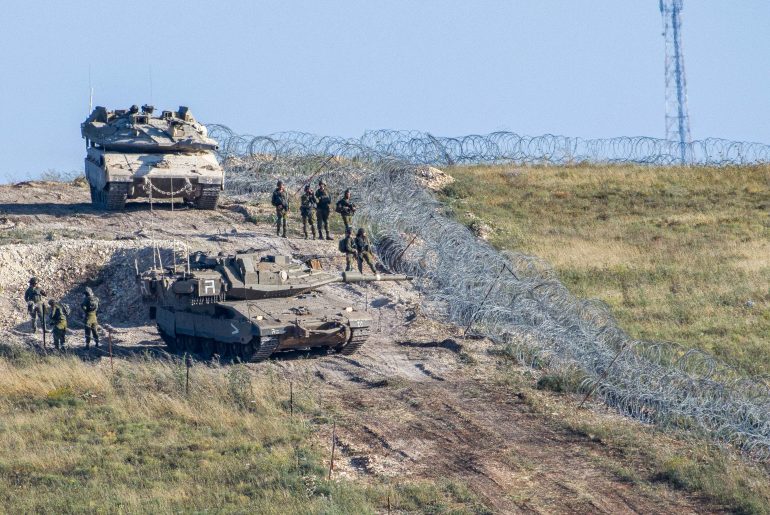
Last week, Israel’s defense minister, Israel Katz, said that Israeli forces will not leave the south of Lebanon after the end of the current war. Katz’s statements are in line with Israel’s Prime Minister Benjamin Netanyahu, who said last weekend that he had instructed the Israeli army to expand its control in the south of Lebanon up to 10 kilometers, to create a “security buffer zone.” These statements come as the Israeli army has deployed four divisions to the Lebanese border, and continues to push into Lebanese territory.

...


Applying Gaza’s ‘Yellow Zone’ logic in Lebanon

In the latest round of fighting between Israel and Hezbollah, Israeli forces have conducted large-scale detonations and demolitions of Lebanese villages and infrastructure in the south. The tactics resemble the same tactics Israel used in Gaza during the height of the genocide.In Gaza, Israel had an explicit goal of pushing Palestinians permanently out of entire areas, like the northern Gaza Strip cities of Beit Hanoun and Beit Lahia, and the southern city of Rafah.

Now, as Israel escalates its war on Lebanon, Israel’s Defense Minister Israel Katz has made Israel’s plans clear: implement the Gaza model of total destruction and ethnic cleansing. He said on Tuesday that “the model of Rafah and Beit Hanoun” will be implemented in Lebanon.

Israeli plans to create a buffer zone 10 kilometers deep into Lebanon are more than a military strategy. It shows an intention to reshape an area of approximately 10,000 square kilometers, making it uninhabitable for its Lebanese residents, and putting it under Israeli military control.

In Syria, Israel hasn’t conducted the same kind of destruction, but it has announced that it will remain in the new territories it occupied after the fall of the al-Assad regime in December 2024. Together, in Lebanon and Syria, Israel seeks to maintain permanent control of some 14,000 square kilometers, all to create a so-called “buffer zone.”

....


Around the Network

Hamas armed wing says disarmament demands not acceptable

Hamas spokesman Abu Obeida has said that calling for the group’s disarmament amounted to an attempt to continue Israel’s genocide.

Hamas’s armed wing has rejected calls for the Palestinian group to disarm, saying that discussing the issue before Israel fully implements the first phase of the United States-brokered “ceasefire” in Israel’s war on Gaza amounts to an attempt to continue the genocide against the Palestinian people.

In a televised statement on Sunday, Obeida, who is Hamas’s armed wing spokesperson, said that raising the issue of weapons “in a crude manner” would not be accepted.

The issue of Hamas relinquishing its weapons is a major obstacle in talks to implement US President Donald Trump’s 20-point plan for Gaza, aimed at ending Israel’s war on the besieged territory. 

Hamas has told mediators it will not discuss disarmament without guarantees that Israel will completely withdraw from Gaza, three sources told the Reuters news agency last week.

“What the enemy is trying to push through today against the Palestinian resistance, via our brotherly mediators, is extremely dangerous,” Obeida said.

He said the disarmament demands were “nothing but an overt attempt to continue the genocide against our people, something we will not accept under any circumstances”.


For decades, Mehdi has been challenging hardcore Zionists and far-right Israel supporters. One question continues to come up: “Does Israel have a right to exist?”

If you've ever been caught in that debate, you're not alone — it’s a common talking point used to shut down critical discussions about Israel.

In his latest monologue, Mehdi dismantles the "bullshit argument" used as Israeli propaganda and gives everyone three powerful counter-arguments to use when faced with the demand to recognize Israel's right to exist.


Israeli army fire on WHO vehicle in southern Gaza kills one, medics report

A member of staff from the World Health Organization (WHO) has been killed in Gaza and several others injured when the Israeli army fired on their vehicle, according to sources, including an Al Jazeera correspondent.

WHO driver Majdi Aslan, 54, was killed on Monday. A doctor from the international organisation and several other Palestinians were also injured in the incident in eastern Khan Younis, according to sources at the enclave’s Nasser and Al-Aqsa hospitals.

As the world’s attention remains fixed on the United States-Israel war on Iran, Israel is continuing its attacks on the Gaza Strip, which has seen near-daily Israeli fire and strikes since a fragile ceasefire was reached in October, with more than 700 Palestinians killed since, according to Gaza’s Health Ministry.


Monday’s incident took place in an area close to the so-called yellow line in eastern Khan Younis, reported Al Jazeera’s Hani Mahmoud. Israeli forces shot “indiscriminately” at people and vehicles moving along the Salah al-Din Street in the southern Gaza Strip, he said.

A commercial vehicle was transporting civilians between southern and central Gaza. It was followed by a car carrying WHO employees, said Mahmoud. “The driver was shot in the head, and by the time he was transported to the Al-Aqsa Hospital, he was announced dead,” the correspondent reported from Gaza City. Seven or so others suffered injuries, he added.


Jobless young Palestinians trapped as Israel holds Gaza’s economy hostage

Mahmoud Shamiya walks to the shores of the Mediterranean Sea every day just to pass the time. He is among Gaza’s tens of thousands of young people who have no work as the economy collapsed during Israel’s devastating war.

Shamiya graduated from Al-Aqsa University with a degree in basic education three years ago, dreaming of becoming a teacher and a role model for children. Today, his daily routine consists of fetching water, scavenging for firewood and surviving in a tent.

“The occupation and this war came and destroyed all the landmarks of education in Gaza,” Shamiya said. “Today, we have become aimless, jobless, and hopeless. We live a deadly routine.”

Israel destroyed most universities and schools in Gaza – home to 2.3 million people – and killed at least 72,000 Palestinians in military operations described as genocide by the UN and global scholars.


Shamiya’s despair reflects a broader generational catastrophe. Approximately 70 percent of Gaza’s residents are under 30 and they are navigating a reality that the United Nations describes as the fastest and most damaging economic collapse on record.

According to the Palestinian Central Bureau of Statistics, unemployment in the Gaza Strip has increased to 80 percent. The local gross domestic product (GDP) has plunged by 87 percent over the past two years to a mere $362m, with GDP per capita down to $161.

Economists says that’s effectively erased 22 years of development, leaving the territory’s youth completely cut off from the outside world and denied the ability to study, work, or secure their basic survival.

https://www.aljazeera.com/economy/2026/4/6/jobless-young-palestinians-trapped-as-israel-holds-gazas-economy-hostage


Gaza Included – Tehran Lays Out Conditions for Permanent End Across Region

https://www.palestinechronicle.com/gaza-included-tehran-lays-out-conditions-for-permanent-end-across-region/

Iran submits detailed response rejecting temporary truce, demanding permanent end to war, sanctions removal, and regional guarantees.

Key Developments

  • Iran formally rejected a temporary truce, insisting any agreement must lead directly to a permanent end to war.
  • Tehran outlined conditions linking the war’s end to Gaza, sanctions removal, Hormuz security, and regional guarantees.
  • The response was transmitted via Pakistan amid ongoing mediation efforts involving multiple regional actors and backchannel diplomacy.

Response delivered:

Iran’s response lays out a detailed set of conditions linking the end of the war to broader political, military, and economic arrangements:

  • Tehran calls for an immediate and comprehensive termination of all wars across the region, including Gaza and Lebanon, accompanied by guarantees preventing any renewed escalation.
  • The response rejects phased ceasefires, insisting that any agreement must directly result in a permanent end to hostilities.
  • Iran also demands the full removal of economic sanctions, linking sanctions relief to both the feasibility of an agreement and post-war recovery.
  • A structured protocol governing secure transit through the Strait of Hormuz is also included, placing the strategic waterway at the center of negotiations and tying it to wider regional security guarantees.
  • The framework further calls for a comprehensive reconstruction process addressing infrastructure damage and humanitarian impact caused by the war.
  • Tehran reiterates its position on the recognition of its right to peaceful uranium enrichment under international law.
  • The response also includes demands for war reparations and broader regional security arrangements aimed at preventing future escalation, including issues related to foreign military presence in the region.

Official Position

Earlier, Iranian Foreign Ministry spokesman Ismail Baghaei confirmed that Tehran had received proposals through intermediaries, including Pakistan and “some friendly countries.” He described the US proposals as “extremely exaggerated, unusual and illogical,” adding: “We have prepared our responses and we will announce them clearly whenever necessary.”

Baghaei stated that Iran’s position had already been conveyed through mediators and would continue to be communicated through those channels. He also said that “negotiations do not align with an ultimatum or the threat of committing a war crime.”


Weekend Developments

The response follows developments reported over the weekend, including military activity in western and central Iran and what was described as a failed US airborne operation.

According to IRNA, these developments reinforced Iran’s position in the conflict and shaped the timing of the response. Baghaei said the “American operation failed miserably,” adding that Iranian forces had effectively countered it.

He stated that the landing site in Isfahan was far from its alleged objective and suggested the possibility that the operation was aimed at seizing enriched uranium.

The diplomatic exchange is taking place as the war continues across multiple fronts. US and Israeli strikes have targeted civilian infrastructure, health facilities, and educational institutions, while Iran continues its operations, including strikes on US bases in the region and sites inside Israel.


Israeli air strike kills at least 10 Palestinians near Gaza school

An Israeli air strike has killed at least 10 ⁠people and wounded several ⁠others near a school housing displaced Palestinians in central Gaza, according to health officials.

The strikes on Monday came as Palestinians had clashed with members of ⁠an Israeli-backed militia that had reportedly attacked the school in an attempt to abduct some people, according to medics and residents.

“At least 10 people were killed and dozens injured, including six in critical condition, by Israeli shelling and clashes east of Maghazi refugee camp,” the Al-Aqsa Martyrs Hospital said in a statement.

In the midst of the clashes, Israeli ⁠drones fired two missiles, killing at least 10 people and wounding several others, the witnesses added. “The residents tried to defend their homes, but the occupation forces targeted them directly,” Ahmed al-Maghazi told the Reuters news agency.

The leader of the Israeli-backed militia said in a video published later that they killed some five Hamas members. Al Jazeera cannot independently verify this claim. There was no immediate comment from Hamas.


‘Dying of thirst’: Inside Gaza’s al-Mawasi water crisis

Water shortages have recently worsened in several areas across Gaza, including al-Mawasi, after Eta – a company that provided clean and potable water, serving displaced people across the Strip from Rafah to Beit Hanoun – stopped operating due to what it said was a lack of funding.

“Water trucks used to come almost daily near the tents and eased the burden of collecting and transporting water,” Nawaf says. “But for several weeks now, these trucks have stopped, and our struggle to obtain drinking water has doubled.”

Nawaf explains that he can barely fill two small jerrycans due to the overwhelming crowd and intense competition among displaced people to access the filling stations. “We died from hunger, and now they are testing death by thirst on us… this is what’s left,” Nawaf says.

Nawaf and other displaced residents fear that the water crisis will worsen further, especially with the arrival of summer and rising temperatures.

“I won’t even begin to describe the suffering of summer in the tents… It feels like we are literally being roasted in a frying pan… There is no roof to protect us or our children’s bodies… and now, with the lack of drinking water, things will definitely be catastrophic,” Nawaf says.


Palestinians in al-Mawasi travel for hours to fill up jerry cans with drinking water

According to UN human rights experts, the majority of Gaza’s population does not receive enough drinking water. The crisis “was not only predictable; it was predicted”, the experts said.

UN officials have also noted that “people are receiving far less water than they need”, leading to the spread of waterborne diseases amid rising temperatures and deteriorating sanitation conditions.

This collapse is the result of Israel’s widespread destruction of water infrastructure, alongside fuel shortages and Israeli restrictions on the entry of equipment needed for maintenance.

The Palestinian Water Authority has confirmed that attacks have “destroyed water infrastructure in the Gaza Strip”, including “around 65 percent of water wells” in some areas, leading to a sharp decline in the sector’s ability to produce and distribute water.

As a result of the war, per capita water availability has dropped by 97 percent, while total available water in Gaza is now estimated to be only 10 to 20 percent of pre-war levels. This supply remains unstable and dependent on fuel availability, as Gaza relies primarily on groundwater sources, according to a report by the Palestinian Water Authority.

Systematic problem

At the same time, human rights organisations warn that the crisis is no longer merely a byproduct of war but has taken on a systematic nature. According to the Euro-Med Human Rights Monitor, “the lack of clean drinking water has become a matter of life or death” for civilians.

UN experts have also argued in a letter in July 2025 that what is happening goes beyond a conventional humanitarian crisis and falls within the use of essential resources as a tool of pressure.

The experts said the issue was not limited to infrastructure destruction, but also included cutting supplies, restricting fuel entry needed to operate water facilities, and obstructing repair and maintenance efforts.

“Israel’s blockade and destruction of civilian infrastructure has left most of Gaza’s two million residents displaced and without access to the minimum vital amount of drinking water,” the experts said.

This recurring pattern, combining direct targeting with sustained restrictions, has led to a deliberate reduction in the amount of water available to the population.

The UN experts warned that the “use of thirst as a weapon” has become a reality in Gaza, stressing that “cutting water and food is a silent but deadly bomb”.


And now Israel + the US are repeating destruction of water infrastructure in Lebanon and Iran.