By using this site, you agree to our Privacy Policy and our Terms of Use. Close

Forums - Gaming - How do the visuals on the Nintendo Switch compare to those of the Xbox 360 & PS3?


The Nintendo Switch hardware is...

A big leap over 7th gen 71 40.11%
 
A minor leap over 7th gen 72 40.68%
 
About the same as 7th gen 24 13.56%
 
Actually WORSE than last gen 10 5.65%
 
Total:177
OTBWY said:
quickrick said:

you have no point, every single open world games ran much better on 360/ps3, there was even a developer that said wiiu cpu was weak, and when lot of enemies coming at you at once, the performance tends to be affected because of the CPU. you running around telling people zelda cant run on ps3/360 is baseless speculation, and wrong. anyway this isn't going no where, until there is zelda port on ps3/360 or GTAV port this is a waste of time.


"This isn't going no where"

It's been going nowhere ever since you entered the thread mate. I think you need to actually calm down "kid" and read the thread title to know why the point has been made. I even used the typical console warz DF video as a counterargument that basically disproves what you said and keep repeating. You cherrypick certain aspects to fit your argument and never actually source (what developer?). Now, like I said, have that seat.

every open world runs better on 360/ps3, fanboy screaming zelda can't run on ps3/360, yet every developers have gotten better results  on 360/ps3 with very open world game, NO i know better then them. LMAO.

User was moderated for this post

-Super_Boom

Last edited by Super_Boom - on 27 January 2018

Around the Network

I wanna see how Bayonetta 3 looks against Bayonetta.  Let’s see what 3gb of RAM in the GPU does, compared to 256mb (plus an ability to tap into some of the CPU’s RAM.)  We need more titles on Nintendo Switch that are built from the ground up, in genres that were seen often on the Xbox 360 and PlayStation 3.  Overall though, yes, NS games are better looking.


quickrick said:

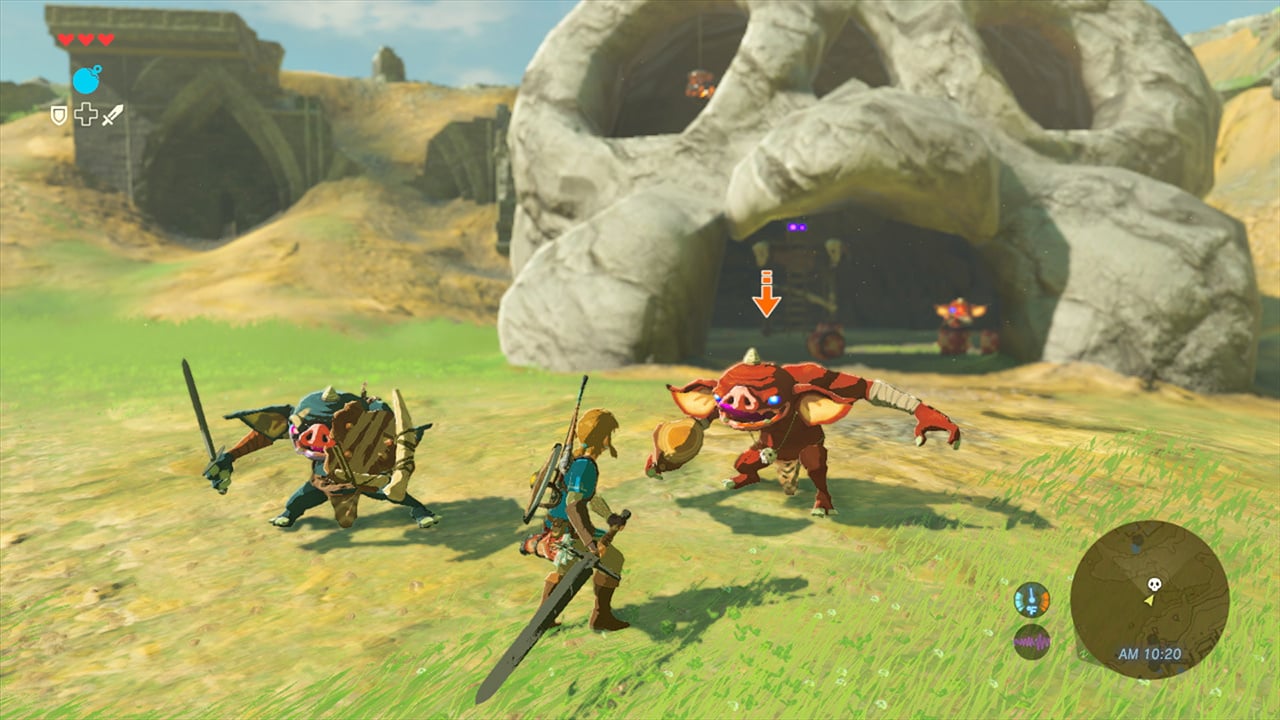
1. for starters zelda is dynamic 720p, and 2. it's AA solution is very weak, if you have eyes and look at the pics, you can easily see better IQ in GTAV, 2. shadow quality is better and  4. shading is much better 5. realistic requires more processing power then cell shading, the world is also way more detailed. 

1. Stand corrected there, I forgot that the Wii U version dropped to 1152 x 648 in a select few locations. 

2. All post-processing AA is very weak. I personally prefer not having it (opting for a sharper image.) The relevant question is about whether or not it is demanding (using a lot of resources) in either game, which it isn't. Post-processing AA has very little affect on game performance. 

3. 


Any difference in shadow quality is pretty minimal. The GTA V shadows have sharper edges, but BoTW's shadows are definitely more geometrically accurate, which is due to its superior lighting system.  Both are pretty low quality compared to what can be achieved on PS4/XBO and even other Switch titles though. 

4. Can you provide me some examples of where you think "shading is much better?" 

5. If all other things are equal, sure, but this is not something which translates across games with different methods of shading. But yeah, if BOTW were aiming for more realism it would need to make more calculations within its deferred shading system and the converse is true of GTA V (360.) 


quickrick said:

i'

curl-6 said:

Yeah I have played GOW3 actually. It looked absolutely amazing in 2010 but up against the better looking games on Switch it definitely shows its age in terms of shaders, textures, effects work, as is to be expected since the disparity in hardware makes it an unfair comparison to begin with.

The thing is, looks and power are not necessarily the same thing. For example, to me Okami on PS2 still looks better than most PS4 games; not because it's more graphically advanced, but simply cos I love its art style. If you love God of War's style and think it looks more visually pleasing than what Switch has on offer, that's fine. But as we seem to agree, Switch's technological superiority is a fact.

i'm not seeing how GOW3 and und uncharted 3 are showing there age compared to this, yes it's technically more demanding cause it runs at 60ffps which is very demanding, but those graphics, are a step down, aside from running higher resolution   

Yeah these graphics are really nothing to boast about. Great for handheld but already aged by this gens home console standards. 

Alkibiádēs said:
Kerotan said:

I said in terms of graphics it's like the successor to the Vita. Rather than the ps3/360.

Most Vita games look bad, there's only a few exceptions like Killzone. Very few developers got the best out of the Vita because most big budget games skipped the platform. 

The Switch is much more comparable to the PS3/360/Wii U.

Switch as the next generation to the Vita graphically or the same gen as ps3 is the same thing. Both things I've said. Glad you agree with one of them. 


sc94597 said:
quickrick said:

1. for starters zelda is dynamic 720p, and 2. it's AA solution is very weak, if you have eyes and look at the pics, you can easily see better IQ in GTAV, 2. shadow quality is better and  4. shading is much better 5. realistic requires more processing power then cell shading, the world is also way more detailed. 

1. Stand corrected there, I forgot that the Wii U version dropped to 1152 x 648 in a select few locations. 

2. All post-processing AA is very weak. I personally prefer not having it (opting for a sharper image.) The relevant question is about whether or not it is demanding (using a lot of resources) in either game, which it isn't. Post-processing AA has very little affect on game performance. 

3. 


Any difference in shadow quality is pretty minimal. The GTA V shadows have sharper edges, but BoTW's shadows are definitely more geometrically accurate, which is due to its superior lighting system.  Both are pretty low quality compared to what can be achieved on PS4/XBO and even other Switch titles though. 

4. Can you provide me some examples of where you think "shading is much better?" 

5. If all other things are equal, sure, but this is not something which translates across games with different methods of shading. But yeah, if BOTW were aiming for more realism it would need to make more calculations within its deferred shading system and the converse is true of GTA V (360.) 


its very evident  GTAV has better shading but, it's obvious you need that to have realistic looking material vs cell shaded. also your pics of zelda is the switch version which is 900p, not a fair comparison, but looking at GTAV 360 vs wiiu zelda, direct feed pics, i can't understand how anyone thinks zelda looks better.   

Last edited by quickrick - on 27 January 2018

Around the Network
quickrick said:

1. it's impossible to know how many things a game is doing under the hood. hard to compare games until they are both on the same systems, but just using common sense, making a living  breathing realistic city with traffic is gonna be way more demanding then a open world cell shaded game in the forest. 2. as for  the developer he says there is way more traffic in the next gen versions, 3. which would be too taxing for switch CPU. 4. he also compares 360/ps3 cpu vs switch. t would be highly dependent on the code they are running.


 "Cell and Xenon are good in highly optimized SIMD code. Xenon = 3 cores at 3.2 GHz, four multiply-adds per cycle (76.8 GFLOP/s). That's significantly higher theoretical peak than the 4x ARM cores on Switch can achieve. But obviously it can never reach this peak. You can't assume that multiply-add is the most common instruction (see Broadwell vs Ryzen SIMD benchmarks for further proof). Also Xenon vector pipelines were very long, so you had to unroll huge loops to reach good perf with it. Branching and indexing based on vector math results was horrible (~40 cycle stall to move data between register files). ARM NEON is a much better instruction set and OoO and data prefetch helps even in SIMD code.

If you compare them in standard C/C++ game code, ARM and Jaguar both stomp over the old PPC cores. I remember that it was common consensus that the IPC in generic code was around 0.2. So both Jaguar and ARM should be 5x+ faster per clock than those PPC cores (IIRC Jaguar average IPC was around 1.0 in some real life code benchmark, this ARM core should be close). However you can also write low level optimized game code for PPC, so it all depends on how much resources you had to optimize and rewrite the code. Luckily those days are a thing of the past. I don't want to remember all those ugly hacks we had around the code base to make the code run "well enough". The most painful thing was that CPU didn't have a data prefetcher. So you had to know around 2000 cycles in advance which memory regions your future code is going to access, and prefetch that data to cache. If you didn't do this, you would get 600 cycle stalls on memory loads. Those PPC cores couldn't even prefetch linear arrays."

1. This is not necessarily clear to be honest. In some ways it might be more demanding, in other's it might not be, and we need to consider the whole picture not just "traffic" which is the point I was trying to get across. There are points in BOTW that are understandably demanding, because there are many simulations going on at once, just like with GTA V. The "city" thing is what is tricking you here. It's not as if GTA V is simulating the city and then popping you into the middle of it. It runs the city on a very deterministic path, only modifying that path as you interact with it. 

2. Okay, even if that is true it's irrelevant to the discussion, and actually tells us how scalable GTA V is as a game. I'd also like to point out that this strongly hints that GTA V's traffic "simulation" isn't all that complex. If they can increase the traffic count without too many unforeseen consequences that implies a somewhat simple and deterministic model. 

3. Sure, nobody expects the Switch to run the PS4/XBO versions 1:1, but that they increased the traffic count shows that a hypothetical Switch version might be scaled in between PS360 and PS4/XBO, which is where its CPU places it. 

4. Everything he described is correct, but I'd like to contextualize it. The Xbox 360 and PS3, when running very specific unstructured code, can outperform the ARM and even in the Cell's case the Jaguars found in the PS4 and XBO for very specific tasks. It is why you always get people randomly saying, "the cell is better than the PS4's CPU!" because of that benchmark which compares their relative floating point performances. Really it is only better at that particular type of code though: highly parallel vectorized floating point operations. When you create a game though, you aren't just doing floating point operations, and you're definitely not running code that is always easily parellized/vectorized. Of course if you rewrote things in a certain way with assembly or C level code (rather than standard C++ or C#) you could maximize the amount of code which incorporates these operations, but why bother? It's a waste of time and money for multiplatform releases, and you're not even sure that your programmers would even want to do this. It would be very hard and tedious work. GPU's can perform these operations much better than any CPU can, so if the Switch or PS4/XBO's CPU really needed that much more performance for these operations, one could just offset it to the GPU and still get better results without having to get into low-level programming. 

Some people on Neogaf have actually done some benchmarks and calculated an approximate idea of how the Switch's CPU compares to the PS4's in terms of real-world performance. 

https://www.neogaf.com/threads/what-is-the-actual-power-of-the-nintendo-switch.1379817/page-9

"Blu and I did some math with some benchmarks. The Switch's CPU came up with being roughly 80% of the performance of the PS4 per core. When we consider the dimishing returns of splitting tasks among more than 3 cores and not knowing how much of the 4th core is available for Switch devs, we may be looking at something like 50% of the CPU performance of the PS4 at full utilization."



It's basically PS3 like visuals rendered at full 720p/900p/1080p, where the PS3 was usually sub 720p.


e=mc^2

Gaming on: PS4 Pro, Switch, SNES Mini, Wii U, PC (i5-7400, GTX 1060)

sc94597 said:
quickrick said:

1. it's impossible to know how many things a game is doing under the hood. hard to compare games until they are both on the same systems, but just using common sense, making a living  breathing realistic city with traffic is gonna be way more demanding then a open world cell shaded game in the forest. 2. as for  the developer he says there is way more traffic in the next gen versions, 3. which would be too taxing for switch CPU. 4. he also compares 360/ps3 cpu vs switch. t would be highly dependent on the code they are running.


 "Cell and Xenon are good in highly optimized SIMD code. Xenon = 3 cores at 3.2 GHz, four multiply-adds per cycle (76.8 GFLOP/s). That's significantly higher theoretical peak than the 4x ARM cores on Switch can achieve. But obviously it can never reach this peak. You can't assume that multiply-add is the most common instruction (see Broadwell vs Ryzen SIMD benchmarks for further proof). Also Xenon vector pipelines were very long, so you had to unroll huge loops to reach good perf with it. Branching and indexing based on vector math results was horrible (~40 cycle stall to move data between register files). ARM NEON is a much better instruction set and OoO and data prefetch helps even in SIMD code.

If you compare them in standard C/C++ game code, ARM and Jaguar both stomp over the old PPC cores. I remember that it was common consensus that the IPC in generic code was around 0.2. So both Jaguar and ARM should be 5x+ faster per clock than those PPC cores (IIRC Jaguar average IPC was around 1.0 in some real life code benchmark, this ARM core should be close). However you can also write low level optimized game code for PPC, so it all depends on how much resources you had to optimize and rewrite the code. Luckily those days are a thing of the past. I don't want to remember all those ugly hacks we had around the code base to make the code run "well enough". The most painful thing was that CPU didn't have a data prefetcher. So you had to know around 2000 cycles in advance which memory regions your future code is going to access, and prefetch that data to cache. If you didn't do this, you would get 600 cycle stalls on memory loads. Those PPC cores couldn't even prefetch linear arrays."

1. This is not necessarily clear to be honest. In some ways it might be more demanding, in other's it might not be, and we need to consider the whole picture not just "traffic" which is the point I was trying to get across. There are points in BOTW that are understandably demanding, because there are many simulations going on at once, just like with GTA V. The "city" thing is what is tricking you here. It's not as if GTA V is simulating the city and then popping you into the middle of it. It runs the city on a very deterministic path, only modifying that path as you interact with it. 

2. Okay, even if that is true it's irrelevant to the discussion, and actually tells us how scalable GTA V is as a game. I'd also like to point out that this strongly hints that GTA V's traffic "simulation" isn't all that complex. If they can increase the traffic count without too many unforeseen consequences that implies a somewhat simple and deterministic model. 

3. Sure, nobody expects the Switch to run the PS4/XBO versions 1:1, but that they increased the traffic count shows that a hypothetical Switch version might be scaled in between PS360 and PS4/XBO, which is where its CPU places it. 

4. Everything he described is correct, but I'd like to contextualize it. The Xbox 360 and PS3, when running very specific unstructured code, can outperform the ARM and even in the Cell's case the Jaguars found in the PS4 and XBO for very specific tasks. It is why you always get people randomly saying, "the cell is better than the PS4's CPU!" because of that benchmark which compares their relative floating point performances. Really it is only better at that particular type of code though: highly parallel vectorized floating point operations. When you create a game though, you aren't just doing floating point operations, and you're definitely not running code that is always easily parellized/vectorized. Of course if you rewrote things in a certain way with assembly or C level code (rather than standard C++ or C#) you could maximize the amount of code which incorporates these operations, but why bother? It's a waste of time and money for multiplatform releases, and you're not even sure that your programmers would even want to do this. It would be very hard and tedious work. GPU's can perform these operations much better than any CPU can, so if the Switch or PS4/XBO's CPU really needed that much more performance for these operations, one could just offset it to the GPU and still get better results without having to get into low-level programming. 

Some people on Neogaf have actually done some benchmarks and calculated an approximate idea of how the Switch's CPU compares to the PS4's in terms of real-world performance. 

https://www.neogaf.com/threads/what-is-the-actual-power-of-the-nintendo-switch.1379817/page-9

"Blu and I did some math with some benchmarks. The Switch's CPU came up with being roughly 80% of the performance of the PS4 per core. When we consider the dimishing returns of splitting tasks among more than 3 cores and not knowing how much of the 4th core is available for Switch devs, we may be looking at something like 50% of the CPU performance of the PS4 at full utilization."

I don't know well see, if GTAV comes out  on switch, but Noir didn't fair to well, it had worse frame rate then the ps3 version.


quickrick said: 

its very evident  GTAV has better shading but, it's obvious you need that to have realistic looking material vs cell shaded. also your pics of zelda is the switch version which is 900p, not a fair comparison, but looking at GTAV 360 vs wiiu zelda, direct feed pics, i can't understand how anyone thinks zelda looks better.   


So yes, you can't name a specific shader or feature that affects the overall shading system and compare them? Realism vs. cel-shading are pretty useless descriptors without context. It is like saying Call of Duty 2 has better shading because it aimed for realism, while BoTW has worse shading because its art-style is stylized. 

Both of the BOTW images I posted are 1280 x 720. One is from a Wii U gameplay video and I just found it on google images. The other was 

https://www.youtube.com/watch?v=gISRDvSUA7w

The other is from Nintendolife's page for the Wii U game 

http://www.nintendolife.com/games/wiiu/legend_of_zelda_breath_of_the_wild/screenshots


I find it difficult to give a fair assessment as different consoles excel in different areas of their specification and commercial factors also determine performance.

I've yet to see the Switch offer many of the large ambitious games that we got on ps3 and 360 because the developers that developed those games have moved onto later more powerful hardware. The Switch is in a position of getting great Nintendo games and a few weak ports of third party games often by sub par developers. Also Switch has pressure to keep cartridge sizes small and not take up too much flash memory. PS3 and 360 had larger hard drives and cheap optical storage.

Dual layer PS3 bluray discs offered 50GB of storage but that isn't really viable for a mobile platform. Clearly the Switch is more powerful but that doesn't mean we should expect to see more ambitious games than ps3 and 360 the third party games will likely be smaller games or conversions of old ps3 and 360 games plus weak xbone and ps4 ports.

So my point is it doesn't matter in some ways if the Switch is more powerful because there are other factors in play that will prevent it getting the wide range of ambitious titles that the ps3 and 360 got.

Not forgetting there are some pretty decent graphic intensive games now for Android, IOS and windows tablets.

There are a lot of impressive games on a lot of different systems and many game genres can now be done very well on even quite cheap hardware.