By using this site, you agree to our Privacy Policy and our Terms of Use. Close

Forums - Nintendo - Who will provide the NX GPU?


Who is making the NX GPU

nVida 187 41.19%
 
AMD 210 46.26%
 
Silicon Graphics Inc 16 3.52%
 
Sony (the power of the Cell!!!) 41 9.03%
 
Total:454
TheLastStarFighter said:
JEMC said:

There are still too many things we don't know to take any conclusions.

Conclusions, no, of course not.  But there is lots of fodder for solid speculation.  If I were to wager, I'd go with NX using the Tegra X2, and it's power will come in around 90% of an XBox One, which was an earlier rumor.  I'd say a solid chance of a docking station suplimental GPU, perhaps doublling performance.  We know by the patents a suplimental processing unit has been under consideration, the question is whether it will become a reality.

I was talking about your 1+1+3+3 TFlops distribution of Tegras and GPUs, mainly because the GP106 that powers the GTX 1060 (and that doesn't fit with what Nvidia showed in the slade I posted earlier) is rated at 3.8 TFlops, and I don't know if the GP107 will be able to give those 3 Tflops.

And I'm not one of those that believe the theory of the dock having extra hardware. First, because it makes no sense to have that hardware there and not being able to use it without the NX hybrid device, it would be better to launch the dock as a home console and talk about being able to connect both devices to have more performance and experience an even greater experience. And second, because there has been only two consoles with two sets of processors, the Neo Geo (that was too expensive and only had 1st party games) and the Sega Saturn... and devs hated to develop for that console.


Please excuse my bad English.

Former gaming PC: i5-4670k@stock (for now), 16Gb RAM 1600 MHz and a GTX 1070

Current gaming PC: R5-7600, 32GB RAM 6000MT/s (CL30) and a RX 9060XT 16GB

Steam / Live / NNID : jonxiquet    Add me if you want, but I'm a single player gamer.

Around the Network
TheLastStarFighter said:

Please don't use flops in that way.

It's not an accurate denominator for gauging performance, certainly not real-world performance.

You really need to stop saying that tired line over and over in an attempt to sound smart.  You absolutely can compare flops with flops to compare computing capacity.  At no point did I say something like twice the flops = twice the performance, but twice the flops is twice the flops.

No you can not, if you have information that points to the contrary, link it. - I am sure we would all like to read it.

1) Flop numbers are typically a single precision floating point, theoretical compute performance ceiling that GPU's often don't reach.
2) There is more to rendering games than single precision floation point.
3) Don't forget about integers.
4) What about double precision and half precision? For mobile, Half precision is typically more important than your single precision Gflop number.
5) What about bandwidth?
6) What about caches? Memory capacity?
7) What about the memory controller, pipelining?
8) What about texturing performance?
9) What about geometry performance? And more? (Get the picture yet?)

Not only that, but in the GPU world it's fairly common to take a GPU with a lower Gflop number and have it outperform a GPU with a higher Gflop number. (If you wish for me to school you on this and provide examples, I would be more than happy to do so.)

So I ask you this, if you are unable to reliable use it to compare GPU's as an overall performance metric, THEN WHY USE IT AT ALL?
Rather, hows about you compare GPU's for all their merits instead of just single precision floating point so you have a higher degree of relevency and accuracy?


www.youtube.com/@Pemalite

Pemalite said:
TheLastStarFighter said:

You really need to stop saying that tired line over and over in an attempt to sound smart.  You absolutely can compare flops with flops to compare computing capacity.  At no point did I say something like twice the flops = twice the performance, but twice the flops is twice the flops.

No you can not, if you have information that points to the contrary, link it. - I am sure we would all like to read it.

1) Flop numbers are typically a single precision floating point, theoretical compute performance ceiling that GPU's often don't reach.
2) There is more to rendering games than single precision floation point.
3) Don't forget about integers.
4) What about double precision and half precision? For mobile, Half precision is typically more important than your single precision Gflop number.
5) What about bandwidth?
6) What about caches? Memory capacity?
7) What about the memory controller, pipelining?
8) What about texturing performance?
9) What about geometry performance? And more? (Get the picture yet?)

Not only that, but in the GPU world it's fairly common to take a GPU with a lower Gflop number and have it outperform a GPU with a higher Gflop number. (If you wish for me to school you on this and provide examples, I would be more than happy to do so.)

So I ask you this, if you are unable to reliable use it to compare GPU's as an overall performance metric, THEN WHY USE IT AT ALL?
Rather, hows about you compare GPU's for all their merits instead of just single precision floating point so you have a higher degree of relevency and accuracy?

I am no computer expert, but as far as I have heard and read FLOPS are FLOPS. All of the other stuff doesn't matter, because FLOPS are literally processes performed per second, therefor a lot of the things listed, would ALREADY be taken into account. It's total computing power for a component, and obviously is combined with all other components of a final build to come up with a total FLOPS possible, but we are talking about a single component, so I do not think that rudely shutting someone down on the account of trying to sound like a computer expert is the best way to approach things. I could care less about how much you know about computers, personally, and I am sure no one else here is impressed either. The point of a forum is to discuss things and to make points based on our own thoughts and logic, not to come in and bash people because they aren't super experts on a computer build and how everything fits together and works.

Also, on the point of it being potentially potent enough to raise above XBox One and PS4, this is because PASCAL is supposed to be so efficient that it can free up much of the power of the processor for other things. Obviously we don't really know yet, but it is definitely possible that this could be one of the most efficient chips to ever hit the market (Especially the mobile market) in which case it could be one of the most powerful. I will remain optimistic until I see reports to the contrary. The people who start these articles and get excited about these things are experts in their own fields as well, so I would say that they know what they are talking about related to the possibilities of this thing.


NNID: Dongo8                              XBL Gamertag: Dongos Revenge

Pemalite said:

No you can not, if you have information that points to the contrary, link it. - I am sure we would all like to read it.

1) Flop numbers are typically a single precision floating point, theoretical compute performance ceiling that GPU's often don't reach.
2) There is more to rendering games than single precision floation point.
3) Don't forget about integers.
4) What about double precision and half precision? For mobile, Half precision is typically more important than your single precision Gflop number.
5) What about bandwidth?
6) What about caches? Memory capacity?
7) What about the memory controller, pipelining?
8) What about texturing performance?
9) What about geometry performance? And more? (Get the picture yet?)

Not only that, but in the GPU world it's fairly common to take a GPU with a lower Gflop number and have it outperform a GPU with a higher Gflop number. (If you wish for me to school you on this and provide examples, I would be more than happy to do so.)

So I ask you this, if you are unable to reliable use it to compare GPU's as an overall performance metric, THEN WHY USE IT AT ALL?
Rather, hows about you compare GPU's for all their merits instead of just single precision floating point so you have a higher degree of relevency and accuracy?

lol, you're so confused.  Try reading what I said again. Double the flops doens't necessarily mean double the performance, but double the flops definitely, by definition, means double the flops.

lol, you're hilarious.


JEMC said:
TheLastStarFighter said:

Conclusions, no, of course not.  But there is lots of fodder for solid speculation.  If I were to wager, I'd go with NX using the Tegra X2, and it's power will come in around 90% of an XBox One, which was an earlier rumor.  I'd say a solid chance of a docking station suplimental GPU, perhaps doublling performance.  We know by the patents a suplimental processing unit has been under consideration, the question is whether it will become a reality.

I was talking about your 1+1+3+3 TFlops distribution of Tegras and GPUs, mainly because the GP106 that powers the GTX 1060 (and that doesn't fit with what Nvidia showed in the slade I posted earlier) is rated at 3.8 TFlops, and I don't know if the GP107 will be able to give those 3 Tflops.

And I'm not one of those that believe the theory of the dock having extra hardware. First, because it makes no sense to have that hardware there and not being able to use it without the NX hybrid device, it would be better to launch the dock as a home console and talk about being able to connect both devices to have more performance and experience an even greater experience. And second, because there has been only two consoles with two sets of processors, the Neo Geo (that was too expensive and only had 1st party games) and the Sega Saturn... and devs hated to develop for that console.

Yeah, of course, I'm just speculating on the 1+1+3+3 thingy.

I'm not sure if they will do the suplimental device thing, but it does make a tonne of sense if they can do it right.  It would be mostly new for consoles, but PC's use multipe GPUs all the time, and Alienware offers a supplimental GPU for their laptops now.

So, if done right, Nintendo could offer a portable system for the bulk of their customers, the "3DS audience".  They could offer a second SKU that includes the portable and the SCU docking station for home gaming.  Let's just throw out price points of $299 and $399 to start.  The "home" SKU could include the power-boosting docking station and pro-style controller.  This console setup could be appealing to those that want the home Nintendo experience, or the "Wii U" audience.

If you have both the NX and its dock with say an 800 GFLOP GPU unit, that unit alone would be screaching performance for a portable.  Combined 2X, the home unit would be acceptable levels for current consoles.

The goal here from a company perspective, would be that you sell a tonne of the portable NX and get real good 3rd party support and have extensive 1st party support focused on the single system.  SInce a kid can then dock the system to their TV and up performance and play their favorite titles, why bother buying another home console?  This appealing setup could then lead to more third party support, which leads to more sales, which leads to the system being more in demand, and it's a continous positive cycle.


Around the Network
dongo8 said:

I am no computer expert, but as far as I have heard and read FLOPS are FLOPS. All of the other stuff doesn't matter, because FLOPS are literally processes performed per second, therefor a lot of the things listed, would ALREADY be taken into account.

The problem with Flops, and the reason why Pemalite always tries to warn people to not make that mistake, is that they are only valid for one of the tasks a GPU can do, and gaming is not that task.

Let's put an example that explains what he's talking about:

(data taken from The Tech Report)

If we only look the TFlops, then the performance of those cards, from slower to faster would be

R9 380 = GTX 970 < GTX 1060 < R9 390 < GTX 1070 < RX 480

Well, let's look at the relative performance of those cards tested with 16 games:

(graph taken from The Tech Report review of the GTX 1060, that's why this card is the base card at 100%.)
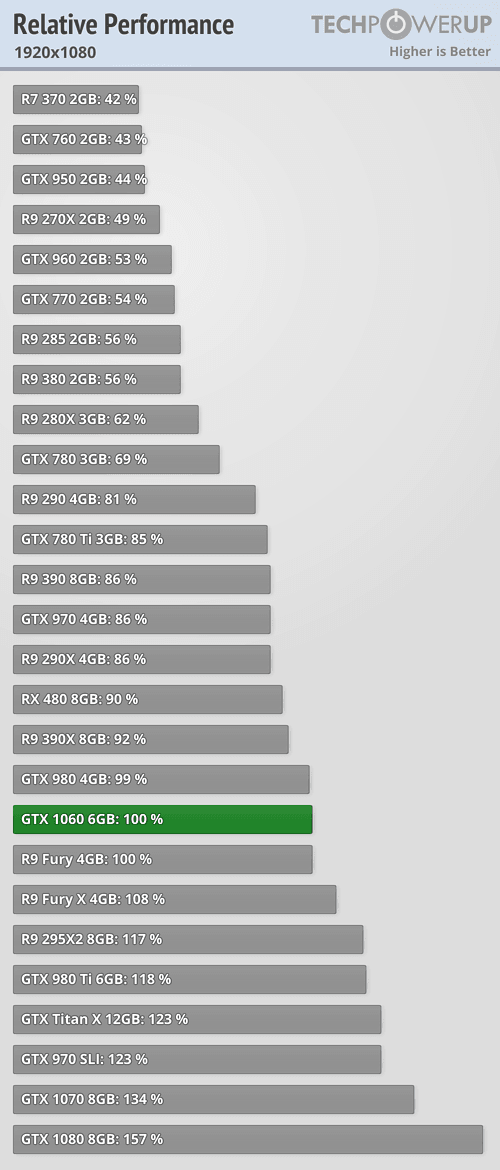
Surprise!

The GTX 970 is not only much faster than the equal (in Flops) 380, but it's almost on par with the 390 and 480. The 1060 is around 10% faster than the 480 despite having 2 full TeraFlops less, and the 1070 simply destroys them all.

That's the reason why TFlops are not a good way to compare performance in videoconsoles, even less is they are from two different vendors and from different generations too.

TheLastStarFighter said:
JEMC said:

I was talking about your 1+1+3+3 TFlops distribution of Tegras and GPUs, mainly because the GP106 that powers the GTX 1060 (and that doesn't fit with what Nvidia showed in the slade I posted earlier) is rated at 3.8 TFlops, and I don't know if the GP107 will be able to give those 3 Tflops.

And I'm not one of those that believe the theory of the dock having extra hardware. First, because it makes no sense to have that hardware there and not being able to use it without the NX hybrid device, it would be better to launch the dock as a home console and talk about being able to connect both devices to have more performance and experience an even greater experience. And second, because there has been only two consoles with two sets of processors, the Neo Geo (that was too expensive and only had 1st party games) and the Sega Saturn... and devs hated to develop for that console.

Yeah, of course, I'm just speculating on the 1+1+3+3 thingy.

I'm not sure if they will do the suplimental device thing, but it does make a tonne of sense if they can do it right.  It would be mostly new for consoles, but PC's use multipe GPUs all the time, and Alienware offers a supplimental GPU for their laptops now.

So, if done right, Nintendo could offer a portable system for the bulk of their customers, the "3DS audience".  They could offer a second SKU that includes the portable and the SCU docking station for home gaming.  Let's just throw out price points of $299 and $399 to start.  The "home" SKU could include the power-boosting docking station and pro-style controller.  This console setup could be appealing to those that want the home Nintendo experience, or the "Wii U" audience.

If you have both the NX and its dock with say an 800 GFLOP GPU unit, that unit alone would be screaching performance for a portable.  Combined 2X, the home unit would be acceptable levels for current consoles.

The goal here from a company perspective, would be that you sell a tonne of the portable NX and get real good 3rd party support and have extensive 1st party support focused on the single system.  SInce a kid can then dock the system to their TV and up performance and play their favorite titles, why bother buying another home console?  This appealing setup could then lead to more third party support, which leads to more sales, which leads to the system being more in demand, and it's a continous positive cycle.

PCs have it, but they need special drivers and they don't scale perfectly. And we're talking about a secondary GPU, because if that powered dock has another Tegra to work in tandem, that's another CPU thrown in the mix...

Also, in your example, if they make two SKUs with the NX and then dock+controller, why can't they make the dock+controller a console by itself? Why does it need the NX? It's a wasted oportunity.


Please excuse my bad English.

Former gaming PC: i5-4670k@stock (for now), 16Gb RAM 1600 MHz and a GTX 1070

Current gaming PC: R5-7600, 32GB RAM 6000MT/s (CL30) and a RX 9060XT 16GB

Steam / Live / NNID : jonxiquet    Add me if you want, but I'm a single player gamer.

JEMC said:
dongo8 said:

I am no computer expert, but as far as I have heard and read FLOPS are FLOPS. All of the other stuff doesn't matter, because FLOPS are literally processes performed per second, therefor a lot of the things listed, would ALREADY be taken into account.

The problem with Flops, and the reason why Pemalite always tries to warn people to not make that mistake, is that they are only valid for one of the tasks a GPU can do, and gaming is not that task.

Let's put an example that explains what he's talking about:

(data taken from The Tech Report)

If we only look the TFlops, then the performance of those cards, from slower to faster would be

R9 380 = GTX 970 < GTX 1060 < R9 390 < GTX 1070 < RX 480

Well, let's look at the relative performance of those cards tested with 16 games:

(graph taken from The Tech Report review of the GTX 1060, that's why this card is the base card at 100%.)

Surprise!

The GTX 970 is not only much faster than the equal (in Flops) 380, but it's almost on par with the 390 and 480. The 1060 is around 10% faster than the 480 despite having 2 full TeraFlops less, and the 1070 simply destroys them all.

That's the reason why TFlops are not a good way to compare performance in videoconsoles, even less is they are from two different vendors and from different generations too.

TheLastStarFighter said:

Yeah, of course, I'm just speculating on the 1+1+3+3 thingy.

I'm not sure if they will do the suplimental device thing, but it does make a tonne of sense if they can do it right.  It would be mostly new for consoles, but PC's use multipe GPUs all the time, and Alienware offers a supplimental GPU for their laptops now.

So, if done right, Nintendo could offer a portable system for the bulk of their customers, the "3DS audience".  They could offer a second SKU that includes the portable and the SCU docking station for home gaming.  Let's just throw out price points of $299 and $399 to start.  The "home" SKU could include the power-boosting docking station and pro-style controller.  This console setup could be appealing to those that want the home Nintendo experience, or the "Wii U" audience.

If you have both the NX and its dock with say an 800 GFLOP GPU unit, that unit alone would be screaching performance for a portable.  Combined 2X, the home unit would be acceptable levels for current consoles.

The goal here from a company perspective, would be that you sell a tonne of the portable NX and get real good 3rd party support and have extensive 1st party support focused on the single system.  SInce a kid can then dock the system to their TV and up performance and play their favorite titles, why bother buying another home console?  This appealing setup could then lead to more third party support, which leads to more sales, which leads to the system being more in demand, and it's a continous positive cycle.

PCs have it, but they need special drivers and they don't scale perfectly. And we're talking about a secondary GPU, because if that powered dock has another Tegra to work in tandem, that's another CPU thrown in the mix...

Also, in your example, if they make two SKUs with the NX and then dock+controller, why can't they make the dock+controller a console by itself? Why does it need the NX? It's a wasted oportunity.

Makes sense, but again I think that he may have jumped on the subject way too negatively, and down Starfighter's throat way too quickly. Starfighter said essentially the same thing that I did, (it's all theoretical until put into practice, of course) which is that FLOPS are FLOPS. Meaning if it has the power to process at say 4 TFLOPS than that is the power it has to process at. I wasn't trying to put it into a full test machine and see what the ACTUAL output was, everyone knows that will vary depending on where those are allocated and what it is paired with. The point is he jumped on Starfighter because he made an analytical statement without taking into account the other components and the possible things these FLOPS could be attributed to. Well that's not what we were doing, we were simply stating that at X number of FLOPS, it SHOULD be able to perform at a high level.

I do appreciate the side by side comparisons and the attempted explanation of what he was getting at though. I already had thought about that though, and it makes sense, my statement remains the same, FLOPS are FLOPS. The allocation is going to be different for sure, but according to NVidia and the outlets that I have read, the PASCAL architecture is pretty special and should keep them at a pretty high number due to its efficiency. It's a wait and see game, unfortunately no one is working with absolutes. Thank you again though! : )


NNID: Dongo8                              XBL Gamertag: Dongos Revenge

JEMC said:

TheLastStarFighter said:

Yeah, of course, I'm just speculating on the 1+1+3+3 thingy.

I'm not sure if they will do the suplimental device thing, but it does make a tonne of sense if they can do it right.  It would be mostly new for consoles, but PC's use multipe GPUs all the time, and Alienware offers a supplimental GPU for their laptops now.

So, if done right, Nintendo could offer a portable system for the bulk of their customers, the "3DS audience".  They could offer a second SKU that includes the portable and the SCU docking station for home gaming.  Let's just throw out price points of $299 and $399 to start.  The "home" SKU could include the power-boosting docking station and pro-style controller.  This console setup could be appealing to those that want the home Nintendo experience, or the "Wii U" audience.

If you have both the NX and its dock with say an 800 GFLOP GPU unit, that unit alone would be screaching performance for a portable.  Combined 2X, the home unit would be acceptable levels for current consoles.

The goal here from a company perspective, would be that you sell a tonne of the portable NX and get real good 3rd party support and have extensive 1st party support focused on the single system.  SInce a kid can then dock the system to their TV and up performance and play their favorite titles, why bother buying another home console?  This appealing setup could then lead to more third party support, which leads to more sales, which leads to the system being more in demand, and it's a continous positive cycle.

PCs have it, but they need special drivers and they don't scale perfectly. And we're talking about a secondary GPU, because if that powered dock has another Tegra to work in tandem, that's another CPU thrown in the mix...

Also, in your example, if they make two SKUs with the NX and then dock+controller, why can't they make the dock+controller a console by itself? Why does it need the NX? It's a wasted oportunity.

They could and maybe they will.  But the idea here is that the home station isn't all that powerful alone.  It's when combined with the porable that it has significant power.  The portable alone is powerful because it's rendering on a small screen.  On a big screen it might be weak.  But you double the power for home so it can offer the same experience with many more pixels.  One piece of software, two settings, portable and home (docked).


TheLastStarFighter said:
JEMC said:

PCs have it, but they need special drivers and they don't scale perfectly. And we're talking about a secondary GPU, because if that powered dock has another Tegra to work in tandem, that's another CPU thrown in the mix...

Also, in your example, if they make two SKUs with the NX and then dock+controller, why can't they make the dock+controller a console by itself? Why does it need the NX? It's a wasted oportunity.

They could and maybe they will.  But the idea here is that the home station isn't all that powerful alone.  It's when combined with the porable that it has significant power.  The portable alone is powerful because it's rendering on a small screen.  On a big screen it might be weak.  But you double the power for home so it can offer the same experience with many more pixels.  One piece of software, two settings, portable and home (docked).

My problem isn't with the idea by itself, but the implementation.

Something like this is not as easy to do as it seems.


Please excuse my bad English.

Former gaming PC: i5-4670k@stock (for now), 16Gb RAM 1600 MHz and a GTX 1070

Current gaming PC: R5-7600, 32GB RAM 6000MT/s (CL30) and a RX 9060XT 16GB

Steam / Live / NNID : jonxiquet    Add me if you want, but I'm a single player gamer.

JEMC said:
TheLastStarFighter said:

They could and maybe they will.  But the idea here is that the home station isn't all that powerful alone.  It's when combined with the porable that it has significant power.  The portable alone is powerful because it's rendering on a small screen.  On a big screen it might be weak.  But you double the power for home so it can offer the same experience with many more pixels.  One piece of software, two settings, portable and home (docked).

My problem isn't with the idea by itself, but the implementation.

Something like this is not as easy to do as it seems.

Absolutely.  I'll wait to see what they do with the concept.  It could be industry-dominating amazing or a total crash-and-burn.  The product needs to be effective for delivering an optimum gaming experience, and also seem appealing to new customers.