
By using this site, you agree to our Privacy Policy and our Terms of Use. Close

Forums - Gaming - Lets talk about the Future of the industry

Lets start by looking up the make-up of an engine or a console in no specific order. And advances made in those areas and their limitations.

  • CPU Currently the only things the CPU is "expected" to do in a game engine are; AI(where npcs goa nd how the react or what they do), Simulating the scene (the CPU makes positional and quantitative analysis of everything in the scene, in relation to the user input, then sends an updated scene to the gpu to draw. This is infinitely more complicated than my brief description). A good way to look at it is that any task in a game engine that requires more than one specific variable to resolve, is handled by the CPU. Down to where textures end up going cause those things need postional and directional data to be placed. The gpu take over from ther and renders the texture though.
  • GPU In a game engine there are tons of "simple code" (pixel colour/amount, texture rederinging, geometry redering, skin maps, post processing efffects, AA, AO....etc) and with each passing year more and more of general code is simplified to a point wheer they can run on a GPU. Hence why physics and basic compute (think screen facing/back facing triangles and tesselation) are being moved over to the GPU. Not much to say here besides that every generation GPUs get more and more powerful. BUt there is really only sooo much you can do with rasterization (thats the industry standard rendering model). More on that later.
  • RAM Faster memory is more important that more memory. You don't believe that? And entire level in most games is made up of no more than 1.5-3GB of data. This inculdes fixed data the is reused in other levels of the game. What will bring any game/engine to its knees though, is how fast you can move that data around in memory and this render it. That pretty much means that this should have been referred to as Bandwidth instead of RAM. Don't get this twisted, this doesn't mean that its ok to have 1GB of RAM with 1TB/s bandwidght. The 1GB limits how much detail and variety you can put into a scene at any given second. But rst assured though, you will have pop-ups and visible texture loads at 100fps.
  • I/O Unfortunately, marketing speak leads most to believe that this usually only comes down to the bandwidght of the RAM and how fast you can move data between it. But in truth whats just as important is the other part of the equation that no one seems to talk about. How fast can you move/streame data from the disc/HDD/SSD to system memory to begin with? 

Now lets talk about the perfect console.

  •  CPU Yh yh, faster and better CPU is all we need. But just how fast? A game console that has the processing power of 2 top of the line core i7 intel processors is all we would really ever need. Especially if inroads into GPU compute continue happenning. And this is actually overkill. 
  • GPU Lets take the AMD R9 290x GPU for instance, its got 2816 cores. To put things into perspective the PS4 has got 1152 cores. So lets look at 4k gaming. And lets use BF4 as our test bed. Look at this. In the chart below you can see that using two of some of the best cards on the market today will allow you get around 50+fps in 4k, one card only however gives you no more than 30ish. What the graph doesn't show you though, is what happens if you use 3 cards instead of 2. What you will notice is not a near 100% bump in render performance, but rather a miniscule 5-10% bump. Does this mean the third GPU isn't doing anything? Of course not, what it means is that the 3rd GPU is bandwidth starved. Yup, cause the funny thing about multiple GPUs, is that memory bandwidth doesnt stack. (cough#XBODRAM+EDRAM) So if memory bandwith of the individual card went up say from 380GB/s to around 600GB/s, then you will see that game running at around 110fps. So as a baseline, we need a GPU that has got at least 8000 cores.
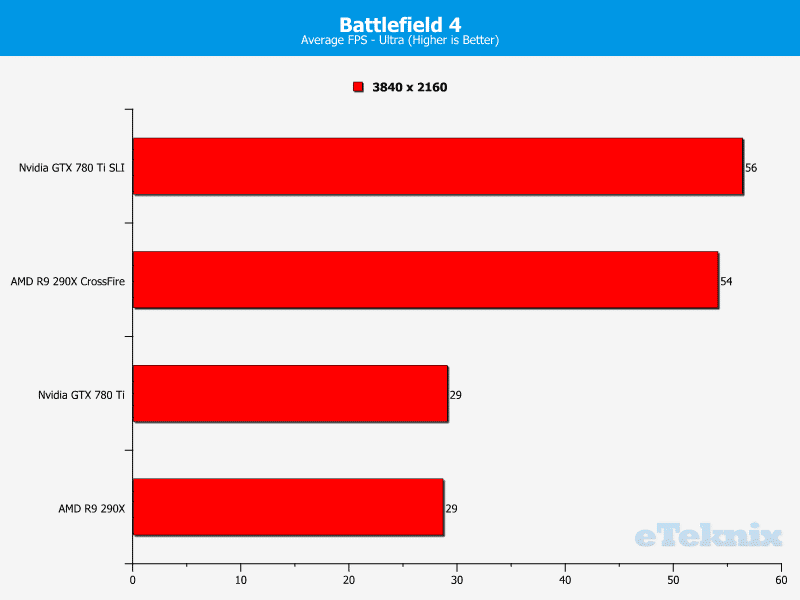
 

  • RAM If the above example has thought us anything, is that ys, RAM bandwith is actually really important. Now if the cards above which have an effective bandwidth of around 350GB/s (approximation to keep things simple) can give you 4k@50+fps, then having bandwidth of say 1TF/s will be more than we ever need for 4k gaming and all the eye candy you can throw at the screen. And say about 16GB of usable game ram.  This I also believe to be overkill.
  • I/O You need to be able to move data from and system ram at at least 1-1.5GB/s. Yes, this is possible when considering PCIE based SSDs. 


To sum that all up here i what a perfect console will/should look like for 4k@60fps gaming with every possible effect you can wave a stick at in 6-8yrs.

  • CPU with 2 x Core i7 4790k power
  • GPU with 4x AMD R9 290x power
  • 16GB of GDDR memory with an effective memory bandwidth of 600GB/s to 1TB/s and 4GB DRAM for the OS.
  • SSD with a proprietary connector that allows for up to 1GB/s transfer speeds. This wil probably limit the most we would get in the box to 1TB on launch and will mean we pay more for more space.
  • All of the above for no more than $499.

So is this possible, will it happen? and if it does, will it mark the start of what may become the longest console generation in the history of gaming?

Around the Network

mobile gaming keeps on increases ye ye ye.


Next gen(gen 9) systems will be interesting.

Assuming things haven't moved to streaming, here's what I'd expect from a system releasing in 2020.


CPUs are all but a thing of the past. They are still very important for a few tasks, but the majority of the work is done by the GPU. Because of this the systems will move from x86 to arm.

The GPU will be a beast by today's standards, but in 2020 it'll be mid tier compared to PCs. However the efficiency will make it hit above its weight class.

RAM will be huge. Either it'd go with 128 gb of unified memory similar to the PS4, or alternativly if the tech gets there I could see a 256 gb ssd being used in combination with 4 gb of ultra fast memory. Doubt it'd have seperate RAM just for the os.


I think next gen will be trying to push 1080p at min rather than 4k 60fps loll


PC Specs: CPU: 7800X3D || GPU: Strix 4090 || RAM: 32GB DDR5 6000 || Main SSD: WD 2TB SN850

JoeTheBro said:

CPUs are all but a thing of the past. They are still very important for a few tasks, but the majority of the work is done by the GPU. Because of this the systems will move from x86 to arm.


GPUs can't replace CPUs. The opposite actually is possible from a technical standpoint, while a GPU simply can't replace a CPU. GPUs are massivelly parallel, but all of their cores have to execute the same instruction in the code at the same time (with different data). That's great for graphics: you apply the same lightning to a lot of vertices or rasterize them as pixels. But when you got AI code or any thing that needs decisions, recursive calls and so on, a GPU simply is too slow.

GPUs only exist because they are cost effective ways to be massively parallel, only because of their simplistic nature. We actually have attempts to add GPU-like parallelism to CPUs in the Cell and now in the Xeon Phi processor, while the opposite simply is impossible because GPUs don't have the same capacities as a CPU (while a CPU has all habilities of a GPU and more).


Around the Network
JoeTheBro said:
Next gen(gen 9) systems will be interesting.

Assuming things haven't moved to streaming, here's what I'd expect from a system releasing in 2020.


CPUs are all but a thing of the past. They are still very important for a few tasks, but the majority of the work is done by the GPU. Because of this the systems will move from x86 to arm.

The GPU will be a beast by today's standards, but in 2020 it'll be mid tier compared to PCs. However the efficiency will make it hit above its weight class.

RAM will be huge. Either it'd go with 128 gb of unified memory similar to the PS4, or alternativly if the tech gets there I could see a 256 gb ssd being used in combination with 4 gb of ultra fast memory. Doubt it'd have seperate RAM just for the os.


Assuming it has moved to streaming, things might be even more interesting, as what will distinguish consoles will be hardware's features (Motion gaming, VR, even weirder pads, ...)


If this gen is any indication, next gen will be 4k@30fps.


If you demand respect or gratitude for your volunteer work, you're doing volunteering wrong.

RenCutypoison said:
JoeTheBro said:
Next gen(gen 9) systems will be interesting.

Assuming things haven't moved to streaming, here's what I'd expect from a system releasing in 2020.


CPUs are all but a thing of the past. They are still very important for a few tasks, but the majority of the work is done by the GPU. Because of this the systems will move from x86 to arm.

The GPU will be a beast by today's standards, but in 2020 it'll be mid tier compared to PCs. However the efficiency will make it hit above its weight class.

RAM will be huge. Either it'd go with 128 gb of unified memory similar to the PS4, or alternativly if the tech gets there I could see a 256 gb ssd being used in combination with 4 gb of ultra fast memory. Doubt it'd have seperate RAM just for the os.


Assuming it has moved to streaming, things might be even more interesting, as what will distinguish consoles will be hardware's features (Motion gaming, VR, even weirder pads, ...)

I don't think we wuld ever move to streaming. The computational equirements and all the unknowns are simply ridiculous. Just think of how much power will be needed to play BF10@4k@60fps........ for 20ml gamers simultaneously. And the cost o upgrading the hardware will be even more ridiculous on the server side. 

@Joe. There are tasks that the GPU can never do better than a CPU. And as games get ore and more demanding, those CPU tasks become even more important. So no, we won't ever go to CPUs based on ARM, hell.... when you consider that even in the mobile space the next big thing are 64bit processors you can clearly se that even mobile processors are demanding more and more power. And 2.5Ghz 8 core ARM 64bit cpu is not the same thing as 2.5Ghz 8 core X64. Not even close.

I have to agree with you on the GPU side of things but I think it wil be very dfferent from what most of us think. The simple truth of the matter is that as long as we are using silicon, GPUs can only so much more powerful. At 15nm fabrication, you can basically put exactly double the cores if using a similarly sized die. So basically what had to be done with dual cards could be done with one card. And it doesn't even work just like this.  But to have 4k@60fps, consoles basically need to have a gpu that has around 4x the cores of an R9 290 right now. Or somehow manage to have an R9 290 running at 4ghz.

I think you are mixing up Ram with storage space. As far as Ram goes, I doubt any game now or in the next 20 years will ever need more or even upto 20GB of RAM to run. I have it pegged at 16GB. And having an additional 4GB of DRAM just for the OS is actually really really cheap, especially by 2017. 


Console gaming should never focus on graphics. This is not how console gaming works. Main priority should be decent hardware with great exclusives. Hardware manufacturers should know their limits. No need to chase graphics.


I might be the only one hoping for this but I hope next gen pushes online services further and we get to play games via the clouds (and on a console for those who want a console) so this way games won't be held back by hardware. I would gladly subscribe to a Sony, MS or Nintendo channel so I can access the games I want at anytime without having to buy more hardware.