


Intrinsic on 01 June 2014
Lets start by looking up the make-up of an engine or a console in no specific order. And advances made in those areas and their limitations.
- CPU Currently the only things the CPU is "expected" to do in a game engine are; AI(where npcs goa nd how the react or what they do), Simulating the scene (the CPU makes positional and quantitative analysis of everything in the scene, in relation to the user input, then sends an updated scene to the gpu to draw. This is infinitely more complicated than my brief description). A good way to look at it is that any task in a game engine that requires more than one specific variable to resolve, is handled by the CPU. Down to where textures end up going cause those things need postional and directional data to be placed. The gpu take over from ther and renders the texture though.
- GPU In a game engine there are tons of "simple code" (pixel colour/amount, texture rederinging, geometry redering, skin maps, post processing efffects, AA, AO....etc) and with each passing year more and more of general code is simplified to a point wheer they can run on a GPU. Hence why physics and basic compute (think screen facing/back facing triangles and tesselation) are being moved over to the GPU. Not much to say here besides that every generation GPUs get more and more powerful. BUt there is really only sooo much you can do with rasterization (thats the industry standard rendering model). More on that later.
- RAM Faster memory is more important that more memory. You don't believe that? And entire level in most games is made up of no more than 1.5-3GB of data. This inculdes fixed data the is reused in other levels of the game. What will bring any game/engine to its knees though, is how fast you can move that data around in memory and this render it. That pretty much means that this should have been referred to as Bandwidth instead of RAM. Don't get this twisted, this doesn't mean that its ok to have 1GB of RAM with 1TB/s bandwidght. The 1GB limits how much detail and variety you can put into a scene at any given second. But rst assured though, you will have pop-ups and visible texture loads at 100fps.
- I/O Unfortunately, marketing speak leads most to believe that this usually only comes down to the bandwidght of the RAM and how fast you can move data between it. But in truth whats just as important is the other part of the equation that no one seems to talk about. How fast can you move/streame data from the disc/HDD/SSD to system memory to begin with?
Now lets talk about the perfect console.
- CPU Yh yh, faster and better CPU is all we need. But just how fast? A game console that has the processing power of 2 top of the line core i7 intel processors is all we would really ever need. Especially if inroads into GPU compute continue happenning. And this is actually overkill.
- GPU Lets take the AMD R9 290x GPU for instance, its got 2816 cores. To put things into perspective the PS4 has got 1152 cores. So lets look at 4k gaming. And lets use BF4 as our test bed. Look at this. In the chart below you can see that using two of some of the best cards on the market today will allow you get around 50+fps in 4k, one card only however gives you no more than 30ish. What the graph doesn't show you though, is what happens if you use 3 cards instead of 2. What you will notice is not a near 100% bump in render performance, but rather a miniscule 5-10% bump. Does this mean the third GPU isn't doing anything? Of course not, what it means is that the 3rd GPU is bandwidth starved. Yup, cause the funny thing about multiple GPUs, is that memory bandwidth doesnt stack. (cough#XBODRAM+EDRAM) So if memory bandwith of the individual card went up say from 380GB/s to around 600GB/s, then you will see that game running at around 110fps. So as a baseline, we need a GPU that has got at least 8000 cores.
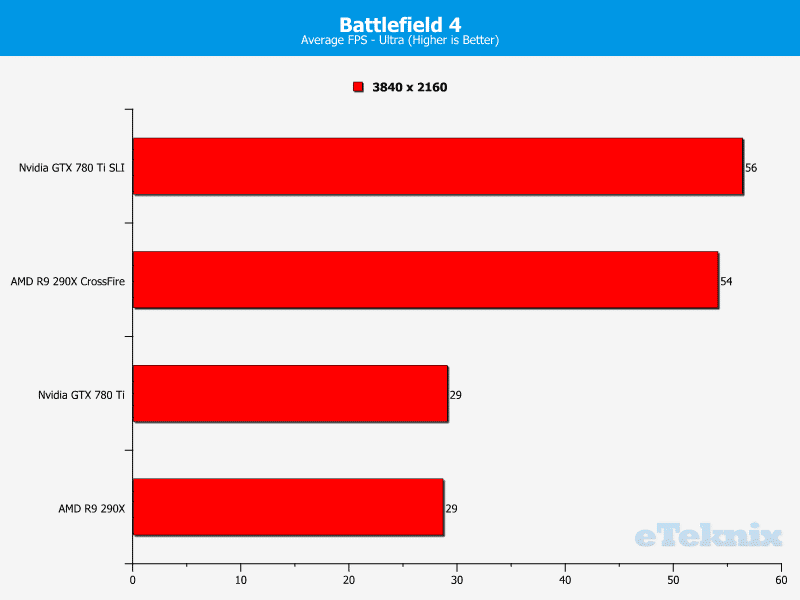
- RAM If the above example has thought us anything, is that ys, RAM bandwith is actually really important. Now if the cards above which have an effective bandwidth of around 350GB/s (approximation to keep things simple) can give you 4k@50+fps, then having bandwidth of say 1TF/s will be more than we ever need for 4k gaming and all the eye candy you can throw at the screen. And say about 16GB of usable game ram. This I also believe to be overkill.
- I/O You need to be able to move data from and system ram at at least 1-1.5GB/s. Yes, this is possible when considering PCIE based SSDs.
To sum that all up here i what a perfect console will/should look like for 4k@60fps gaming with every possible effect you can wave a stick at in 6-8yrs.
- CPU with 2 x Core i7 4790k power
- GPU with 4x AMD R9 290x power
- 16GB of GDDR memory with an effective memory bandwidth of 600GB/s to 1TB/s and 4GB DRAM for the OS.
- SSD with a proprietary connector that allows for up to 1GB/s transfer speeds. This wil probably limit the most we would get in the box to 1TB on launch and will mean we pay more for more space.
- All of the above for no more than $499.