OXMUK
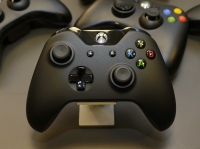
According to Xbox Accessories general manager Zulfi Alam, Microsoft once considered building in a screen and speakers - the approach Nintendo took with the Wii U's tablet controller. "Yes there was a temptation," he said. "And during the process there were a number of prototypes with displays on them, with speakers on them."
These quickly proved to be a hindrance, he went on. "The first thing about a display on a controller is that it needs to be super hi-res, which chews the battery life much more aggressively, which will irritate gamers.
"The second thing is that your HDTV will be the better display, and your eyes having to move between screens to get all the information is not a compelling gameplay scenario. It makes for worse gameplay."
To pre-empt the obvious objection here, having a screen built into the pad isn't the same thing as Xbox SmartGlass - an app which tethers your phone or tablet to the console, allowing it to serve as an auxiliary gameplay resource. "SmartGlass is different because it's for extra information," Alam clarified. "When I'm playing Call of Duty I don't want the second screen to be compulsory. So that's why having a second screen sounds interesting, but is actually detrimental to core gameplay."
Microsoft also thought about building in biometric sensors, but eventually decided that Kinect would do the job by itself. "We already have the ability to know what your emotion and heart-rate is, and that's through the Kinect camera. Adding biometric sensors would drain battery life, and we've already got it via Kinect, so why do it?"
There's plenty more in the feature, including details of battery life, what happens when you plug in a micro-USB cable, and why Microsoft had to wait to implement a plus-shaped D-pad.
http://www.oxm.co.uk/60291/microsoft-tested-xbox-one-controller-with-built-in-screen-found-it-detrimental-to-core-gameplay/