

By using this site, you agree to our Privacy Policy and our Terms of Use. Close

Forums - Gaming - AMD’s Jaguar Architecture: The CPU Powering Xbone, PS4, Kabini & Temash (2GHz clock speed requires 66% TDP increase compared to 1.6GHz)

Here everything you need to know about the CPU powering the PS4 and Xbone and the fact they will not run close to 2.0Ghz.

The full acticle: http://www.anandtech.com/show/6976/amds-jaguar-architecture-the-cpu-powering-xbox-one-playstation-4-kabini-temash

Final Words

Bobcat was a turning point for AMD. The easily synthesized, low cost CPU design was found in the nearly 50 million Brazos systems AMD sold since its introduction. Jaguar improves upon Bobcat in a major way. The move to 28nm helps drive power even lower, which will finally get AMD into tablet designs with Temash. Despite being lower power, Jaguar also manages to increase performance appreciably over Bobcat. AMD claims up to a 22% increase in IPC compared to Bobcat. Combine the IPC gains with a more multi-core friendly design and Jaguar based APUs should be appreciably faster than their predecessors.
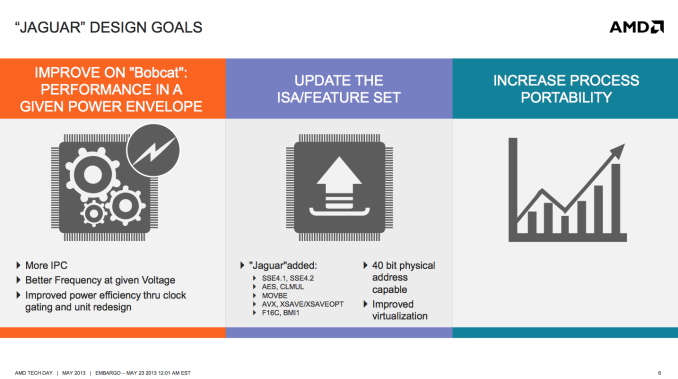
Quite possibly one of the only real weaknesses with Jaguar is the lack of aggressive turbo modes in any of the shipping implementations of the design. It appears that the first implementations of Jaguar were under time constraints, leaving many features (including improved thermal monitoring/management and turbo boost) on the cutting room floor. Kabini and Temash seem ripe for a mid-cycle update enabling turbo across more parts, which could do wonders for single threaded performance.

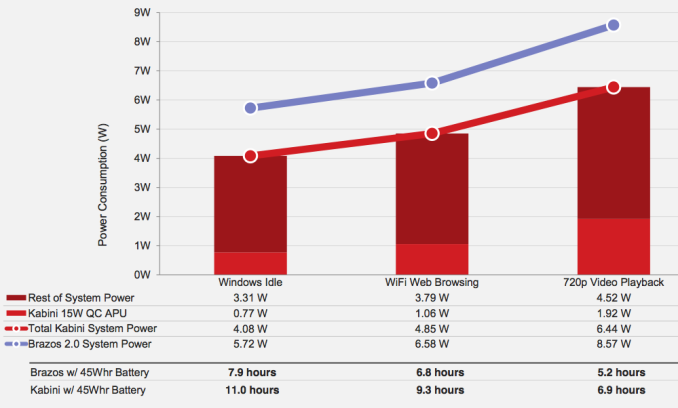
 The Jaguar power story actually looks very good, it's just hampered by traditional PC legacy. None of the launch APUs here support the low power IOs necessary to drive platform power down even further. AMD is getting very close though. Jaguar's core power is easily sub-2W for lightweight tablet tasks, the rest of the platform (excluding display) drives it up to 4 - 7W. AMD definitely has the right building blocks to go after truly low power tablets in a major way, should it have the resources and bandwidth to do so.
In its cost and power band, Jaguar is presently without competition. Intel’s current 32nm Saltwell Atom core is outdated, and nothing from ARM is quick enough. It’s no wonder that both Microsoft and Sony elected to use Jaguar as the base for their next-generation console SoCs, there simply isn’t a better option today. As Intel transitions to its 22nm Silvermont architecture however Jaguar will finally get some competition. For the next few months though, AMD will enjoy a position it hasn’t had in years: a CPU performance advantage.

 I can’t stress enough how important it is that AMD continues to focus on driving the single threaded performance of its cat-line of cores. Second chances are rare in this business, but that’s exactly what AMD has been offered with the rise of good enough computing. Jaguar vs. Atom is the best CPU story AMD has had in years. Regular updates to the architecture coupled with solid execution are necessary to ensure that history doesn’t repeat itself in a new segment of AMD’s business.

 Long term, I can’t help but wonder what Bobcat’s success will do to shape AMD’s future microarchitecture decisions. I’m not sure what Jim Keller’s SoC project is, but I’m wondering if the days of really big cores might be over. I don’t know that really small cores are the answer either, but perhaps something in between...



Around the Network


These are cool but are still very low end chips from AMD focused on power.

The most interesting part I found in this article is this:

"In both our Xbox One and PS4 articles I referred to the SoCs as using two Jaguar compute units - now you can understand why. Both designs incorporate two quad-core Jaguar modules, each with their own shared 2MB L2 cache. Communication between the modules isn’t ideal, so we’ll likely see both consoles prefer that related tasks run on the same module."

Looks like AMD just slapped 2 of these together on the same die and gave them a single more powerful GPU and shared cache.

ethomaz - here is what Xbox One mobo looks like.


disolitude said:

These are cool but are still very low end chips from AMD focused on power.

The most interesting part I found in this article is this:

"In both our Xbox One and PS4 articles I referred to the SoCs as using two Jaguar compute units - now you can understand why. Both designs incorporate two quad-core Jaguar modules, each with their own shared 2MB L2 cache. Communication between the modules isn’t ideal, so we’ll likely see both consoles prefer that related tasks run on the same module."

Looks like AMD just slapped 2 of these together on the same die and gave them a single more powerful GPU and shared cache.

I think that too... 2 quar-core Jaguar taped togueter.

But I think that Xbone and PS4 will divide/fix CPU core by task... eg. maybe 4 core to Games and 4 core to OS in Xbone... so they will not need communicate after all... or another eg. 6 core for Games and 2 for OS... I don't know... just gessing.

The memory will be reserved for sure.

Nice mobo... more PC like than previous consoles.


Dissapointing, but expected. A 66% increase in TDP is pretty crazy for a 20% increase in clock speed. I guess these are intended to be used as LP chips after all.


Around the Network
ethomaz said:
disolitude said:

These are cool but are still very low end chips from AMD focused on power.

The most interesting part I found in this article is this:

"In both our Xbox One and PS4 articles I referred to the SoCs as using two Jaguar compute units - now you can understand why. Both designs incorporate two quad-core Jaguar modules, each with their own shared 2MB L2 cache. Communication between the modules isn’t ideal, so we’ll likely see both consoles prefer that related tasks run on the same module."

Looks like AMD just slapped 2 of these together on the same die and gave them a single more powerful GPU and shared cache.

I think that too... 2 quar-core Jaguar taped togueter.

But I think that Xbone and PS4 will divide/fix CPU core by task... eg. maybe 4 core to Games and 4 core to OS in Xbone... so they will not need communicate after all... or another eg. 6 core for Games and 2 for OS... I don't know... just gessing.

The memory will be reserved for sure.

Nice mobo... more PC like than previous consoles.


Don't forget the rumored arm-processors. We have yet to see which function they will fulfill when not in standby-mode.


hinch said:

Dissapointing, but expected. A 66% increase in TDP is pretty crazy for a 20% increase in clock speed. I guess these are intended to be used as LP chips after all.

I think now both will use 1.6Ghz for the CPU or at maximum 1.8Ghz... neither Sony or MS will go close to 2.0Ghz.


ethomaz said:
hinch said:

Dissapointing, but expected. A 66% increase in TDP is pretty crazy for a 20% increase in clock speed. I guess these are intended to be used as LP chips after all.

I think now both will use 1.6Ghz for the CPU or at maximum 1.8Ghz... neither Sony or MS will go close to 2.0Ghz.

Yeah, thats what I think as well. Considering the rumours we've heard about the Durango (SoC) having troubles with yields, I don't expect any changes done to either console. Things will have to start going in production soon and they won't have time to mess around with that.


walsufnir said:

Don't forget the rumored arm-processors. We have yet to see which function they will fulfill when not in standby-mode.

Yeah...

And I can't see MS or Sony saying to developer... you have 6 cores to use if that app is running... if not you have 7 cores to use lol.
So they will put some kind of software wall to reserve most part of CPU, GPU and Memory resourses for games only (well GPU I guess will be all for the developers).


ethomaz said:
walsufnir said:

Don't forget the rumored arm-processors. We have yet to see which function they will fulfill when not in standby-mode.

Yeah...

And I can't see MS or Sony saying to developer... you have 6 cores to use if that app is running... if not you have 7 cores to use lol.
So they will put some kind of software wall to reserve most part of CPU, GPU and Memory resourses for games only (well GPU I guess will be all for the developers).

Yes, devkits will prevent using more cores aswell as the respective operating systems will lock out ressources.

I am so looking forward for hardware-breakdowns! I already did a little bit on my own given the picture above but it was too bad to identify every bit. But I can proove it's ddr3-ram :)