Alrighty. For all those who would suggest just starting a war in Asia as good for the economy, let me bring some perspective.
Yes, post WWII was good for the US speaking strictly monetarily. The entirety of the country and the US economy was geared up purely to conduct war. The United States is not and has never entered that state in any period since then. The US has never so fully devoted it's economy and industrial might to any other endeavour. The US then spent billions to rebuild the countries they'd destroyed. This fostered better relationships as well as an inherent dependancy upon the US. This also ensured that the world did not see a repeat of the impacts seen due to how heavily the Treaty of Versailles impacted the defeated nations and ended up fostering a very strong German economy which would've been impossible without the help of the Marshall Plan. It was a mutually beneficial deal for the US to rebuild Europe. It established good trade relations and aided in unifying the world to use the US Dollar as the benchmark for most things.
Pretty much every other nation involved was economically shattered. The Soviet Union was able to recover due to the new found work force in terms of political and military prisoners, some who weren't released for many years after the war while being used as slave labor. Many never were released because they didn't survive long enough. Even so, the Soviets were stuck repairing a phenomenal amount of damage due to both the invasion and repulsion of Nazi forces, but also due to the scorched earth tactics employed by the Soviets which decreed that nothing of use be left to the enemy. The political situation did not help things either as many of the greatest minds the Soviets had to offer would run afoul of someone in the wrong place and end up in the gulag.
The British not only were deep in debt for years afterwards, but they also had lost or were on the verge of turning over all their territorial/colonial posessions. The British government only finished paying off the Lend Lease debt to the US government in December of 2006. The British government was in no position to resume operating as it had during the post war world.
The Japanese became entirely dependant in many ways on the US due to their constitution. They were very carefully watched and the US was very cautious about ever letting the country become fully independant again due to utter brutality with which they'd fought. Germans forces would surrender. The Japanese would not. Captured pilots in the European theater would occasionally be brought to share a meal with the pilot who'd shot them down before being sent to a prison camp. The Japanese would torture and kill those they'd found if they were unable to work. I have yet to touch on what they did to the Asian mainland, especially what is currently China.
The JSDF doesn't have any sort of force projection. The JSDF is merely for National Security and Defense. The force only consists of about 227,000 soldiers as of January 2013. Compare that to the size of the US Military at 1,430,000. They have no strategic bombers. They have few aircraft capable of ground attack and even those are limited in capability and scope. Most are of US vintage, being F-15 Eagles and F-4 Phantoms as well as EWACS aircraft, cargo, and other support or training aircraft. This is why they rely so heavily on the US Military for support. The US is their offensive arm.
Any attack by the Japanese would be suicidal anyways for the following reasons.
1) Outside of the JSDF relatively poor military standing, the North Korean Army, while ill trained and generally terrible, are a much larger standing force with a large conscripted population available in reserve. The JSDF could not stand against them in a toe to toe fight. The NK troops would simply be able to do the equivelant of a human zerg rush.
2) While the continental US is (generally speaking) outside of the range of a NK nuke, Japan is well within range. Assuming that somehow the Japanese military did close in on Pyongyang, there's no reason not to believe that the NK government would not detonate a nuke on their own soil to take as many of them with them as possible or to galvanize their people and hopefully the world against the invading force by claiming the nuke was used by the US to assist in the destruction of NK.
3) The Chinese would not like it. At all. The Japanese forces during WW2 made the term "rape and pillage" seem like an easter egg hunt. Read up on the Rape of Nanking. Read up on Unit 731. Read up on "comfort women". I could go on, but the point is that China has tried to distance themselves from the NK. The Japanese and the Chinese still harbor a lot of ill will towards one another due to WW2. Any Japanese incursion in mainland Asia might see the Chinese up in arms simply based on principle or some very harsh and strong language from the Chinese with some possible support of the North Koreans.
4) As has been said before, the Japanese economy could not support such a thing. The US was able to provide so much material for WW2 because not only was the entire nation geared up for the war, but the US had stores or access to just about every single war material you could ask for. Lumber in the West. Oil from the southern Midwest. Uniforms and cloth materials from the South. Heavy industry in the North and North East as well as many major cities across the country. The Japanese were forced to import many important items to conduct a war effort during WW2. That is one reason the US oil embargo worked so well. Because the Japanese has to expand their empire to gain the needed materials, this extended time to production. While the US could theoretically supply such things if the Japanese decided to get into a war with North Korea, there'd be no reason for the prior reasons mentioned. The US would already be involved more than likely.
Let history teach another lesson. This one comes from the MIddle East. When the Soviet Union invaded Afghanistan, the CIA took the time to train the Mujahideen fighters so that they could fight a proxy war against a US enemy, the Soviets. The Afghan fighters were taught how to bleed their opponent, either by manpower or financially. The Soviets were already on their way down by this point, but their war in Afghanistan was the straw that broke the camels back. It pushed them over a cliff economically that they could not recover from.
The fighters there still use this tactic today. How much has been spent to uparmor vehicles against IEDs? How much has research into how to disable or prevent IED attacks cost? Start taking the info from this graphic into account to see the difference in costs per soldier and compare the past to today. 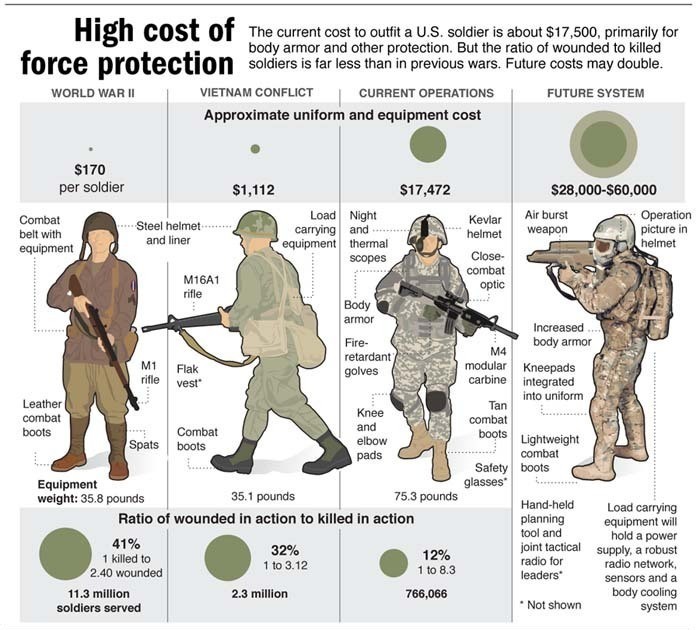
Let's take this a step further. It may cost them $50 (probably less) to stuff a bomb in a package to send the US. Maybe about $500-1000 if you send it on a person. How much money has the US invested since 9/11 to stop hijackings and things like the shoe bomber or the underwear bombers? Lets start with the TSA. How much do all the individuals working there cost? How much are their benefits? How much for those X-ray machines? How much to train bomb dogs? How much for their handlers? How much for air marshals? Support staff? Airport remodelling to implement new policies? Equipment for all those individuals? Uniforms? What about ICE? The cost of covering and inspecting ports? Their equipment? Vehicles? Start trying to figure out just how much money the US has invested to stop a $50 package. The CIA taught the Mujahideen how to not only strike physically, but to strike economically only 30 years ago.
Could the Japanese afford to do what I'd just mentioned if the North Koreans took a more "terroristic" approach to fighting a war with them? Is Japan in any fiscal position to do such a thing? Doubtful, honestly, but the people would demand it and it would push them even further into economic turmoil.
So, if you've read all that, that covers a lot of the military, some of the political, and some of the economic reasons that Japan declaring war on NK would be a bad idea.



























 Currently Online