By using this site, you agree to our Privacy Policy and our Terms of Use. Close

Forums - Nintendo - Wii U GPU new info and more speculation

unaveragejoe said:
Does anyone think and AMD HSA technology might be used in the GPU?


Not a possibility, as the MCM with the GPU and CPU is not an APU because of the two separate dies. APUs, including ones with HSA technology, have the GPU and CPU on the same die, which isn't the case on Wii U.


Around the Network
RazorDragon said:
unaveragejoe said:
Does anyone think and AMD HSA technology might be used in the GPU?


Not a possibility, as the MCM with the GPU and CPU is not an APU because of the two separate dies. APUs, including ones with HSA technology, have the GPU and CPU on the same die, which isn't the case on Wii U.

I think you've misunderstood the question.

It's not "what if the GPU has HSA technology in how it works with the CPU?" It's "what if the GPU also contains more CPU circuitry, and thus is closer to being an APU?"

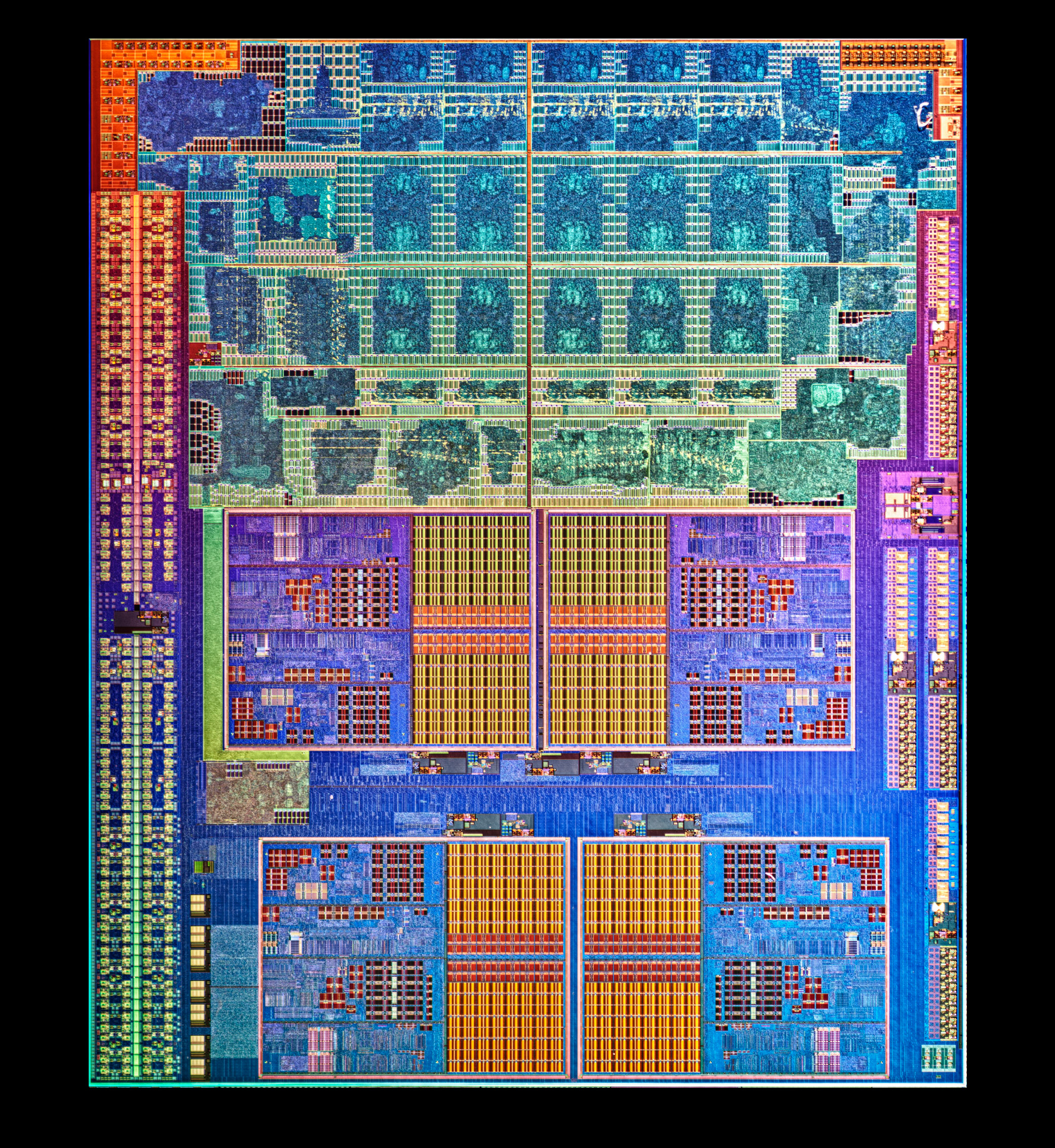
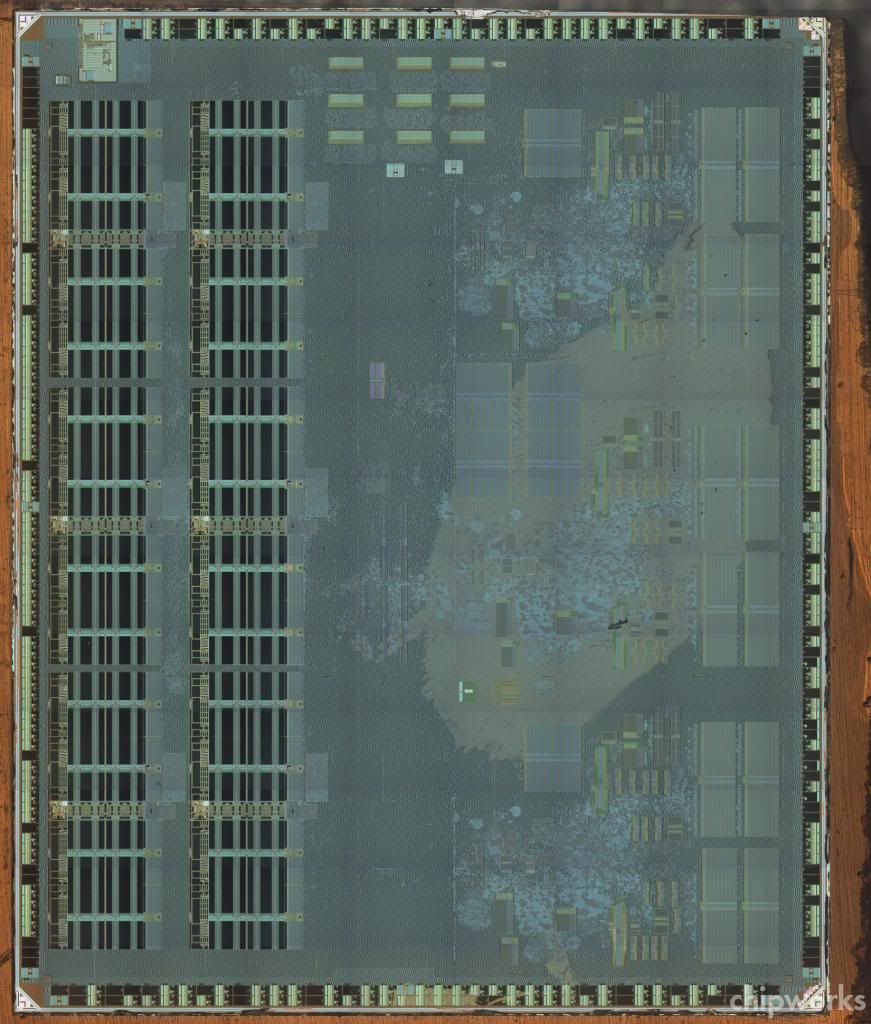
After all, we've heard repeatedly that the GPU in the Wii U is meant to basically be a GPGPU, and my understanding is that AMD's HSA technology is meant to be their equivalent of a GPGPU, just in the form of an APU. It might explain why we've got so much conflicting information. I even see what I think is a plausible location for it - feature D on the annotated die image. Mind you, I'm no expert - I'm just looking for similarities between Llano and the Wii U CPU and GPU dies. There are some structures in D that resemble structures in the CPU part of Llano (the bottom part of this image), and aren't all that dissimilar to the right side of the CPU (this image), where the actual CPU components are (the left side has the memory). And if you compare the size of D with the size of the CPU cores (you can recognise them based on the fact that there are three cores, and the middle one has four times the cache), it actually comes out damn close.

It doesn't necessarily have to have any physical CPU core - just some of the logic, etc.


Aielyn said:
RazorDragon said:
unaveragejoe said:
Does anyone think and AMD HSA technology might be used in the GPU?


Not a possibility, as the MCM with the GPU and CPU is not an APU because of the two separate dies. APUs, including ones with HSA technology, have the GPU and CPU on the same die, which isn't the case on Wii U.

I think you've misunderstood the question.

It's not "what if the GPU has HSA technology in how it works with the CPU?" It's "what if the GPU also contains more CPU circuitry, and thus is closer to being an APU?"

After all, we've heard repeatedly that the GPU in the Wii U is meant to basically be a GPGPU, and my understanding is that AMD's HSA technology is meant to be their equivalent of a GPGPU, just in the form of an APU. It might explain why we've got so much conflicting information. I even see what I think is a plausible location for it - feature D on the annotated die image. Mind you, I'm no expert - I'm just looking for similarities between Llano and the Wii U CPU and GPU dies. There are some structures in D that resemble structures in the CPU part of Llano (the bottom part of this image), and aren't all that dissimilar to the right side of the CPU (this image), where the actual CPU components are (the left side has the memory). And if you compare the size of D with the size of the CPU cores (you can recognise them based on the fact that there are three cores, and the middle one has four times the cache), it actually comes out damn close.

It doesn't necessarily have to have any physical CPU core - just some of the logic, etc.


I'd be pretty surprised if even PS4/NexBox have fully implemented HSA. According to AMD's roadmap, one of HSA's two major features is scheduled for 2013 (unified memory adrress space for CPU and GPU), so that one might be in, but the other is slated for 2014 (GPU compute content switching).

That said, it would be great if they actually psuhed AMD to go ahead of schedule and make them fully capable HSA parts - then we would finally see all this GPGPU talk making much more sense.

http://www.anandtech.com/print/5503


Aielyn said:
RazorDragon said:
unaveragejoe said:
Does anyone think and AMD HSA technology might be used in the GPU?


Not a possibility, as the MCM with the GPU and CPU is not an APU because of the two separate dies. APUs, including ones with HSA technology, have the GPU and CPU on the same die, which isn't the case on Wii U.

I think you've misunderstood the question.

It's not "what if the GPU has HSA technology in how it works with the CPU?" It's "what if the GPU also contains more CPU circuitry, and thus is closer to being an APU?"

After all, we've heard repeatedly that the GPU in the Wii U is meant to basically be a GPGPU, and my understanding is that AMD's HSA technology is meant to be their equivalent of a GPGPU, just in the form of an APU. It might explain why we've got so much conflicting information. I even see what I think is a plausible location for it - feature D on the annotated die image. Mind you, I'm no expert - I'm just looking for similarities between Llano and the Wii U CPU and GPU dies. There are some structures in D that resemble structures in the CPU part of Llano (the bottom part of this image), and aren't all that dissimilar to the right side of the CPU (this image), where the actual CPU components are (the left side has the memory). And if you compare the size of D with the size of the CPU cores (you can recognise them based on the fact that there are three cores, and the middle one has four times the cache), it actually comes out damn close.

It doesn't necessarily have to have any physical CPU core - just some of the logic, etc.


I guess my understanding of the HSA technology was wrong, then. I thought it was only applicable to APU solutions and not on separate CPU+GPU solutions. Based on what i understood, you're talking about the GPU containing some CPU logic and thus being somewhat an APU, so Wii U's MCM would actually contain a CPU and an APU, is that right? That's actually a quite interesting theory and, in theory, it would be possible, altough i don't see why Nintendo would choose to use a separate CPU and an APU instead of just using one big die with both the GPU and a complete CPU, not just some logic, in a more common APU setting. It would also explain Iwata talking about how important the GPGPU functionality of the console is, even if the GPU had only 160SPs, for example, the embedded CPU logic would give the GPGPU funcionality quite a boost. However, I don't think AMD would allow to put IBM's CPU design on their APU chip, and if AMD did that CPU logic inside the GPU, then there would be a lot of problems utilizing it thanks to the difference in x86 and PowerPC achitecture. I mean, i'm no expert either, so what i'm talking here might be worth nothing, but what you said could be possible, after all, there's still 30% unknown in that GPU and this unknown part is close to where you pointed.


RazorDragon said:
I guess my understanding of the HSA technology was wrong, then. I thought it was only applicable to APU solutions and not on separate CPU+GPU solutions. Based on what i understood, you're talking about the GPU containing some CPU logic and thus being somewhat an APU, so Wii U's MCM would actually contain a CPU and an APU, is that right? That's actually a quite interesting theory and, in theory, it would be possible, altough i don't see why Nintendo would choose to use a separate CPU and an APU instead of just using one big die with both the GPU and a complete CPU, not just some logic, in a more common APU setting. It would also explain Iwata talking about how important the GPGPU functionality of the console is, even if the GPU had only 160SPs, for example, the embedded CPU logic would give the GPGPU funcionality quite a boost. However, I don't think AMD would allow to put IBM's CPU design on their APU chip, and if AMD did that CPU logic inside the GPU, then there would be a lot of problems utilizing it thanks to the difference in x86 and PowerPC achitecture. I mean, i'm no expert either, so what i'm talking here might be worth nothing, but what you said could be possible, after all, there's still 30% unknown in that GPU and this unknown part is close to where you pointed.

Keep in mind that I'm not saying that it does have it, or anything like it. I was primarily explaining what unaveragejoe was talking about, and then was inspired to compare CPUs with Latte, just to see if it could actually make sense.

As for why they'd have an AMD APU and an Intel CPU on the same MCM... the obvious explanation would be that the Intel chip can run the OS and handle backwards compatibility (GC and Wii both had Intel CPUs - note that Espresso is understood to have a very similar processor to the Wii in terms of core architecture), while the APU could handle games, with the CPU helping out where appropriate.

There's an interesting thing to notice about the Wii U's MCM and the location of the RAM around it - it's all much closer to the GPU than the CPU.
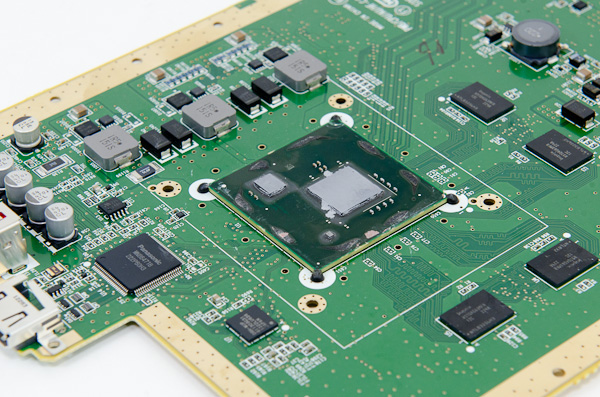
The large square on the MCM is the GPU, the smaller one is the CPU. The RAM is on the right side. Why position them like this? I'm not saying it's meaningful, because it very well might not be - but it could be evidence.

Essentially, the question is whether we're really understanding the architecture of the system. There are so many possibilities we haven't accounted for, yet, and this is just one of them. Note that there's also the question of the third chip on the MCM - what is that smaller chip (just below the GPU in the above image)? There's been some speculation, but nobody actually knows at this point.

Note that I looked at the CPU for inspiration when making the comparison - I also looked at Llano, which is an AMD chip, because it should more resemble that than the CPU.

Everyone compares to Llano, by the way... which is a 28nm APU. What if we compare with a 40nm APU like Zacate?

Look at the section marked "CPU Core". Now, compare with what we see on Latte, in section D. To me, there's definitely a similarity, although I can't be sure. I also see something similar in X. An interesting thing to note is that some, including that Marcan guy, have speculated that Y is the equivalent of the Wii's own CPU-core-on-the-GPU, Starlet, which people have taken to calling Starbuck as a dual reference to coffee and Starlet. Indeed, Y looks a fair bit like the "centre" part of the two CPU cores (the top half of the bottom core, and the bottom half of the top core) of Zacate, while the bottom part of X looks a lot like the other halves of the Zacate cores.

Anyway, it's food for thought.


Around the Network
Aielyn said:
RazorDragon said:
unaveragejoe said:
Does anyone think and AMD HSA technology might be used in the GPU?


Not a possibility, as the MCM with the GPU and CPU is not an APU because of the two separate dies. APUs, including ones with HSA technology, have the GPU and CPU on the same die, which isn't the case on Wii U.

I think you've misunderstood the question.

It's not "what if the GPU has HSA technology in how it works with the CPU?" It's "what if the GPU also contains more CPU circuitry, and thus is closer to being an APU?"

After all, we've heard repeatedly that the GPU in the Wii U is meant to basically be a GPGPU, and my understanding is that AMD's HSA technology is meant to be their equivalent of a GPGPU, just in the form of an APU. It might explain why we've got so much conflicting information. I even see what I think is a plausible location for it - feature D on the annotated die image. Mind you, I'm no expert - I'm just looking for similarities between Llano and the Wii U CPU and GPU dies. There are some structures in D that resemble structures in the CPU part of Llano (the bottom part of this image), and aren't all that dissimilar to the right side of the CPU (this image), where the actual CPU components are (the left side has the memory). And if you compare the size of D with the size of the CPU cores (you can recognise them based on the fact that there are three cores, and the middle one has four times the cache), it actually comes out damn close.

It doesn't necessarily have to have any physical CPU core - just some of the logic, etc.


Wow I had not thought of that. My thinking was on the possibility of a makeshift APU maybe with HSA technology. Because Nintendo needed IBM to make the CPU for backwards compatibility I knew the typical AMD APU would not work. That is an interesting thought though to have a CPU in addition to an APU on the MCM.


Aielyn said:
RazorDragon said:
I guess my understanding of the HSA technology was wrong, then. I thought it was only applicable to APU solutions and not on separate CPU+GPU solutions. Based on what i understood, you're talking about the GPU containing some CPU logic and thus being somewhat an APU, so Wii U's MCM would actually contain a CPU and an APU, is that right? That's actually a quite interesting theory and, in theory, it would be possible, altough i don't see why Nintendo would choose to use a separate CPU and an APU instead of just using one big die with both the GPU and a complete CPU, not just some logic, in a more common APU setting. It would also explain Iwata talking about how important the GPGPU functionality of the console is, even if the GPU had only 160SPs, for example, the embedded CPU logic would give the GPGPU funcionality quite a boost. However, I don't think AMD would allow to put IBM's CPU design on their APU chip, and if AMD did that CPU logic inside the GPU, then there would be a lot of problems utilizing it thanks to the difference in x86 and PowerPC achitecture. I mean, i'm no expert either, so what i'm talking here might be worth nothing, but what you said could be possible, after all, there's still 30% unknown in that GPU and this unknown part is close to where you pointed.

Keep in mind that I'm not saying that it does have it, or anything like it. I was primarily explaining what unaveragejoe was talking about, and then was inspired to compare CPUs with Latte, just to see if it could actually make sense.

As for why they'd have an AMD APU and an Intel CPU on the same MCM... the obvious explanation would be that the Intel chip can run the OS and handle backwards compatibility (GC and Wii both had Intel CPUs - note that Espresso is understood to have a very similar processor to the Wii in terms of core architecture), while the APU could handle games, with the CPU helping out where appropriate.

There's an interesting thing to notice about the Wii U's MCM and the location of the RAM around it - it's all much closer to the GPU than the CPU.

The large square on the MCM is the GPU, the smaller one is the CPU. The RAM is on the right side. Why position them like this? I'm not saying it's meaningful, because it very well might not be - but it could be evidence.

Essentially, the question is whether we're really understanding the architecture of the system. There are so many possibilities we haven't accounted for, yet, and this is just one of them. Note that there's also the question of the third chip on the MCM - what is that smaller chip (just below the GPU in the above image)? There's been some speculation, but nobody actually knows at this point.

Note that I looked at the CPU for inspiration when making the comparison - I also looked at Llano, which is an AMD chip, because it should more resemble that than the CPU.

Everyone compares to Llano, by the way... which is a 28nm APU. What if we compare with a 40nm APU like Zacate?

Look at the section marked "CPU Core". Now, compare with what we see on Latte, in section D. To me, there's definitely a similarity, although I can't be sure. I also see something similar in X. An interesting thing to note is that some, including that Marcan guy, have speculated that Y is the equivalent of the Wii's own CPU-core-on-the-GPU, Starlet, which people have taken to calling Starbuck as a dual reference to coffee and Starlet. Indeed, Y looks a fair bit like the "centre" part of the two CPU cores (the top half of the bottom core, and the bottom half of the top core) of Zacate, while the bottom part of X looks a lot like the other halves of the Zacate cores.

Anyway, it's food for thought.

 

I think you meant IBM instead of Intel.