Soleron said:
The real issue is that AMD has run out of cash to keep up with Nvidia. Semiaccurate reported that an entire internal team defected to Apple late last year. Makes sense because Apple designed their own custom CPU so graphics is the last thing they depend on external design for, and Apple hate relying on single outside suppliers.
|
How does a team of CPU engineers fleeing to Apple have anything to do with AMD's GPUs? There are many other reasons why AMD has no interest in making a $900 Titan competitor and never even intended to so do:
1) AMD doesn't have a strong Professional Graphics unit that sells GPUs to corporations (Tesla and Quadro), but NV does. For that reason, all the failed GK110 chips that couldn't be sold as K20X chips can be resold instead of just being thrown out. *Hint: the Titan will not have full double precision performance required for the Tesla markets due to issues with the chip. Watch, the double precision computational performance on the Titan will be completely crippled compared to K20X parts because NV will use salvaged K20Xs chips. Then they'll take advantage of the additional power consumption headroom left by the "turned off/broken" DP compute transistors to clock the actual GPU higher* Becase NV shares its R&D for GeForce and Tesla/Quadro product lines, it allows them them to build 500-550mm2 die chips. AMD cannot afford this luxury and never did if you revisit all their GPUs back to 2900XT in 2007. To suggest AMD ran out of $ to compete with NV in the large die strategy ignored completely what AMD has been doing since HD2900XT series. Without the Tesla/Quadro products' success, the large die 500-500mm2die strategy would likely not be possible.
2) AMD has never built a 500mm2 die GPU chip and neither has ATI. For that reason alone, once NV continued with its big die strategy, NV having a class leading GPU on the high-end was a foregone conclusion since GeForce 8800GTX in 2006. That's 7 years ago. Your comment implies this just happened. Nope. AMD was never competitive with NV's flagship ~500mm2 chips.
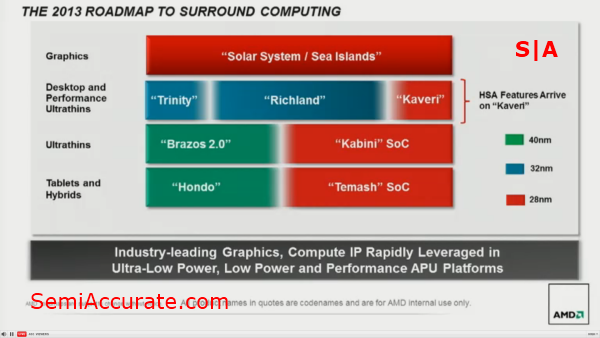
3) AMD is focusing its efforts on HSA and compute. GCN was designed to be a well-rounded GPU for both of these purposes, not only games. The Titan will be a dog for OpenCL and DirectCompute. The upside for NV is the industry hardly uses these features for now. The downside for AMD is that they bet too early on these features and the industry is far behind in their adoption.
4) AMD publicly stated that they have no interest whatsoever to pursue low volume design wins. With Titan's launch rumored at just 10,000 units, AMD has better things to do than waste hundreds of millions designing a 500-550mm2 die GPU that less than 0.1% of GPU consumers will buy. It doesn't make any financial sense. For NV it's about selling K20X scrap rather than throwing it out completely. The Titan for NV is also about building brand equity and reinforcing the idea that they are a class leader in graphics. After-all, AMD is primarily a CPU/APU/server company (in Q4 alone AMD's CPU computing division lost more than than their entire graphics division made in 2-3 years). Contrast this with NV which is primarily focused on visuals and graphics, only recently having expanded into other markets with Tegra, which now comprises 30% of their revenue. They have done so because the GPU market is hardly growing.
http://www.brightsideofnews.com/news/2013/2/13/nvidia-geforce-titan-launches-february-18th2c-2013-loses-to-gtx-6902c-amd-hd-7990.aspx
5) Even when AMD launched HD5850-5870 and completely dominated NV for 6 months, it hardly made an impact on their profitability. Then when HD7970 launched and had class leading performance for 2.5 months, it hardly mattered. This is more evidence if anything that these high-end GPUs do not really matter. Most of the GPU sales happen in the $100-250 price segment, not in the $400-500 ones and definitely not in the $800+ levels.
Nvidia's own GPU breakdown shows that very few people buy GPUs above $199 level. The amount of total GPUs that are sold in the $400+ level is less than 5% of NV's/AMD's total discrete GPU sales.

6) The high-performance OEM market for companies like HP/ Dell / Lenovo also shows the picture clearly. Less than 7% of all desktop PCs sold are high-end systems, using at minimum a Core i5 or FX8000 series CPUs. The definition for this price segment is "Premium prices in the range of $1000 and up are usual in this category, and towers and minitowers are the most common form-factors. Processors used here include Intel’s Core i7, Core i5 or AMD’s FX and A10 chips."

http://www.xbitlabs.com/news/other/display/20121108145442_High_End_Personal_Computers_Account_for_Less_Than_10_of_PC_Market_Report.html
7) Rumors keep hinting that the design wins for PS4/720 are not just licensing of AMD's graphics IP but apparently AMD may have secured the delivery of actual chips that will go inside those consoles. The result is this new product stream (IPs and Other) may account for 20-40% of their total revenue by Q4 2013. It's a lot more strategic and financially lucrative to focus on delivering on these contracts to Sony and MS (not to mention the risks and obligations), rather than spending millions of dollars in a very highly competitive/contested $500+ discrete GPU market. Since NV lost the design wins for all 3 next gen consoles, they have to make up their profits somewhere, which ultimate meant raising the price of their products (GK104 is really a mid-range GTX560Ti successor but NV priced it at $499).
So why would AMD waste millions of dollars pulling a similar PR stunt as the Titan when the Titan:
1) Will hardly matter for NV in terms of making $, but it makes sense for them instead of throwing out K20X scrap;
2) Changes nothing about AMD still retaining class-leading performance and price/performance on the desktop at nearly every level from $100 to $500;
3) Misses the point that AMD lost the most market share in the mobile space, not desktop space, which suggests AMD's greatest area where NV beat them was GTX600M parts (NV reportedly secured 300+ design wins with Kepler while AMD dropped the ball refusing to do custom design wins and go aggressively after the mobile OEM markets).
No matter how you slice it, the Titan is an amazing enthusiast card, but overall, it means squat for the graphics market.
P.S. And finally even if you are a serious enthusiast (i.e., you don't mind tinkering), you will think twice or three times before wasting $900 on a Titan because 3x HD7970s make $250 a month bitcoin mining (!). For those who research bitcoin mining, you can make $ on 3x $350 HD7970s in the foreseable future. The Titan still seems like the most financially irresponsible product to purchase since it will be slower and will depreciate over the next 12 months, making $0 in the process towards next generation 20nm upgrade path. When HD7970s are fully paid off and will have made $1000-1,500 towards the next HD8970 x 3 upgrade, in that context the Titan doesn't look so hot.





















 .
.