
By using this site, you agree to our Privacy Policy and our Terms of Use. Close

Forums - Politics - Putin: US is economic parasite on the global economy

Viper1 said:
richardhutnik said:
Viper1 said:

You go try that.  Let us know how that turned out.  The rest of us will be taking bets on the future of your employment.

Well, the word is that businesses always are able to pass on new taxes, that shrink their profitability, in the form of new prices.  Why wouldn't it be any different for employees?  Wait, maybe businesses aren't able to pass on new taxes in the form of increased prices, due to the marketplace preventing them from raising prices.

The higher price doesn't shrink their profit margins unelss they don't raise the price an equivelant to match the higher tax.  And if they did dip into their profit margins, investors would drop stock pretty damn fast.

As for employees demanding a higher pay to offset an increase in income tax, go ahead and try that one.   Keep in mind that it wasn't your employer that raised your income tax so I doubt they'll be sympathetic enough to give you a raise.   Just also keep in mind they may raise prices to compensate for the higher employee pay.  And also, be sure that the pay raise doesn't bump you into a higher tax bracket...you'd actually make less money then.

And the free market doesn't prevent anyone from raising prices, it just ensures that lower prices are in their best interest. 

Supply and demand, and supply and demand ALONE determines what sets prices, nothing else.  A business, if they can get away with charging more, will do this.  Same thing goes with employees and so on.  Doesn't matter if college education goes up, people can't get more money, if the market doesn't allow it.  Doesn't matter either if your cost of gas goes up.  Same thing with taxes.  Unless it is applied to everyone evenly across the system, like you see in sales tax, it may ormay not show up in higher prices.  And your comment about moving into a higher tax bracket means you get less money is BS.  You get more money, just the rate you get it decreases.  And in business, people will hustle, irregardless of what the rate is, because you always fight to maintain a profit, and you can never tell tomorrow what is going on.

What happens, if you want to argue about increase in taxes causing a rise in prices, ONLY if the rise in taxes causes companies to go out of business, and there is less supply.  At that point, prices will go up, as supply goes down.  Otherwise, businesses have to find ways to increase profits, that doesn't affect their operations and ability to make money.



Around the Network
richardhutnik said:
Viper1 said:

The higher price doesn't shrink their profit margins unelss they don't raise the price an equivelant to match the higher tax.  And if they did dip into their profit margins, investors would drop stock pretty damn fast.

As for employees demanding a higher pay to offset an increase in income tax, go ahead and try that one.   Keep in mind that it wasn't your employer that raised your income tax so I doubt they'll be sympathetic enough to give you a raise.   Just also keep in mind they may raise prices to compensate for the higher employee pay.  And also, be sure that the pay raise doesn't bump you into a higher tax bracket...you'd actually make less money then.

And the free market doesn't prevent anyone from raising prices, it just ensures that lower prices are in their best interest. 

Supply and demand, and supply and demand ALONE determines what sets prices, nothing else.  A business, if they can get away with charging more, will do this.  Same thing goes with employees and so on.  Doesn't matter if college education goes up, people can't get more money, if the market doesn't allow it.  Doesn't matter either if your cost of gas goes up.  Same thing with taxes.  Unless it is applied to everyone evenly across the system, like you see in sales tax, it may ormay not show up in higher prices.  And your comment about moving into a higher tax bracket means you get less money is BS.  You get more money, just the rate you get it decreases.  And in business, people will hustle, irregardless of what the rate is, because you always fight to maintain a profit, and you can never tell tomorrow what is going on.

What happens, if you want to argue about increase in taxes causing a rise in prices, ONLY if the rise in taxes causes companies to go out of business, and there is less supply.  At that point, prices will go up, as supply goes down.  Otherwise, businesses have to find ways to increase profits, that doesn't affect their operations and ability to make money.

You are kind of all over the board here making it hard to follow what you are trying to get at.  So I'll just cover a couple of points.

1. Supply and demand are one of many factors that determine price.  To be certain, it's a big one but by no means is it the sole qualifier for prices.

2. I too called it BS when I was younger and worked extra hard on some overtime only to see I was bumped into a higher tax bracket and my net was less than what I made the week before without overtime.   My comment refered to those right on those bracket borders.  Sure, if the raise is high enough to offset the increased taxes, then you'd make more.


The rEVOLution is not being televised

Viper1 said:
richardhutnik said:
Viper1 said:

The higher price doesn't shrink their profit margins unelss they don't raise the price an equivelant to match the higher tax.  And if they did dip into their profit margins, investors would drop stock pretty damn fast.

As for employees demanding a higher pay to offset an increase in income tax, go ahead and try that one.   Keep in mind that it wasn't your employer that raised your income tax so I doubt they'll be sympathetic enough to give you a raise.   Just also keep in mind they may raise prices to compensate for the higher employee pay.  And also, be sure that the pay raise doesn't bump you into a higher tax bracket...you'd actually make less money then.

And the free market doesn't prevent anyone from raising prices, it just ensures that lower prices are in their best interest. 

Supply and demand, and supply and demand ALONE determines what sets prices, nothing else.  A business, if they can get away with charging more, will do this.  Same thing goes with employees and so on.  Doesn't matter if college education goes up, people can't get more money, if the market doesn't allow it.  Doesn't matter either if your cost of gas goes up.  Same thing with taxes.  Unless it is applied to everyone evenly across the system, like you see in sales tax, it may ormay not show up in higher prices.  And your comment about moving into a higher tax bracket means you get less money is BS.  You get more money, just the rate you get it decreases.  And in business, people will hustle, irregardless of what the rate is, because you always fight to maintain a profit, and you can never tell tomorrow what is going on.

What happens, if you want to argue about increase in taxes causing a rise in prices, ONLY if the rise in taxes causes companies to go out of business, and there is less supply.  At that point, prices will go up, as supply goes down.  Otherwise, businesses have to find ways to increase profits, that doesn't affect their operations and ability to make money.

You are kind of all over the board here making it hard to follow what you are trying to get at.  So I'll just cover a couple of points.

1. Supply and demand are one of many factors that determine price.  To be certain, it's a big one but by no means is it the sole qualifier for prices.

2. I too called it BS when I was younger and worked extra hard on some overtime only to see I was bumped into a higher tax bracket and my net was less than what I made the week before without overtime.   My comment refered to those right on those bracket borders.  Sure, if the raise is high enough to offset the increased taxes, then you'd make more.


That... shouldn't happen though.

Income tax is a gradiant.

You pay zero income tax on the first 10,000 or so, no matter who you are, paying incresed tax rates, only on the amount you make past the bracket.


Kasz216 said:
Viper1 said:
richardhutnik said:
Viper1 said:

The higher price doesn't shrink their profit margins unelss they don't raise the price an equivelant to match the higher tax.  And if they did dip into their profit margins, investors would drop stock pretty damn fast.

As for employees demanding a higher pay to offset an increase in income tax, go ahead and try that one.   Keep in mind that it wasn't your employer that raised your income tax so I doubt they'll be sympathetic enough to give you a raise.   Just also keep in mind they may raise prices to compensate for the higher employee pay.  And also, be sure that the pay raise doesn't bump you into a higher tax bracket...you'd actually make less money then.

And the free market doesn't prevent anyone from raising prices, it just ensures that lower prices are in their best interest. 

Supply and demand, and supply and demand ALONE determines what sets prices, nothing else.  A business, if they can get away with charging more, will do this.  Same thing goes with employees and so on.  Doesn't matter if college education goes up, people can't get more money, if the market doesn't allow it.  Doesn't matter either if your cost of gas goes up.  Same thing with taxes.  Unless it is applied to everyone evenly across the system, like you see in sales tax, it may ormay not show up in higher prices.  And your comment about moving into a higher tax bracket means you get less money is BS.  You get more money, just the rate you get it decreases.  And in business, people will hustle, irregardless of what the rate is, because you always fight to maintain a profit, and you can never tell tomorrow what is going on.

What happens, if you want to argue about increase in taxes causing a rise in prices, ONLY if the rise in taxes causes companies to go out of business, and there is less supply.  At that point, prices will go up, as supply goes down.  Otherwise, businesses have to find ways to increase profits, that doesn't affect their operations and ability to make money.

You are kind of all over the board here making it hard to follow what you are trying to get at.  So I'll just cover a couple of points.

1. Supply and demand are one of many factors that determine price.  To be certain, it's a big one but by no means is it the sole qualifier for prices.

2. I too called it BS when I was younger and worked extra hard on some overtime only to see I was bumped into a higher tax bracket and my net was less than what I made the week before without overtime.   My comment refered to those right on those bracket borders.  Sure, if the raise is high enough to offset the increased taxes, then you'd make more.


That... shouldn't happen though.

Income tax is a gradiant.

You pay zero income tax on the first 10,000 or so, no matter who you are, paying incresed tax rates, only on the amount you make past the bracket.

Don't forget FICA and Medicare.  State too, if applicable.   There are times you can cross brackets and get hit with a much higher tax than with pay just $100 or so less.  My wife and I were both hit with a few times back then.


The rEVOLution is not being televised

Viper1 said:
Kasz216 said:
Viper1 said:
richardhutnik said:
Viper1 said:

The higher price doesn't shrink their profit margins unelss they don't raise the price an equivelant to match the higher tax.  And if they did dip into their profit margins, investors would drop stock pretty damn fast.

As for employees demanding a higher pay to offset an increase in income tax, go ahead and try that one.   Keep in mind that it wasn't your employer that raised your income tax so I doubt they'll be sympathetic enough to give you a raise.   Just also keep in mind they may raise prices to compensate for the higher employee pay.  And also, be sure that the pay raise doesn't bump you into a higher tax bracket...you'd actually make less money then.

And the free market doesn't prevent anyone from raising prices, it just ensures that lower prices are in their best interest. 

Supply and demand, and supply and demand ALONE determines what sets prices, nothing else.  A business, if they can get away with charging more, will do this.  Same thing goes with employees and so on.  Doesn't matter if college education goes up, people can't get more money, if the market doesn't allow it.  Doesn't matter either if your cost of gas goes up.  Same thing with taxes.  Unless it is applied to everyone evenly across the system, like you see in sales tax, it may ormay not show up in higher prices.  And your comment about moving into a higher tax bracket means you get less money is BS.  You get more money, just the rate you get it decreases.  And in business, people will hustle, irregardless of what the rate is, because you always fight to maintain a profit, and you can never tell tomorrow what is going on.

What happens, if you want to argue about increase in taxes causing a rise in prices, ONLY if the rise in taxes causes companies to go out of business, and there is less supply.  At that point, prices will go up, as supply goes down.  Otherwise, businesses have to find ways to increase profits, that doesn't affect their operations and ability to make money.

You are kind of all over the board here making it hard to follow what you are trying to get at.  So I'll just cover a couple of points.

1. Supply and demand are one of many factors that determine price.  To be certain, it's a big one but by no means is it the sole qualifier for prices.

2. I too called it BS when I was younger and worked extra hard on some overtime only to see I was bumped into a higher tax bracket and my net was less than what I made the week before without overtime.   My comment refered to those right on those bracket borders.  Sure, if the raise is high enough to offset the increased taxes, then you'd make more.


That... shouldn't happen though.

Income tax is a gradiant.

You pay zero income tax on the first 10,000 or so, no matter who you are, paying incresed tax rates, only on the amount you make past the bracket.

Don't forget FICA and Medicare.  State too, if applicable.   There are times you can cross brackets and get hit with a much higher tax than with pay just $100 or so less.  My wife and I were both hit with a few times back then.

FICA and Medicare aren't gradiant?  Had no idea, that's stupid.


Around the Network
Viper1 said:
AnthonyW86 said:
Time to raise those taxes, it's the only way. Taxes revenue off the U.S. is only about 25% of GDP, while most other developed countries like Germany, Great Brittain etc. are at around 40% GDP.(with the exeption of Japan). Based on the U.S. GDP of 14.7 trillion a year(yes their public debt is now 100% of their GDP) that difference of taxe revenue acounts for 2 trillion A YEAR. I know those two can't be swapped one on one that easily but it's clear it is something the government has to work on. Because a higher taxe revenue combined with the defense budget cut is really all they need to prevent the debt from increasing.

US corporate taxes are the highest in the world to make up the difference.  And do you really want to tax people in the middle of a recession?  Yeah, that'll make their lives easier.

Government is struggling to pay bills.
People are struggling to pay bills.

If the government can increase my taxes to pay their bills, can I hit up Uncle Sam for some money to pay mine?

That's not true, the taxe revenue number for the U.S. includes taxes at all levels, including corporate taxes. So taxe revenue overall of the U.S. really is alot lower compared to most other developed countries. And i was more thinking in the range of sales/consumption taxes. For example from what i know VAT averages around 6% in the U.S. compared to 16%-21% here in Western Europe, with the tax at 6% for primary needs like food and drinks(alcoholic drinks excluded) to relief the lowest incomes. These taxes make sense since overconsumptiom is one of the reasons the U.S. has such a high public debt in the first place.

Actually the taxe rate on ''damaging'' goods like alcohol in the U.S. is remarkebly low. For example here in the Netherlands the taxerate on alcoholic drinks is 19%(VAT) plus an additional taxes ranging from €0.33 per liter for beer to €5,26 per liter on strong alcohol(Great Brittian is at € 10,00 per liter). Taxes like these make sense because these product are damaging to your health, so cutting consumption means cutting on health expenses aswell. There are even countries with a junkfood taxe.


AnthonyW86 said:
Viper1 said:
AnthonyW86 said:
Time to raise those taxes, it's the only way. Taxes revenue off the U.S. is only about 25% of GDP, while most other developed countries like Germany, Great Brittain etc. are at around 40% GDP.(with the exeption of Japan). Based on the U.S. GDP of 14.7 trillion a year(yes their public debt is now 100% of their GDP) that difference of taxe revenue acounts for 2 trillion A YEAR. I know those two can't be swapped one on one that easily but it's clear it is something the government has to work on. Because a higher taxe revenue combined with the defense budget cut is really all they need to prevent the debt from increasing.

US corporate taxes are the highest in the world to make up the difference.  And do you really want to tax people in the middle of a recession?  Yeah, that'll make their lives easier.

Government is struggling to pay bills.
People are struggling to pay bills.

If the government can increase my taxes to pay their bills, can I hit up Uncle Sam for some money to pay mine?

That's not true, the taxe revenue number for the U.S. includes taxes at all levels, including corporate taxes.

Actually that number DOESN'T include all US taxes.  They only count Federal taxes.  For example that VAT you are talking about (which isn't a vat.) is a State Level tax not included in the number.

So are State property taxes... and a number of other taxes states and counties use... such as Beer taxes, cigarette taxes, various other taxes.


The real number is higher.


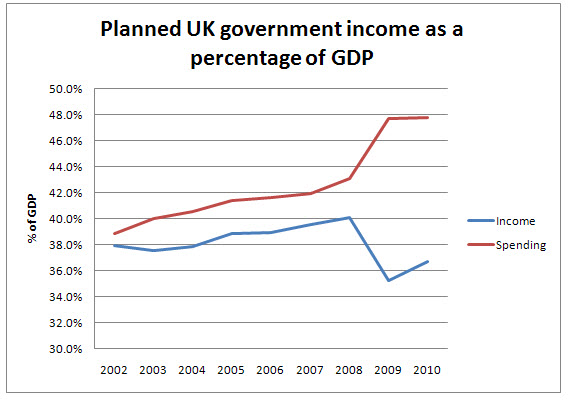
Looks around 33%-34% or so right... now lets look at what the UK's planned income is....


About 37%.


Is tax revenue in the US REALLY too low, espeiecally considering the whole, no unisveral healthcare and other socialized benefits the UK has?  Heck in 09 from the two graphs we may have overlapped the UK.


AnthonyW86 said:
Viper1 said:
AnthonyW86 said:
Time to raise those taxes, it's the only way. Taxes revenue off the U.S. is only about 25% of GDP, while most other developed countries like Germany, Great Brittain etc. are at around 40% GDP.(with the exeption of Japan). Based on the U.S. GDP of 14.7 trillion a year(yes their public debt is now 100% of their GDP) that difference of taxe revenue acounts for 2 trillion A YEAR. I know those two can't be swapped one on one that easily but it's clear it is something the government has to work on. Because a higher taxe revenue combined with the defense budget cut is really all they need to prevent the debt from increasing.

US corporate taxes are the highest in the world to make up the difference.  And do you really want to tax people in the middle of a recession?  Yeah, that'll make their lives easier.

Government is struggling to pay bills.
People are struggling to pay bills.

If the government can increase my taxes to pay their bills, can I hit up Uncle Sam for some money to pay mine?

That's not true, the taxe revenue number for the U.S. includes taxes at all levels, including corporate taxes. So taxe revenue overall of the U.S. really is alot lower compared to most other developed countries. And i was more thinking in the range of sales/consumption taxes. For example from what i know VAT averages around 6% in the U.S. compared to 16%-21% here in Western Europe, with the tax at 6% for primary needs like food and drinks(alcoholic drinks excluded) to relief the lowest incomes. These taxes make sense since overconsumptiom is one of the reasons the U.S. has such a high public debt in the first place.

Actually the taxe rate on ''damaging'' goods like alcohol in the U.S. is remarkebly low. For example here in the Netherlands the taxerate on alcoholic drinks is 19%(VAT) plus an additional taxes ranging from €0.33 per liter for beer to €5,26 per liter on strong alcohol(Great Brittian is at € 10,00 per liter). Taxes like these make sense because these product are damaging to your health, so cutting consumption means cutting on health expenses aswell. There are even countries with a junkfood taxe.

Did I not just say "corporate tax" is the highest in the world? 

http://upload.wikimedia.org/wikipedia/commons/thumb/3/36/Income_Taxes_By_Country.svg/800px-Income_Taxes_By_Country.svg.png

And if you include the state taxes, personal income tax for US citizens can be as high as the more socialized nations.  Live inthe wrong state and make too much money, and you get hit with 45% worth of income tax.

Now combine those 2 and you can see we get taxed (depending on the circumstance) with more income/revenue taxing that any other nation on Earth. 

I'll grant our sales tax (what Eurpeans call VAT) is usually lower.  And I too would much prefer we moved to a consumption tax system.


The rEVOLution is not being televised