By using this site, you agree to our Privacy Policy and our Terms of Use. Close

Forums - General - How effective are the Bush tax cuts at creating jobs?

Kasz216 said:
richardhutnik said:
HappySqurriel said:

This analysis says nothing because there are far too many factors that haven't been accounted for; and the timeline is too short with arbitrary start and end points. To understand what I mean just consider the real-estate bubble that began inflating in the Clinton years and continued through the Bush years, and finally burst right at the end of G.W Bush's last term; there is no reference to how many jobs were "created" or crowded out by this bubble, and you have provided no argument for the level of influence Bush's tax cut policy made in isolation from this bubble.


I believe the real estate bubble happened after the dotcom bubble, as money began to seek out the next investment opportunity and piled into the real estate sector with far too much funds.  This then fed on itself.

Anyhow, in regards to this, there is a question, and it is fundamental to economics on where the money should go, to handle situations that aren't in anyone's control.

Actually the real estate bubble started during the dotcom bubble.

It accelerated after the dotcom bubble burst actually.  One needs to see when real estate prices greatly exceeded inflation rate prices to see when it began.  I could google it, but maybe someone else should.  I had been busy googling Bush tax cuts and job creation.  I did find this one article that listed a number of reasons on why they were disasterous:

http://crooksandliars.com/jon-perr/10-epic-failures-of-the-bush-tax-cuts

It would be good if people can find something in support of them.  Not just say, "Common sense dictates" because as we see now, there are NUMEROUS other factors that impact job creation or job loss.


Around the Network
richardhutnik said:
Kasz216 said:
richardhutnik said:
HappySqurriel said:

This analysis says nothing because there are far too many factors that haven't been accounted for; and the timeline is too short with arbitrary start and end points. To understand what I mean just consider the real-estate bubble that began inflating in the Clinton years and continued through the Bush years, and finally burst right at the end of G.W Bush's last term; there is no reference to how many jobs were "created" or crowded out by this bubble, and you have provided no argument for the level of influence Bush's tax cut policy made in isolation from this bubble.


I believe the real estate bubble happened after the dotcom bubble, as money began to seek out the next investment opportunity and piled into the real estate sector with far too much funds.  This then fed on itself.

Anyhow, in regards to this, there is a question, and it is fundamental to economics on where the money should go, to handle situations that aren't in anyone's control.

Actually the real estate bubble started during the dotcom bubble.

It accelerated after the dotcom bubble burst actually.  One needs to see when real estate prices greatly exceeded inflation rate prices to see when it began.  I could google it, but maybe someone else should.  I had been busy googling Bush tax cuts and job creation.  I did find this one article that listed a number of reasons on why they were disasterous:

http://crooksandliars.com/jon-perr/10-epic-failures-of-the-bush-tax-cuts

It would be good if people can find something in support of them.  Not just say, "Common sense dictates" because as we see now, there are NUMEROUS other factors that impact job creation or job loss.


I did?

You know, the fact that the second round of tax cuts were followed by lowered unemployment?

And the fact that in general that's been the case for taxcuts down the line.


richardhutnik said:
HappySqurriel said:

This analysis says nothing because there are far too many factors that haven't been accounted for; and the timeline is too short with arbitrary start and end points. To understand what I mean just consider the real-estate bubble that began inflating in the Clinton years and continued through the Bush years, and finally burst right at the end of G.W Bush's last term; there is no reference to how many jobs were "created" or crowded out by this bubble, and you have provided no argument for the level of influence Bush's tax cut policy made in isolation from this bubble.


I believe the real estate bubble happened after the dotcom bubble, as money began to seek out the next investment opportunity and piled into the real estate sector with far too much funds.  This then fed on itself.

Anyhow, in regards to this, there is a question, and it is fundamental to economics on where the money should go, to handle situations that aren't in anyone's control.

You'd be wrong.

The bubble has been around for quite some time. The bubble was created when government, business and people got too greedy and wanted to own more homes than the economy would allow. The bubble started growing due to changes in incentives which were a part of the Community Reinvestment Act, among other things.

It wasn't about money getting invested into real estate, which caused the artificial inflation. It was that the government (along with the investment brokerages that hid the toxic assets, and the public that were greedy and bought houses with no money down) decided to incentivize home ownership for those that, quite frankly, had no business owning a home.

Here's the chart:
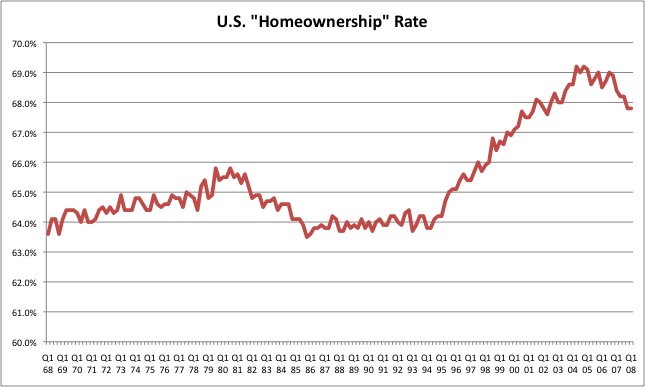
Let me elaborate on why having a too-high home ownership rate is bad:

I am a landlord. I own 2 properties - a single family house, and a 5-unit apartment complex. I plan on buying more in the future, should my funds allow. The thing I've learned is that there are simply a lot of people that do stupid things, and are not capable of home ownership - either due to poor financial management, bankruptcy, lack of income, or otherwise. If the government, banks, or anyone tries to artificially inflate the number of people owning a home, they place an undue burden on the number of people at risk for bankruptcy, as the cost of home ownership rises as supply falls, which causes price to rise, thus requiring more money become comitted to owning a home.

Comparatively, renting is an outlet for people that cannot own. Unfortunately, as a landlord, I've run into MANY people that couldn't own a home, or even be good renters...Yet I know that some of these people wound up getting loans to buy houses that were too large or costly for their sporadic income or poor financial management skills.

I don't know where the rate of 'natural' home ownership lies, but I do know that having it rise by 5% over a 10 year period is a scary thing, given that the median has been around 64-65% for the past 50 years.



Back from the dead, I'm afraid.

I think Warren Buffet said it best recently: some rich people are going to bitch about lower taxes and promote the trickle-down myth endlessly. It's stupid to listen to them, let the cuts drop.


He said it, not me (though i paraphrased rather liberally), but i agree with his sentiment.


It's an interesting crossroads for the Republicans. Time to put up or shut the hell up about deficits


Monster Hunter: pissing me off since 2010.

Mr Khan said:

I think Warren Buffet said it best recently: some rich people are going to bitch about lower taxes and promote the trickle-down myth endlessly. It's stupid to listen to them, let the cuts drop.


He said it, not me (though i paraphrased rather liberally), but i agree with his sentiment.


It's an interesting crossroads for the Republicans. Time to put up or shut the hell up about deficits


... and what is Warren Buffet's effective tax rate? As a percentage of his earnings I bet he pays less than you do.


Around the Network
HappySqurriel said:
Mr Khan said:

I think Warren Buffet said it best recently: some rich people are going to bitch about lower taxes and promote the trickle-down myth endlessly. It's stupid to listen to them, let the cuts drop.


He said it, not me (though i paraphrased rather liberally), but i agree with his sentiment.


It's an interesting crossroads for the Republicans. Time to put up or shut the hell up about deficits


... and what is Warren Buffet's effective tax rate? As a percentage of his earnings I bet he pays less than you do.

He specifically stated this, and said it needed to be dealt with.  He argured taxes should be raised on the rich to address this issue.  Now, should people fault Buffet for playing by the rules and doing this for himself, and thus say that, because he does, people shouldn't listen to him saying taxes should be raised on the rich?


dunno001 said:

Well, I understand the theory behind it- give tax cuts to the rich, and they'll have more disposable income to hire more workers. Problem is, in practice, this doesn't work. They bitch and moan about Obama spending $X to create Y jobs, when the numbers for what actually trickle down in tax cuts for the rich into (lower paying) jobs are about the same.

So no, they're not effective at creating jobs. And you've got it right- the conservatives are all about big business, and screwing over the middle class to give the rich more money. Rather than helping the working middle class, they're going to stick to giving the rich money or nothing. The rich are going to cut jobs because of the higher taxes on them! No, they're going to shed jobs because the middle class has less to spend on disposable items! And by also cutting the programs that help the lower classes pay for extra things, they're going to get a double-whammy, furthering the spread between the rich and the poor...


In short, they didn't create jobs. But we will lose jobs as people have less to spend in general- all to try to give more to the rich.


im always impressed when dunno makes a post and this time is no different; couldn't have said it better if i said it myself.

the bill will never make it pass the senate


richardhutnik said:
HappySqurriel said:
Mr Khan said:

I think Warren Buffet said it best recently: some rich people are going to bitch about lower taxes and promote the trickle-down myth endlessly. It's stupid to listen to them, let the cuts drop.


He said it, not me (though i paraphrased rather liberally), but i agree with his sentiment.


It's an interesting crossroads for the Republicans. Time to put up or shut the hell up about deficits


... and what is Warren Buffet's effective tax rate? As a percentage of his earnings I bet he pays less than you do.

He specifically stated this, and said it needed to be dealt with.  He argured taxes should be raised on the rich to address this issue.  Now, should people fault Buffet for playing by the rules and doing this for himself, and thus say that, because he does, people shouldn't listen to him saying taxes should be raised on the rich?


Except how do you tax the rich?

Progressive income tax schemes don't impact them they impact high income earners who tend to be upper middle class business owners; also known as the individuals who are responsible for most of the job creation within the economy.

Capital Gains taxes impact investment and hurt individuals who have lots of wealth but little income; also known as retired people.


The real solution is to stop trying to improve outcomes through taxation, monetary or fiscal policy; and to have a reasonable taxation rate justified by effective governmental services.


One word: Reaganomics. Look it up.


HappySqurriel said:
richardhutnik said:
HappySqurriel said:
Mr Khan said:


Except how do you tax the rich?

Progressive income tax schemes don't impact them they impact high income earners who tend to be upper middle class business owners; also known as the individuals who are responsible for most of the job creation within the economy.

Capital Gains taxes impact investment and hurt individuals who have lots of wealth but little income; also known as retired people.

The real solution is to stop trying to improve outcomes through taxation, monetary or fiscal policy; and to have a reasonable taxation rate justified by effective governmental services.

And this is a problem with the GOP in regards to economic policies I have spoken about.  There is never figuring out what the optimal tax rate is, and the right mix of government services, to optimize how the economy and people will do.  It is ALWAYS cut taxes, irregardless of how it impacts the deficit and proper funding of needed government services.  Even if tax rates got as low as they were under Reagan, that STILL isn't low enough.  At what point do you say they are too low, or low enough, and say they need to be raised, if they need to? 

I had a conversation today with someone running a coordination charity for a number of other charities in the area, speaking about the employment situation.  As it is now, what is going on doesn't work.  Programs don't effectively get people employment.  People can be funded for training programs, but there be no jobs. And businesses are wanting workers that can hit the ground running.  Talking structural problems here.  Would not the answer be in addressing these structural causes, rather than say $X more dollars is needed, or just give more people tax dollars?   The answer could be different in that society needs to do things different collectively, to make things work better.  For all we know, maybe we hit the wall when it has come to how effective currency is as a solution for managing the distribution of goods and services in society.  We also could of hit a place where employment has become so temporary, that it is no longer able to sustain any semblance of sufficient permanency to be able to properly train anyone, particularly if the training needed runs extra long.

So, let's just say that I will agree with a comment that I don't believe the answer to the current economic and employment issues will be solved by the moving of money about differently.