









Shadow1980 said:
Regarding hardware sales, here is the proof you seek:
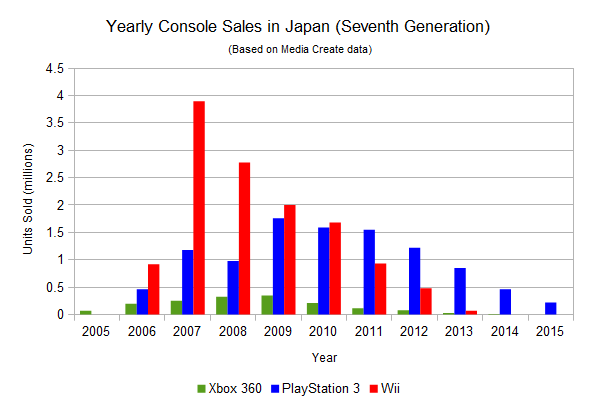
Just two years after its peak, global Wii shipments had declined by 42%. FY2011-12 shipments were 62% lower than they were at its peak. This is a fast decline. The rapid decline is obvious is all regions:
Comparing the Wii to the most popular system from the prior generation, it started off much better than the PS2 did in the U.S. Both systems peaked in their second full calendar year, but overall the Wii declined much faster. In 2011, the Wii sold 55.4% fewer units than it did in 2008, whereas in 2005, the PS2 sold only 35.6% fewer units than it did in 2002. Overall, the Wii sold over nearly 65% of its lifetime sales by the end of its third full calendar year, and 90% of its lifetime total by the end of its fifth year. For the PS2, those numbers were only 48% and 70%. The Wii started off stronger, but it simply didn't have the legs the PS2 did. From their fifth full calendar year to when NPD stopped tracking sales, the PS2 sold over twice as many units as the Wii did. As a consequence the Wii failed to surpass the PS2's lifetime total, even though by time the Wii U came out it was still running surplus over the PS2 (though that surplus was already rapidly shrinking).
By 2009 sales had declined to nearly half of what they were in 2007, and they declined by half yet again by 2011. In fact, in 2011 the Wii was being outsold by the PS3, which, despite peaking in 2009, had a much slower decline. While the PS3 did fail to surpass the Wii, it narrowed its LTD deficit by a significant amount. It was running a deficit of over 5 million in 2010, but that deficit has shrunk to less than 2.3 million thanks to that long tail. This is normal for Nintendo systems. Ever since the N64, Nintendo consoles have had weak legs. They also tend to peak early, being far more front-loaded than PlayStation & Xbox systems. This isn't really a strike against Nintendo. It's simply a necessary consequence of being systems that rely almost entirely on first-party support, support that typically evaporates quite quickly once the system has gotten replaced (and usually starts to slow down even before that as Nintendo starts to shift development priorities for games for the next system's first year). By time it gets to its fourth or fifth full year, every Nintendo home console since the N64 has experienced significant decline from its peak, which has always been no later than its second full calendar year.
|


Thanks for the data, you are the man.
Wyrdness said:
Comparing pro photographers to the majority of consumers is like saying the people who buy the PS4p and Scorpio will still keep the industry a float, gaming platforms however cannot survive that with the AAA culture of the industry as that's a tiny group. Pro cameras are purchased by companies and such gaming platforms however don't have that safety net. |
And where did I say the people that want a dedicated table console are going to be as niche as people that buy pro camera (not only pros buy semi and pro level cameras and lenses)?? All I said is that even if a good portion (that is your and the other guy assumption) of gamers get satisfied with a HH console that doesn't mean it attends all (see the original comment on this) nor that there wouldn't exist a market for table consoles... Consoles more or less would satisfy the gaming need of most people and still PC market still exist.

duduspace11 "Well, since we are estimating costs, Pokemon Red/Blue did cost Nintendo about $50m to make back in 1996"
http://gamrconnect.vgchartz.com/post.php?id=8808363
Mr Puggsly: "Hehe, I said good profit. You said big profit. Frankly, not losing money is what I meant by good. Don't get hung up on semantics"
http://gamrconnect.vgchartz.com/post.php?id=9008994
Azzanation: "PS5 wouldn't sold out at launch without scalpers."


