

Chasesdaddy84 said:
Is this for real? Or are you pulling our leg? It would be really funny if the Wii U is more powerful than the PS4... It would also be a little weird considering it's not possible. Maybe in an alternate universe? lol BUt I agree it's a little more powerful than it's given credit... but it's a much smaller leap over PS3 and 360 than XOne and PS4 are. They are all Next Gen. The PS4 is the unquestioned most powerful, the XOne almost right beside it but a tiny step down and the Wii U holds its own a little ways behind the XOne. It's pretty much just like the PS3, 360, and Wii. Except the Wii U might be closer to the other 2 this gen than the Wii was. I don't understand why we have to debate this anyways. There is already some awesome games for Wii U and they are great looking and fun. Shouldn't it end there? Isn't that enough? |
actualy, the leap from xbone to ps4 is almost the step from wii u to xbone in raw numbers
wii u has about 400 to 550gigaflops, xbone has 1.2 teras and ps4 has 1.8 teras
you can see that wii u is like 600 or 700 gigaflops step away from xbone and xbone is 600 gigaflops step back from ps4
wii u its like the dreamcast or ps2 up againt the gamecube and xbox in raw numbers
but as explained before the true power behind the wiiu and xbone is the tesselation if they use the embeded memory for that, vertex texture fetches can now be stored on edram and so performance improves lots of times
plus, you also save lots of memory
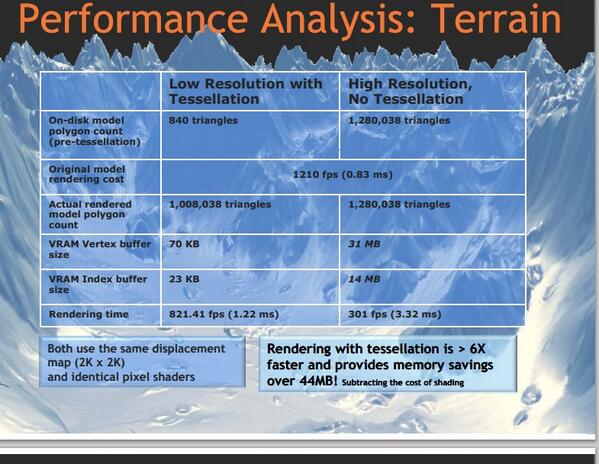
akthough xbox 360 had tesselator, the tesselation was limited back then and also had very few performance
here
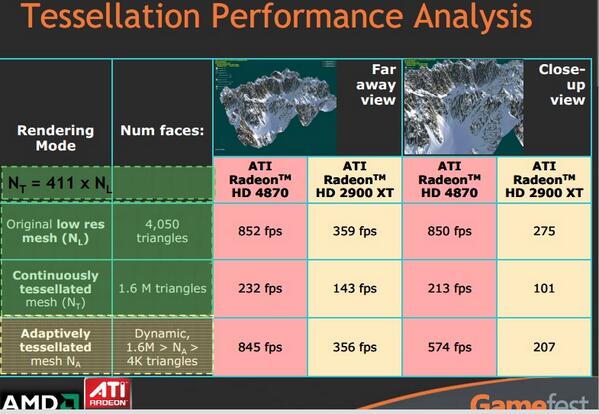
wiiu may have started in the rv770, but obviously since its customized should be on par with the hd5000 or 6000, after all these gpus arent that different to the rv770, in fact are like optimized rv770 with some additional features, but architecture and simd and all stuff remains basically the same, the major changes were removal of interpolators cause amd said they were a perfromance limit in the rv770nd now interpolation is done throug the stream cores, there was an increase on internal memory bandwidth on the gpu, for example L1 texture chaches have about 1 terabyte of bandwidth each(hd4000 had 480GB/s), and there is a l1 texture cache per simd core, also local data shares on rv770 had 1 terabyte of bandwidth and now was increased to 2terabytes of bandwidth on hd5000
here
http://developer.amd.com/wordpress/media/2012/10/WileyAuthoringforTessellation.pdf
"
The first and most obvious benefit of real-time tessellation and
displacement mapping is the dramatic increase in visual
quality. Tessellation in conjunction with displacement mapping
eliminates one of the last hurdles towards achieving cinematic
quality visuals in games.Film has been using this technique
for years in order to provide animators with manageable
meshes to work with during the animation portion of
development while still providing the highest quality results at
render time. This technique eliminates polygonal artifacts and
provides highly detailed, smooth internal and external
silhouettes.
Another slightly less obvious benefit of this technique is the
effect that it has on your memory footprint. Essentially, you
can think of real-time tessellation and displacement mapping
as an effective form of geometry compression. This technique
utilizes the same art assets as conventional rendering with the
only additional storage requirement being the 16 bit
displacement map. If we take the Froblin character as an
example we see that the memory footprint for the low
resolution mesh and 2k x 2k 16 bit displacement map
requiring about 10 megabytes of video memory. This is
compared to the 450 megabytes of video memory that would
be required to render the high resolution Froblin model that
weighs in at around 15 million triangles. So, for just a
modest increase in memory footprint, we are able to
dramatically increase the total polycount and visual detail of
the render mesh when using this technique.
Another less obvious benefit of this technique is in animation
quality. Transforming the low resolution mesh is faster than
attempting to transform the high resolution equivalent. This
means that we get better animation performance. Also, as we
just saw in the previous slide, we are storing exponentially
fewer vertices in video memory. This means that we are able
to store more data per vertex. What this provides us, for
example, is the ability to increase skinning quality by being
able to store more influences per vertex. This would also
allows us to store a much larger library of morph targets for
better facial animation, etc
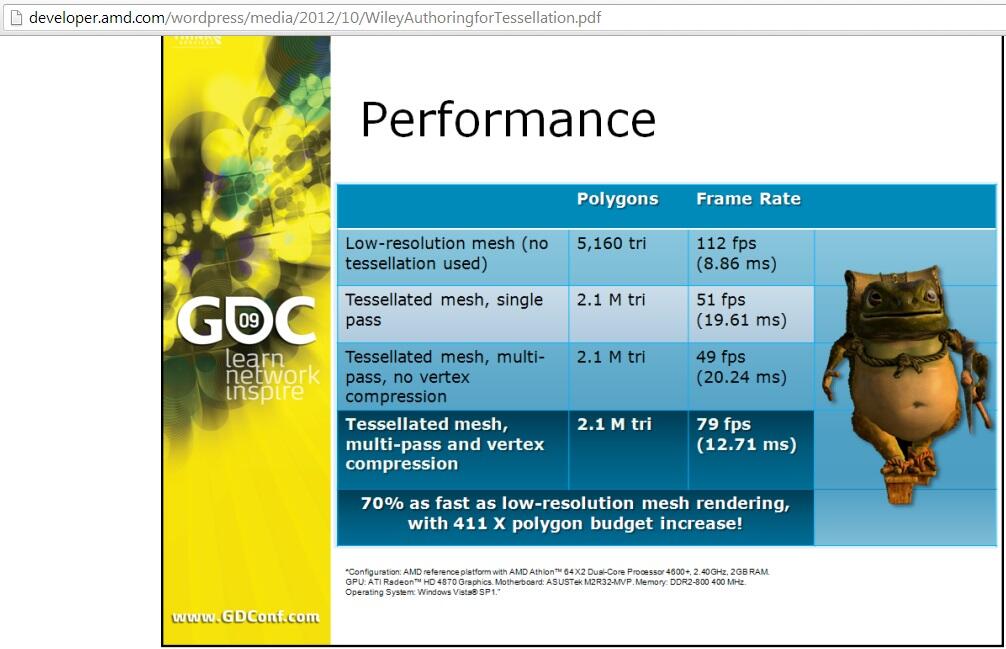
Performanceis yet another benefit of real-time tessellation and displacement mapping.You can see here that when implemented with multipassrendering and vertex compression we are able to render over 400 times as many polygons while only taking a 33 frames per second or 30 percent performance hit when compared to rendering only the corresponding low polygon mesh. That is a pretty good trade off.
"
of course that since micro wants to be as close as possible to the native 1080p, the esram is being squeezed just for framebuffer, 200GB/s of bandwidth, even with the adventage of no refreshing and latecny you still are using to much of the esram for framebuffer close to 1080p
nitnedo on the other hand wants to stay on 720p to both save up gpu power and also use less edram bandwith(563.2GB/s to 1 terabyte of bandwidth) on framebuffer, therefore it can use it for vertex fetch data, tesselation+ dispalcements, etc
JUST HOPE MORE AND MORE GAMES start to take profit on tessealtion for wiiu
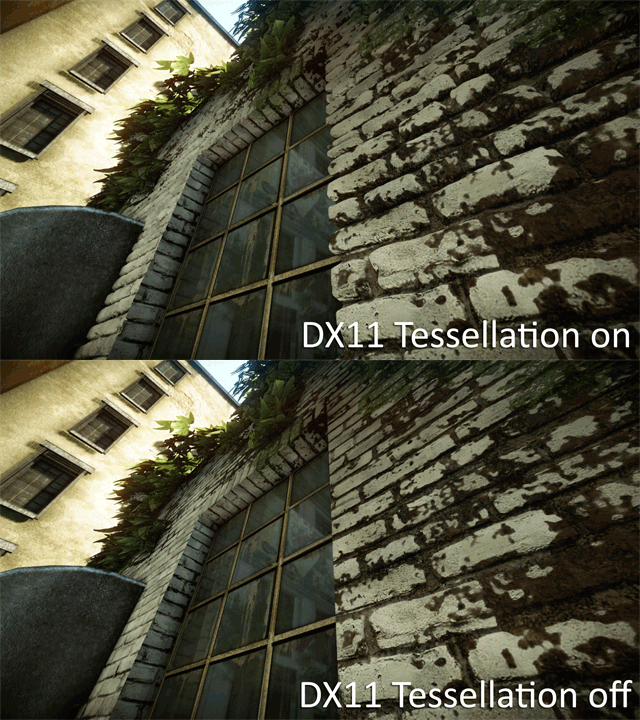


i wonder if mario kart for wiiu uses a bit of tesselation in some areas?

not sure though, but that statue looks really detailed