Aielyn said:
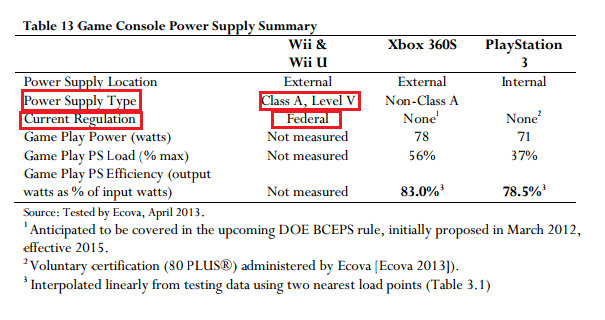
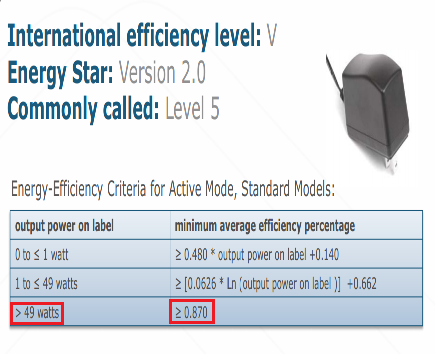
The one part you're not quite comprehending, yet, is that they're saying that it's rated to use UP TO 73 Watts (at the wall), with an efficiency of 87%. It is possible that Nintendo decided to play it safe, and left plenty of buffer between the maximum draw of the system and the output capability of the supply.
Power supplies don't provide a constant level of wattage. The wattage is controlled by the thing drawing the power. In this case, the Wii U draws the power, and the power supply is rated, in effect, to be able to supply up to 63 Watts to the Wii U. The Wii U doesn't have to ever draw that much, and if it draws less, then the power supply simply uses less total power at that point in time. The Wii U doesn't have an extra 20-30 watts flowing into it that it doesn't use.
That being said, those who argue for this not being an important bit of information because of the above facts are (probably wilfully) ignoring the fact that Nintendo are huge on efficiency of design, and wouldn't provide a power supply that is rated for twice the power draw compared to what the Wii U is capable of drawing. They would undoubtedly leave a small buffer, but there's no way that it's a third to a half of the power supply's capability. If the highest the Wii U went were 40 Watts, they'd only supply a 50-55W power supply, not a more expensive 73W power supply. At the very least, this implies that Nintendo wanted to be able to overclock their system, if necessary - more likely, it's simply capable of more than what we've seen so far.
Curiously, I haven't seen any measurements done for any recent games. It would be interesting to see if 3D World has a higher power consumption rate than the launch titles that all the measurements were done for.
|