









| megafenix said:
just look at the difference dude gamecube edram or 1tsram embedded in the gpu gives 10gb/s and thats only for 1 jegabyte
the wiiu edra is packed in the sae die with the gpu just like gaecube had its ebedded emory in the gpu
there is no external bus in the wii u edra with the gpu, the access its straightfowar, just ike xbox 360 rops had full access to the edram 256gb/s since they were on the sae die, the same applies to wii u gpu with the edram, the wii u gpu has full accessto the edram internal bandwidth |

There is always an external bus that connects one group of functional units to another, regardless if they are on the same die or not.
Nintendo would have done the math on this and chosen the most optimal amount of bandwidth, one thing is for sure, it's going to be substantually lower depending on the type of bus they used.
If we get back to internal bandwidth... If it used a hub bus, Nintendo would then be able to optimise bandwidth for each individual unit based on need, that then reduces chip complexity and by extension power.
Ring Busses also introduce latency as data will have to travel around a ring, it's a much longer trip than a road that connects to each individual unit.
For example, AMD had a Ring bus in the Radeon 2900 and Radeon 3800 series, which had obscene amounts of bandwidth to all the individual parts of the GPU, when the Radeon 4800 series launched, AMD dropped the Ring bus and instead opted for a hub bus, the important parts got massive amounts of bandwidth, whilst the less memory hungry units got less bandwidth.
The result is, you still get an increase in performance, without any of the waste.
The chip was then connected to video memory at much lower levels of bandwidth, which then had to travel down a much smaller interconnect to reach System Ram.
As for the Xbox 360, initially the eDRAM wasn't on the same die, the eDRAM had a road that connected all the individual parts of the eDRAM with a 256GB/s bus, it still connected to everything else like the CPU and GPU with a much slower 32GB/s bus however.
When Microsoft moved the eDRAM on-die the bandwidth characteristics didn't actually change for obvious reasons.
This Diagram (from wikipedia) explains it perfectly.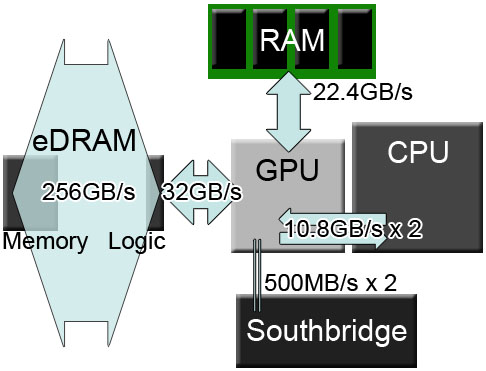
Also, keep in mind that the Radeon 290X with almost 20 teraflops of single precision floating point performance actually only has a 512bit memory bus.
The Geforce 780Ti and nVidia TITAN only has a 384bit external memory bus, neither are slower than the gamecube, in fact! All those cards have more performance in terms of floating point than all the next generation consoles combined.

www.youtube.com/@Pemalite


