Hate to tell you this but, the strongest console never won a generation.
Hate to tell you this but you forgot to put your tin foil hat on this morning, Also the SNES had more power and resources than the Megadrive, despite Sega's marketing spin the Motorola 68000 processor lacked game specific functions present in Nintendo's custom 5A22, despite the M68000 running at twice the speed of the 5A22 the porcessors maximum MIPS was 0.7 apposed to the 5A22's 1.5 MIPS, the overclocked M68000 used in the NeoGeo of the same console generation ran at a maximum 1.25 MIPS, too.
I really wish people would actually do some research before spouting the 'strongest console never won a generation' because it just shows how ill informed they are and makes them sound like absolute nutcases.
I believe Neo Geo was part of that gen and was much more powerful than SNES, not sure if Jaguar, CDi and 3DO were considered 4th gen
I addressed the NeoGeo, the MVS was 4th gen and ran on an unmodified but overclocked M68000 and was capable of 1.25mips running at normal speed or 1.31mips with some software restrictions removed on *some* development software for the AES only, the snes could also display 32,768 colors on screen at any given time, while the neogeo MVS and AES were limited to 4096 due toa 15 bit color space RGP as apposed to the neogeos 12 bit.
So actually, despite being part of the 4th gen, the neogeo wasn't 'much more powerful' than the snes, it wasnt even 'more powerful', the slightly higher ram resources given to the neogeo were there simply to support the slightly larger native resolution of the console, but even here, the maximum resolution of the AES and MVS was 320x224, most games because of TV standards used 304x224 so that everything would display right on most sets, in contrast the SNES ran at 256x224 in progressive scan, and 512 × 478 when interlaced.
Additionally while the neogeo had higher ram amounts available to video memory (largely due to the higher native res), the snes came with 128kb of dram mapped directly to primary bus, benefitting greatly from the custom Ricoh CPU.
People are of course free to cite all the games they want to 'backup' their claims to counter that, but the fact of the matter is, the SNES had the most functional and comprehencive hardware of the 4th gen, despite that, it sold by far the most of the 4th generation consoles - People just wont admit that, even if theyre diehard nintendo fans, because it doesn't gell with their stupid 'most powerful console never won a gen' argument, even though it's a nintendo console that proves their argument wrong.
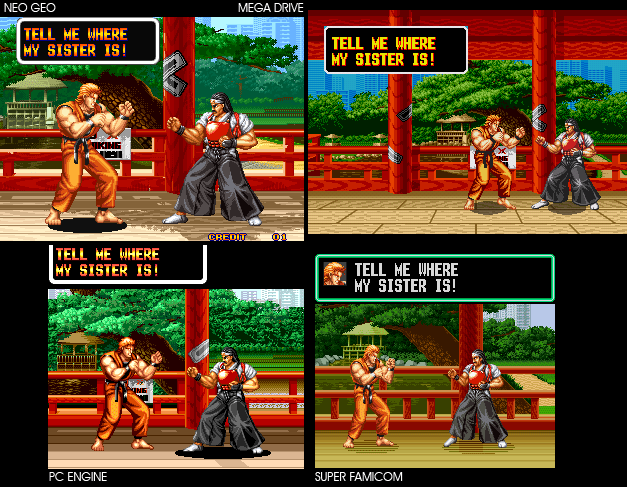
The SNES had some more graphical features but powerwise it was no match for NeoGeo. Games for SNES might look more beautiful due to more colors but comparisons between NeoGeo-games and SNES show that NeoGeo could handle sprites way better:
NeoGeo
Snes
All systems-comparison:
And a Youtube-comparison:
These games were built for the MVS and ported to other systems by SNK, the develop/publisher that released the system, do you honestly think if Sony, Microsoft or Nintendo were to release one of their first party titles on another system of the same gen they'd aim for parity in quality?
As i've mentioned twice now, the overclocked 68000 in the mvs and aes is still not as powerful as the 5A22 in the snes, the zilog 80 doesn't offset this difference, leaving the snes the victor in terms of raw power, larger texture tiling is an offset from a result of the higher texture memory provided for the higher resolutions, a benefit if you will, of which the snes has many the neogeo does not - but the argument is 'the most powerful system has never won a gen', putting the graphics aside, the sound processor, and CPU/GPU solutions in the Snes are more powerful than the neogeo's, in raw form, and that's entirely the point here.
Also, the neogeo wasn't able to do 3d polygons, nor was it able to do transparencies, at all, and instead resorted to checkered solids - snes on the other hand could handle 3d polygons and proper transparencies.