









Aielyn said:
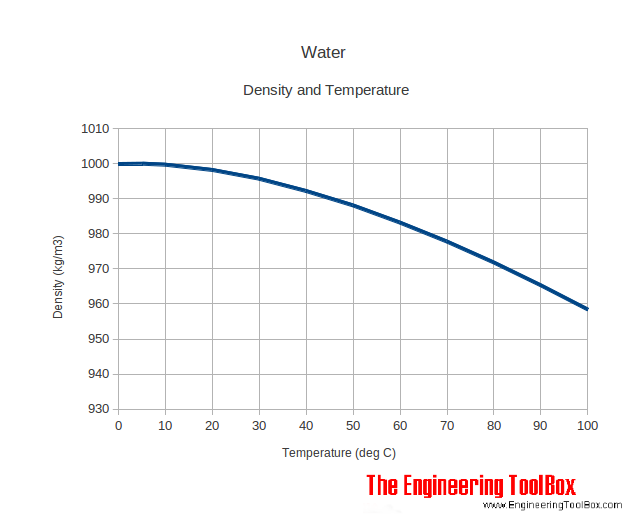
If you don't actually know your physics, please don't make out as though you do. First of all, there's no conservation of energy argument in this situation, because energy isn't being conserved within the system being looked at - there is energy flow into the ice and water from the surrounding air (which isn't being treated as part of the system) in the form of heat. Second of all, water and ice don't have identical densities. The reason why that experiment works is called buoyancy - the ice is floating in the water because it is less dense, and the volume displaced is equal to the volume that an equal mass of water would have (this is Archimedes' principle). Therefore, when the ice melts, it turns to water, and fills exactly that amount of volume. Water is not of constant density. Here's a plot of water density relative to temperature at 1 atmosphere:
The density reaches a maximum at approximately 4 degrees celsius. It then decreases. Note the vertical scale - it drops from about 1000 g/L (or kg/m^3 - two expressions of the same actual unit) to 960 g/L within 100 C. So as a simple approximation, a 2 C increase would reduce the density by somewhere around 0.4 g/L, or 0.04%. Doesn't sound like much, right? But it's a lot more than you think. Estimates of the total water mass of all of the oceans is roughly 1.37 × 10^21 kg. If we pretend that all of the water is at a temperature such that 1000 g/L (note: we're simplifying everything anyway, since the pressure of water deep under the surface will be much higher, and the temperature lower, so the above graph isn't quite accurate for that situation), then that would be a volume of 1.37 × 10^18 m^3. A 2 degree increase in temperature would produce a volume increase to 1.37055 × 10^18 m^3, an increase of 5.5 × 10^14 m^3. The radius of the earth is 6371 km, and thus the surface area is approximately 5.1*10^14 m^2. As such, the increase in water volume would produce a little over a metre of sea level raise, just due to the 2 C increase in temperature. In reality, I'd expect the impact to be somewhat smaller than this - perhaps half a metre, perhaps a tenth of a metre - but considering that the entire sea level rise so far has been just under 20 cm, and is already causing problems, you can't dismiss volume increase due to temperature increase. Anyway, this is why knowledge of mathematics and physics is so important if you want to comment on something like this. |
ALso, i thinkn what that ice cup experiment does NOT demonstrates are all the ice that are on top of mountain that are frozen all year long. Those will run off and flood surrounding areas too!


