









- guardian.co.uk, Wednesday 29 September 2010 05.59 BST
- Article history
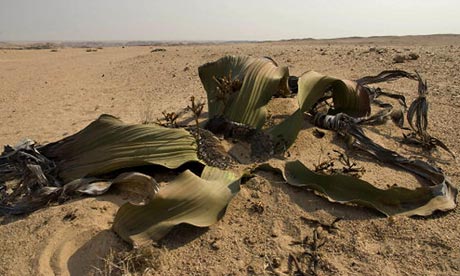 The tree tumbo – which is found in the African desert and can live to more than 1,000 years old – is one of the species identified as at-risk. Photograph: Andrew Mcrobb/PA
One in five of the world's plant species – the basis of all life on earth – are at risk of extinction, according to a landmark study published today.
At first glance, the 20% figure looks far better than the previous official estimate of almost three-quarters, but the announcement is being greeted with deep concern.
The previous estimate that 70% of plants were either critically endangered, endangered or vulnerable was based on what scientists universally acknowledged were studies heavily biased towards species already thought to be under threat.
Today the first ever comprehensive assessment of plants, from giant tropical rainforests to the rarest of delicate orchids, concludes the real figure is at least 22%. It could well be higher because hundreds of species being discovered by scientists each year are likely to be in the "at risk" category.
"We think this is a conservative estimate," said Eimear Nic Lughadha, one of the scientists at Kew Gardens in west London responsible for the project.
The plant study is also considered critical to understanding the level of threat to all the natural world's biodiversity, said Craig Hilton-Taylor of the International Union for the Conservation of Nature (IUCN), which runs the world's offical "red list" of threatened species. "Plants are the basis of life, and unless we know what's happening to plants it has many implications," said Hilton-Taylor.
The results will be presented to world leaders meeting at Nagoya in Japan in October to discuss the world's biodiversity crisis, along with new red lists for vertebrates and several groups of the planet's millions of invertebrate species.
"This is a base point," said Lughadha. "What we do from now is going to lead to the future of plants. We need to challenge the idea that plants are there to be exploited by us, we need to move to a system where we're nurturing plants much more carefully [and] actively taking steps to conserve them."
Politicians and conservation experts will also be told that by far the biggest threat to plants is human – rather than natural – causes, especially intensive agriculture, livestock grazing, logging and infrastructure development.
Caroline Spelman, the environment secretary, who will travel to Japan for the final talks, said the results were deeply troubling. She added: "Plant life is vital to our very existence, providing us with food, water, medicines, and the ability to mitigate and adapt to climate change."
Scientists randomly selected 7,000 species from across the major plant groups as a representative sample of the estimated 380,000-400,000 so far known to science. Of these, 3,000 were found to have too little information to begin making an proper assessment – a result that was expected and so built into the selection process.
The remaining 4,000 species were assessed and the level or risk based on a combination of the absolute number of plants estimated in the wild, the known decline, and the total area in which they are thought to live.
Of the 4,000, 63% were found to be of "least concern", 10% near threatened, 11% vulnerable, 7% endangered and 4% critically endangered. Another 5% were rated "data deficient".
The proportion of plant species deemed at-risk is similar to that of the IUCN's red list for mammals, worse than that for birds (less than 10% at-risk) and better than the number for amphibians (more than a quarter under threat).
Nearly two-thirds of threatened plant species are found in tropical rainforests, five times the proportion for the nearest other habitats – rocky areas, temperate forests and tropical dry forests. This is because of their huge density of biodiversity and the widespread risks of logging and clearance for other agriculture, said analysts.
Previously the red list for plants contained assessments for a greater number of plants – about 12,873 or 3% of known species – but was not considered representative because scientists had focused on at-risk species so that they could get attention and funding for conservation.
The assessment was done using experts and collections at the herbaria at Kew Gardens, the Natural History Museum in London and Missouri Botanical Garden in the US, plus specialist experts from the IUCN


