









Let's use a little sence. First, the current amount of money from accessories and games is not meeting the cost of selling the system. Price cuts have also never made a long term impact. The longest this generation was Sony's first one, but this on eventually fizzeled out, and the cut was from $600. Another one will have less of an impact. The whole goal to cutting the price is to bring in people who wanted the console, but could not afford or want to spend the current (or old) price tag. So, with more and more cuts, the effect is less. I doubt another one will have a large impact.
Huh? Generally speaking the best selling price point for almost every console has been hitting the $200 sweet spot. That would spit in the face of your assumption of the price cut not having a long term impact. I understand the concept of a price cut. The point is $600 was too expensive for people who had money to spend. 400$ is too expensive for most people as well.
This is why $200 is always a hot selling point because people can afford it. Sony has several levels of price cutting it can go through to make it's system more appealing to the consumer.
This may be true, but let's look at a comparison.
http://vgchartz.com/hwcomps.php?weekly=1
As you can see, there has not be a change in the overall slope. The 360 should have a change that is more drastic as it is now at the $200 price tag. How come it's not moving as fast as the Wii, and why is it staying the same compaired to when it was a higher price. Now, 2 years back
http://vgchartz.com/hwcomps.php?cons1=Wii®1=All&cons2=PS3®2=All&cons3=X360®3=All&start=39089&end=39929&weekly=1
Now notice the other two guys to the Wii. The Wii is growing faster despite it never had a price cut.
Here's the things: you put too much on price. Price is not as importaint as you make it out to be. The costumer's wants is what really push this. The PS3 and 360 are not what the consumers want. They want Wiis. This graph shows that. That is why the Wii remains at it's launch price while the other guys have to cut price to stay afloat.
Sure it is. Price isn't though. Consumers would have loved to spend $600 on a PS3 if they had the cash. Unfortunately that's a car payment, mortgage payment, etc for most people. It's viewed as a luxury more then a necessity. The PS3 is viewed as more valuable, I would guarantee it. The Wii is viewed as more desireable though (Much of this is due to price).
Everyone wants a mansion. Does that mean demand is high for mansions even though no one can afford one? No. Now, demand does increase as income increases, but not all goods are effected. Cars are something more people want, but not everyone would buy more cars if they are wealthy (although they may buy better cars). They may buy pool tables, but they might not.
Now what about the PS3. It is clear to me that people will not buy a PS3 if they had the income (unlike a mansion). It not a good people want. However, people bought Wiis for higher prices then PS3s for a longer time. The Wii was out of stock. The Wii is a product people want. "Oh, but that's becuase of it's low price." Not true, people payed a lot for Wiis on Ebay, even up until the next Christmas. The Wii is more along the line of people's values, unlike the PS3. Notice how it's Nintendo making 90% of the growth of the industry. That is not just low price becuase the 360 is cheaper and other consoles have been. I will tell you that a PS3 at $200 would be outsold by a Wii at $300.
Demand on a literal purchasing sense? Ofcourse higher prices mean lower demand. Higher prices don't mean lower demand on what I'd like to call 'Window shopping'. For example, I wanted a nice 57" Samsung HDTV for the longest amount of time. It was just too expensive for me to afford.
My demand was there, I just physically couldn't afford it. If they started selling 57" Samsung's for the same price as a 32" Sony? They would fly off the shelves. Why?
Consumers view the PS3 as that awesome item that's just too expensive for them that they would love to have. This is the advantage that the PS3 has over the Wii/360. It's an advantage that loses it's potency though the longer it prolongs.
You missed the idea behind the demand curve. If the price of TVs went down, then the demand would go up. But there is little demand for the HD consoles. This is why the systems get only small burst from the price drops. The 360 is stilling doing worse then the Wii despite it is $50 higher. Here is a picture explaining it.
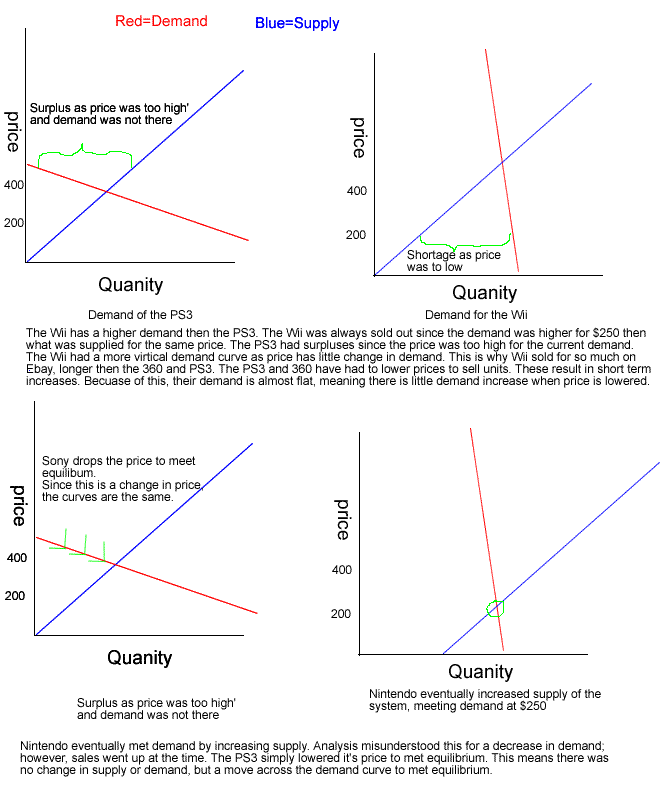
BTW, this is very simplistic. Some people will probaly notice flaws in the graph. It's just to make a point.


