









| appolose said: Confusion I’ve read your response several times and I’m very confused as to what you mean in many cases and what relevancy it has to what I formerly made a point of.
In the course of arguing on epistemology I’ve found that people often develop their own terminology throughout. I’ve done my best to conform to your terminology but right when I think I’ve understood, it seems you bring a new phrase or refer to it a little differently. Like the phrase “the concept of ‘belief within belief’ versus ‘knowledge within belief’.” I already didn’t understand what you meant last time when you were dealing with the difference between knowledge, belief, and input/output. Another example would be: “Looking at it from another angle, such a person would have to reevaluate his position if he followed the same math rules”. The meaning or relevancy to what I said eludes me.
Sophistry Didn’t mean as in insult, sorry it came off that way. Just the status at which I hold such distinctions.
My Fundamental Issue The only thing that seems fairly clear to me in your post is that you do in fact flatly disagree with my fundamental issue that sense data can represent any interpretation. I get this from your statements: 1. “a person, presuming he trusted his input data, would have to reevaluate either the input data or his breakfast plans upon being corrected” 2. “I think we now agree ‘Belief sets exist that can be contradicted by sense data’.” (No I don’t agree… my fundamental point is that sense data doesn’t indicate anything by itself so you’d have to arbitrary choose an interpretation to make it contradict some other belief you’ve taken [for a reason still unknown to me].) 3. “within empiricism the moon is definitely rock. The sense data proves this (under the assumption that sense data is more or less accurate).” 4. “What I'm saying is that your sense data, taken all together, indicate one general picture of the world.”
Maybe starting over with my fundamental issue will get us back on a course.
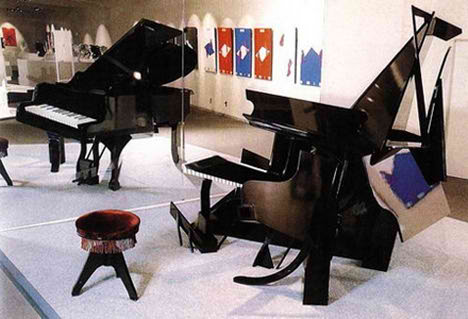
Lets say you see the sense data as shown on the left of this image. What does it represent? Within certain beliefs: If you’re standing at a certain angle of this, it appears to be a piano but when you walk around it, it’s just a jumble of disjointed objects. Both of those interpretation about this particular portion of reality oppose each other.
Sense data is reliable and real in the sense that I think you mean it. But my point has always been that we have no way to obtain the correct interpretation of what it represents by it. No, the sense data does not give us a general “picture” – as you meant that in the sense of the objects represented - it gives us millions.
Looking at that blob of colors a person might believe it represents a real piano (whereas ye philosopher already knows the possibilities of sense data and make no arbitrary judgment from it). The person has this ‘input’ of sense data and he ‘outputs’ a response to it… walking up to sit on what he believes is the bench of the piano and then to play it. But because it’s not a piano and only emitted sense data exactly like a piano, his ‘output’ is not in correspondence with his ‘input’. I call that acting on a false belief, but you may call it something else.
If I find myself experiencing this sense data in my life, a number of possibilities will come to my mind as to what it represents. And it could be any of them. That’s what I mean by “any”… it could mean any of those possibilities. This has no relation to former assumptions (which by introducing, skirt the very question of how they got there). This has no relation to sense data experienced at a later time or former time – which according to the point I’m presenting - would carry the same dilemma anyway. |
"Confusion"
The reason I've used varying terminology is to try to avoid misunderstanding; using different words to convey the same idea lowers the chance IMO that a key phrase will cause misinterpretation of meaning. It would seem that this attempt has failed spectacularly.
What I meant by the math comment was that the person who thought that 4 was the only answer to X times 0 equals 0 according to the rules of mathematics as we know them would have to reevaluate his position based on the fact that his position can be demonstrated to be wrong (that is, at least ONE of the TWO beliefs in his belief set is clearly incorrect as they contradict one another). This is not a rebuttal to your point but (once again) me using your example to illustrate an example of my own.
"Sophistry"
No problem. The first dictionary I checked said it involved deliberate deception, but the second, more trusted one didn't mention that as necessarily the case, so you're off the hook. 
"My Fundamental Issue"
A.
"(No I don’t agree… my fundamental point is that sense data doesn’t indicate anything by itself so you’d have to arbitrarily choose an interpretation to make it contradict some other belief you’ve taken [for a reason still unknown to me].)"
And MY point is that (1) a BELIEF is an arbitrary choice. One can arbitrarily believe that sense data means such and such, and some beliefs would be that a given type of sense data can ONLY mean ONE thing. (2) Thus, if sense data is inputted to a person with a belief that it means a certain thing, and that certain thing in this instance contradicts another belief they have been holding, then their beliefs contradict each other. (3) Therefore, their BELIEF SET (beliefs taken together in a system that ought to be internally self-consistent) is self-contradicting and has disproved itself, with the inclusion of the sense data (that can only be interpreted one way by the belief set).
The only way to deny this IMO is to deny that a person can possibly have a belief that a particular type of sense data can only be interpreted one way.
Even aside from the above argument however, I am puzzled that you would say you DISAGREE with the statement "Belief sets exist that can be contradicted by sense data" when you have just said, "So yes, of course your scenario is possible in the sense of illegitimate beliefs. I never meant to imply such illegitimate beliefs didn’t exist."
If illegitimate belief sets exist (as you agree -- or at least specifically deny implying otherwise) and they can be self-contradictory in the face of sense data (as in my example, which you agree is possible) then how can you deny that belief sets exist that can be contradicted by sense data? HOW?!
B.
With the piano example, the empirical belief set includes the possibility of illusion, because the senses are not always 100% accurate. But they DID detect things that have the appearance of piano keys, etc. The person did not approach and find that the piano had turned into a bear. The world did not explode. You misunderstood what I meant by "one general picture of the world", and I struggle to continue to believe it was a genuine mistake. How often does a piano really turn out to not be a piano? The senses are generally reliable, by which I mean they are reliable enough that they form a coherent world. The fake piano revealed itself in proper parallax, wouldn't you agree? There was no inaccuracy there?
MOREOVER, your reply completely ignores the very next sentence: "It may not be a correct picture, but the picture exists." When I said "picture", I didn't mean like a Polaroid. I meant it more generally, to include the passage of time. So in fact, the fake piano is consistent with this picture, because as I said it tricks one, and reveals its trick, in a way consistent with the empirical understanding of your senses and powers of observation and time. I thought you would understand this because I talked about output 'affecting the picture' and the picture 'reacting' which implies successive images, not just one -- and therefore, by implication, the entire observable world from supposed cradle to assumed grave. (I suppose this assumes the existence of memory but as this part of the discussion is at some point about practicality, that must be a given IMO.)
Also, this part of the discussion is not about absolute truth. If you mean possibilities like "this could be a fake piano like the one in that exhibit" then that is a possibility accounted for in empiricism.
Tag (courtesy of fkusumot): "Please feel free -- nay, I encourage you -- to offer rebuttal."
- - - - - - - - - - - - - - - - - - - - - - - - - - - - - - - - - - - - - - - - - - - - - - - - - - - - - - - - - - - - - - - - - - - - - - - - - - - - - - - - - -
My advice to fanboys: Brag about stuff that's true, not about stuff that's false. Predict stuff that's likely, not stuff that's unlikely. You will be happier, and we will be happier.
"Everyone is entitled to his own opinion, but not his own facts." - Sen. Pat Moynihan
- - - - - - - - - - - - - - - - - - - - - - - - - - - - - - - - - - - - - - - - - - - - - - - - - - - - - - - - - - - - - - - - - - - - - - - - - - - - - - - - - -
The old smileys: 


 ; - ) : - ) : - ( : - P : - D : - # ( c ) ( k ) ( y ) If anyone knows the shortcut for
  , let me know!
- - - - - - - - - - - - - - - - - - - - - - - - - - - - - - - - - - - - - - - - - - - - - - - - - - - - - - - - - - - - - - - - - - - - - - - - - - - - - - - - - -
I have the most epic death scene ever in VGChartz Mafia. Thanks WordsofWisdom!


