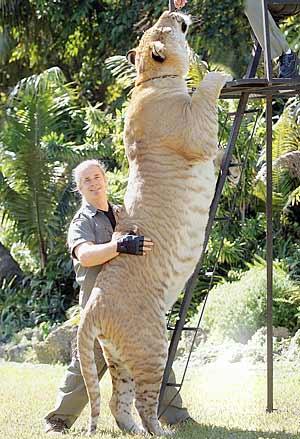
@izaaz:
That's not quite as fierce as I have imagined.
I wonder how crossbreeding effects their natural instinct and pack mentality. Would they be ostracized by other lions/tigers? Would they ostracize each other?
@izaaz:
That's not quite as fierce as I have imagined.
I wonder how crossbreeding effects their natural instinct and pack mentality. Would they be ostracized by other lions/tigers? Would they ostracize each other?
Well, they've only been bred in captivity - that's why they probably seem almost bored. With the few cross species animals that exist, they've been done almost exclusively in a zoo or a farm.
I have no idea if they'd be ignored or cast out from their pride, but this most likely doesn't occur in captivity since, I'm assuming here, that most zoos don't have more than a few lions/tigers anyways. In nature, since they're habitats don't overlap, we wouldn't see this sort of mating happen anyway, so it'd be real difficult to test out your questions.
Vagabond(well thought out stuff by the way) - But if breeding between certain brands can only be achieved through scientific procedures, then from an evolutionary standpoint (the ability to reproduce), wouldn't we consider that a speciation event?
Ironman - And a lion and a tabby are both cats, but they're different species.
Khuutra - right, But those offspring can't reproduce. The definition of a seperate species is that they they can produce offspring that can reproduce. A Liger and a Mule can't have kids. If they could, tigers and lions would be the same species, as would donkey's and horses.
Montana - I'm sure there are videos for sale of 8 foot tall men and 3 foot tall women doing their damndest to prove you wrong Montana. But I'm not just talking size, though it is the most easy to illustrate with pictures. What I'm trying to say is that as far as I'm aware, there are some breeds of dogs that just can't produce offspring together (outside of a laboratory). Now I'm not sure if all breeds of dogs can eventually mingle through intermediary dog breeds. But even if that's the case, then wouldn't the only thing stopping a speciation event (I like that word Vagabond) be for one or more of those intermediary breeds to die out?
I'm a mod, come to me if there's mod'n to do.
Chrizum is the best thing to happen to the internet, Period.
Serves me right for challenging his sales predictions!
Bet with dsisister44: Red Steel 2 will sell 1 million within it's first 365 days of sales.
| makingmusic476 said: @izaaz: That's not quite as fierce as I have imagined. |
Wait. This monster isn't scary enough for you?

He wieghs over half a ton. Thank God you don't see these things happen outside captivity.

"The worst part about these reviews is they are [subjective]--and their scores often depend on how drunk you got the media at a Street Fighter event." — Mona Hamilton, Capcom Senior VP of Marketing
*Image indefinitely borrowed from BrainBoxLtd without his consent.
Interesting thing about either tigons or ligers (I forget which) is that they lack the gene that tells their bodies when to stop growing, hence why they can get more than twice as big as either parent!
I'm sorry I don't know anything really useful, stof
What was it that the other lacked? I think it's the ability to know when it's supposed to hunt or its survival instinct. On the one hand, this means it can't feed itself in the wild. On the other hand, this means it's more docile than a housecat.
I think. I watched that show about them many, many years ago!
@stof. If you killed everything apart from the Chihuahua's and the Great Danes you would probably have to consider them seperate species, there would be a barrier between them breeding.
Also many different species can produce fertile offspring, there only has to be a barrier to them breeding, range for example. That is why wolves and dogs are different species despite being able to produce fertile offspring. Wolves occupy a range that dogs don't.
Same goes for a huge number of species.

What I find interesting is that the evolution of the dog has happened within 13,000 years. This is because of the human domestication of the dog. Different environments cause different evolution and the early ancestor of all the dogs (Canis Canis I believe) were domesticated and used for hundreds of different purposes.
Humans only used the dogs that were best suited for the job they had domesticated them for, the others didn't survive, this is evolution that is extremely rapid. Dogs that were used for protection became increasingly vicious, dogs that were used to plough fields became big and strong and so on. All this change has happened over just a few millenniums.
So to answer your question stof, yes these dogs are the same species and can mate with each other. However, they will continue to drift apart and in a few more thousand years you might find that they will actually become different species all together, and the difference between species becomes ever more vast.
| highwaystar101 said: Humans only used the dogs that were best suited for the job they had domesticated them for, the others didn't survive, this is evolution that is extremely rapid. Dogs that were used for protection became increasingly vicious, dogs that were used to plough fields became big and strong and so on. All this change has happened over just a few millenniums. |
The rapidness was surely because of selective breeding, a strong dog was more then likely able to produce strong offspring, breed a strong dog and bitch together and you've got strong offspring, the weak dogs are seen as inferior and either disposed of do not breed. Just like horses and greyhounds, breeding fast strong runners with females to produce fast runners again.
Oh on the Liger and a Tigon thing, I think how they are named is based on which species is the female and which is the male (so male tiger breeds with female lion and vis versa). Not sure which way round it is though.
Hmm, pie.
I agree with a lot of the replies so far. IMO they're still the same species, as they're genetically compatible. It's actually possible (though unlikely) that they would mate, even in a natural context (though it would have to be a pretty weird situation).
Imagine you put all the black dogs in Australia and all the white dogs in the USA. Do they immediately become different species just because they're unlikely to mate with each other? I don't think so.
My Mario Kart Wii friend code: 2707-1866-0957