
By using this site, you agree to our Privacy Policy and our Terms of Use. Close

Forums - General - Why I Don't Think we Should be Spending Money on Climate Change.

mrstickball said:
I think the issue is that most proposals aren't about spending money on climate change. They are more of designed to regulate and penalize those that don't 'go green'.

That is a very bad difference, I think. Rather than invest in technology that can improve life, they are leveraging political power to tax and damage businesses. You cannot tax and regulate your way to innovation.

I agree with Highway that we need to invest money in NEW technologies rather than attack old businesses. Efficiency, and better power production is something that all energy companies can agree on. However, when they are worried that the government will tax them if their solution isn't 'green', then capital expenditures may not go where they're most needed.

iLet's invest in nuclear, fission, and other promising technologies. We can have clean, efficient energy. We just have to do it in the name of iI efficiency and not in the name of a particular quasi-religious movement.

I agree with you too MrStickball

I recall a few months back in an issue of new scientist or Focus (Some British science journal anyway) is that the reason people are penalised for not being green is that a simple plan doesn't "get the go ahead in Washington" (Used as a phrase to represent how things are done which I will explain).

Basically laws aren't passed anywhere unless it benefits the people who are passing it. People who pass green laws want to see the advantage for themselves, no-one else. They don't care about the technology or the advances, as long as it benefits them. As you said it is leveraging the political power, and that is why Global warming is prevalent, because it holds political power and all politicians and many businesses are looking to exploit it. Old businesses are defended because they have more power at the moment too.

I'll try and find the article tomorrow (It's 2:30 AM here right now) morning for you, because it basically says what you just said.

we should invest in the long term of efficient power production (fusion, solar towers, etc...), instead of what is convenient now. Regardless of the proof of global warming.

If politicians really wanted to stop global warming it would be a clear, concise one page plan.



Around the Network

I think we should do a lot more Geoengineering research.

The problem is you can't do so much as suggest geoengineering without getting completely ridiculed because of how politicized global warming research is.

Which is sad since conservation and energy dependence helps now... but Geoengineering helps climate crisises now AND in the future.

Heck it'd help now even for us not in crisis.


Observed warming in the atmosphere has been at a rate that would indicate that the climate’s sensitivity to CO2 is (roughly) 1/6th what is expected by the IPCC, and a doubling of atmospheric CO2 would translate to a 0.6 degree increase in world temperature. Being that humans currently account for (roughly) 1/3 of all atmospheric CO2 we would have to double our current CO2 output to have doubled natural CO2 levels; and we would have to increase current CO2 production to (roughly) 4 times current level to see a 1 degree increase in global temperatures.

To put this in perspective, a realistic timeline for this to happen is well over 150 years. Now, if you went back in time and projected what the world would look like today 150 years ago assuming we would use the same energy technologies you would come to the conclusion that the sun would be completely blocked out of the sky by the dark clouds of soot and smog from all the coal and wood fires.


SamuelRSmith said:
twesterm said:
I think we should spend all that money on preventing the world ending in 2012 instead...and eliminating Tyra Banks.

So, um, I Google Tyra Banks, and I get this - http://static.fameball.com/imgcache/5/33/0

Are you gay?

Gay because I despite Tyra Banks?  No, I despise her because she's a loud obnoxious self absorbed hypocritcal hack.

And I have no idea what that link is, doesn't work for me.


Kasz216 said:

I think we should do a lot more Geoengineering research.

The problem is you can't do so much as suggest geoengineering without getting completely ridiculed because of how politicized global warming research is.

Which is sad since conservation and energy dependence helps now... but Geoengineering helps climate crisises now AND in the future.

Heck it'd help now even for us not in crisis.

At least you get ridiculed. I don't think I've actually mentioned Geoengineering to anyone without getting a blank expression back...

Anyway,

A lot of the Geoengineering technologies have good merit. There are some really good ideas to do with artificially boosting plankton and algae populations in the ocean and create stratospheric sulphur clouds. In Britain these kind of technologies are getting serious consideration by the government and several other bodies, so I don't think it is something to be ridiculed, some of the technologies do have good merit.


Around the Network

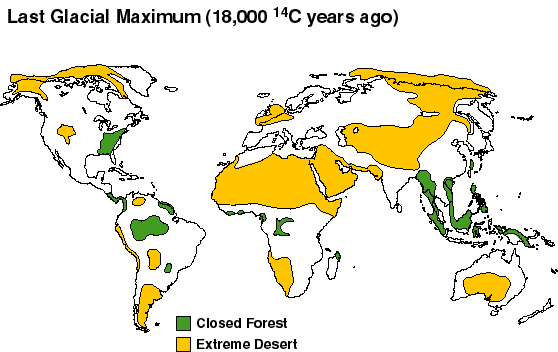
The world at the last glacial maximum. Deserts were much bigger than today, and tropical forests were substituted by savanna due to delayed and reduced monsoon rains. Over 70% decrease on rainfall over Africa, and death of 50% of temperate trees species in Europe. Winters lasted far longer, and temperature lines on February, for instance, were around 20K lower than today. Almost impossible for man to live in latitudes over 35 because of harsh and unpredictable climate conditions.

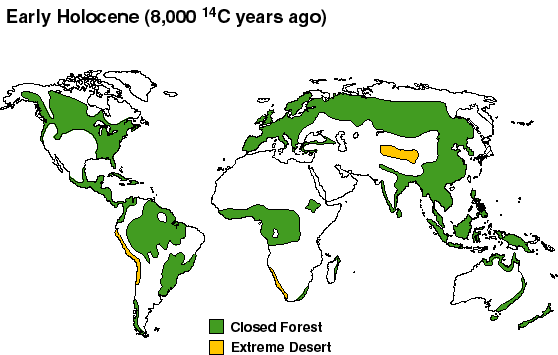
Ah, the holocene climatic optimum. Temperatures were higher and the world was far moister, despite ice caps lingering over what is the Hudson bay nowadays. Florests expanded and no Sahara desert. No summer ice in the arctic.


Talk about which one is dangerous now - cooling or warming. Of course things are different nowadays, due to changes being much faster meaning continents will warm before the oceans, but in the long term things should estabilize if emitions were controller. Instead of this, people insist to engage in an almost irrational doomsday-like movement against global warming.


The best and only good way to tackle climate change is to reduce the consumption of fossil fuels for power stations and automobiles.

This means fusion power, combined with hydrogen fuel cells for transport. These technologies are very cheap to develop compared to solutions that involve geoenfginnering or reorganising our economy, and will do just as much to reduce poverty and improve the economy as anything else you could spend the money on.

So, let's do that and get both at the same time.

But this requires supporting basic research with government money, which apparently governments are allergic to (The US withdrew ITER funding last I heard). It's a shame because if we ever developed a fusion reactor or viable fuel cell then the profits would be very high, and if the government involved only got a tiny percentage back then it would repay development costs.


@kowenicki

Those figures are misleading. We have little manufacturing actually in this country, but if you look at the emissions contributed by companies headquartered in the UK but done in China, India etc., I think it would add up to more like 5%.

We can still legislate. Whether we should or not is another matter, but 'we don't contribute much' isn't the argument I would use in that case.


Soleron said:
The best and only good way to tackle climate change is to reduce the consumption of fossil fuels for power stations and automobiles.

This means fusion power, combined with hydrogen fuel cells for transport. These technologies are very cheap to develop compared to solutions that involve geoenfginnering or reorganising our economy, and will do just as much to reduce poverty and improve the economy as anything else you could spend the money on.

So, let's do that and get both at the same time.

But this requires supporting basic research with government money, which apparently governments are allergic to (The US withdrew ITER funding last I heard). It's a shame because if we ever developed a fusion reactor or viable fuel cell then the profits would be very high, and if the government involved only got a tiny percentage back then it would repay development costs.

About government science funding...

I've often had problems with the UK science funding.

However.

The latest UK science budget plans for 2009 to 2011 will be increased to £4,000,000,000. This will be a budget that allows world class scientific research facilities. It is a step in the right direction for us as our economy is shifting to rely on technology and science. For every £1 the government spends on science, it will eventually lead to £7 (on average in recent times) when the technology has been implemented or sold. Science is a very wise investment. I'm very happy that the government has realised this, and that has lead to increased spending, which will be beneficial in the long run.

I think the government is coming round to the idea that spending money on sciences like nuclear fusion and hydrogen fuel cells is a wise investment as they will be the technology of the future.

Long story short, there is light at the end of the tunnel imo .


kowenicki said:
@soleron

I understand that... but that just lets the developing mega economies off the hook... China and India particularly have to be persuaded to act. China could easliy by emitting 50% of the worlds emissions within a decade or so at their current rate of growth.

What I'm saying is that we have more control over China and India's emissions than they do, because the companies operating the factories or subcontracting work to the foreign ones fall under our legal system.