By using this site, you agree to our Privacy Policy and our Terms of Use. Close

Forums - General - Rocky Planet found outside our Solar System!

Wow...we live in an exciting time! 

http://edition.cnn.com/2009/TECH/space/09/16/new.rocky.planet/index.html

"Scientists have discovered the first confirmed Earthlike planet outside our solar system, they announced Wednesday.
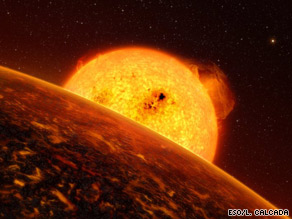
An artist's impression shows what the planet may look like in close orbit with its sun.

"This is the first confirmed rocky planet in another system," astronomer Artie Hatzes told CNN, contrasting the solid planet with gaseous ones like Jupiter and Saturn.

But "Earthlike" is a relative term.

The planet's composition may be similar to that of Earth, but its environment is more like a vision of hell, the project's lead astronomer said.

It is so close to the star it orbits "that the place may well look like Dante's Inferno, with a probable temperature on its 'day face' above 3,600 degrees Fahrenheit (2,000 degrees Celsius) and minus-328 degrees Fahrenheit (minus 200 degrees Celsius) on its night face," said Didier Queloz of Geneva Observatory in Switzerland, the project leader.

Hatzes, explaining that one side of the body is always facing the star and the other side always faces away, said the side "facing the sun is probably molten. The other side could actually have ice" if there is water on the planet.

"We think it has no atmosphere to redistribute the heat," Hatzes told CNN from Barcelona, Spain, where he is attending the "Pathways Towards Habitable Planets" conference.

The astronomers were stunned to find a rocky planet so near a star, he said.

"We would have never dreamed you would find a rocky planet so close," he said. "Its year is less than one of our days."

The planet, known as CoRoT-7b, was detected early last year, but it took months of observation to determine that it had a composition roughly similar to Earth's, the European Southern Observatory said in a statement.

Astronomers were able to measure the dimensions of the planet by watching as it passed in front of the star it orbits, then carried out 70 hours of study of the planet's effect on its star to infer its weight.

With that information in hand, they were able to calculate its density -- and were thrilled with what they found, Hatzes said.

"What makes this exciting is you compare the density of this planet to the planets in our solar system, it's only Mercury, Venus and Earth that are similar," Hatzes, of the Thuringer observatory in Germany, told CNN.

They were helped by the fact that CoRoT-7b is relatively close to Earth -- about 500 light years away, in the constellation of Monoceros, the Unicorn.

"It's in our solar neighborhood," Hatzes said. "The thing that made it easier is it's relatively close, so it's relatively bright. If this star was much much farther away, we wouldn't have been able to do these measurements."

At about five times Earth's mass (though not quite twice as large in circumference), it is the smallest planet ever spotted outside our solar system.

It also has the fastest orbit. The planet whizzes around its star more than seven times faster than Earth moves, and is 23 times closer to the star than Mercury is to our sun.

The planet was first detected early in 2008 by the CoRoT satellite, a 30-centimeter space telescope launched by the European Space Agency in December 2006, specifically with the mission of detecting rocky planets outside the solar system.

At least 42 scientists at 17 institutions on three continents worked on the project.

They are publishing their findings in a special issue of the Astronomy and Astrophysics journal on October 22 as "The CoRoT-7 Planetary System: Two Orbiting Super-Earths"


"...You can't kill ideas with a sword, and you can't sink belief structures with a broadside. You defeat them by making them change..."

- From By Schism Rent Asunder

Around the Network

Very neat.

If the day side is 2000*C, and the night side is -326C, I wonder what the intermediary is that is barely on the dark side?

I wonder if it'd be possible to have something temperate in that area. Certainly may be moot due to no atmosphere, but still interesting.

Always great to see new planetary advancements. I've been following this stuff since I was a few years old, and have never grown tired of announcements.


Back from the dead, I'm afraid.

mrstickball said:
Very neat.

If the day side is 2000*C, and the night side is -326C, I wonder what the intermediary is that is barely on the dark side?

I wonder if it'd be possible to have something temperate in that area. Certainly may be moot due to no atmosphere, but still interesting.

Always great to see new planetary advancements. I've been following this stuff since I was a few years old, and have never grown tired of announcements.

I was wondering the exact same thing. What would it be like on the border? I'm also very interested in stuff related to planets and our universe. It's fascinating!


What an incredible find, I mean studying exoplanets has come on in leaps and bounds recently.


Wow crazyness.

As for the "heat/cold border issue" that was my first thought as well, but with no atmosphere, The only thing that would transfer heat would be the planet's surface. The space would go from 2000 C in the sunlight to -326 in the dark an inch or two later. but surface would take a while to go from molten to freezing again.

So It probably wouldn't be a great place for our first out of Solar system colony. Come on in! "It's -326 degrees outside, but the ground'll burn your boots off!"

Of course, Any ship that attempted to get close to the planet would have melted long before it got there too.

Gee. Astronomy is so cool when you have someone else to do the years and years of searching and discovery for you.


I'm a mod, come to me if there's mod'n to do. 

Chrizum is the best thing to happen to the internet, Period.

Serves me right for challenging his sales predictions!

Bet with dsisister44: Red Steel 2 will sell 1 million within it's first 365 days of sales.

Around the Network
stof said:
Wow crazyness.

As for the "heat/cold border issue" that was my first thought as well, but with no atmosphere, The only thing that would transfer heat would be the planet's surface. The space would go from 2000 C in the sunlight to -326 in the dark an inch or two later. but surface would take a while to go from molten to freezing again.

So It probably wouldn't be a great place for our first out of Solar system colony. Come on in! "It's -326 degrees outside, but the ground'll burn your boots off!"

Of course, Any ship that attempted to get close to the planet would have melted long before it got there too.

Gee. Astronomy is so cool when you have someone else to do the years and years of searching and discovery for you.

stof - Right. I was thinking the same thing. Since there's no atmosphere, the only insulator of heat would be the surface. Now, having said that, I would wonder if the surface would radiate some of the heat further into the night side to allow for a somewhat temperate band on the darkside. Since it's tidally locked, this area should be easy to find through thermal imaging.

Of course, the question is if such an area would be useful for habitation. We have far better candidates for research and colonization in our own solar system.


Back from the dead, I'm afraid.

I imagine that that band would exist, but again, I believe that without an atmosphere, the radiation of heat would only be what wells up directly from the still hot parts of the planet, so any area of space on the darkside that is hot would have to have an incredibly hot portion of earth(does that word apply here?) underneath it.

I think that kind of heat would dissapate incredibly fast in to the void of space, so if it's hot enough to stop something from completely freezing, it's probably also going to melt whatever touches the ground.


I'm a mod, come to me if there's mod'n to do. 

Chrizum is the best thing to happen to the internet, Period.

Serves me right for challenging his sales predictions!

Bet with dsisister44: Red Steel 2 will sell 1 million within it's first 365 days of sales.

stof -

I get (kind) of what your saying, but here's what I can see from my research:

Space is a great insulator of heat. If you were to magically become exposed to space, you would not die from thermal problems, but atmospheric (or the lack of it).

So as you stated, the only way heat would be transferred to the dark side would be that which heats the planet's surface, then radiates through the ground to the darkside.

Such a band would probably be very small, and get progressively colder, very quickly. However, it may provide a small band of a very temperate area. Nothing that would make for a fantastic voyage, but could maybe support an underground network of habitability along that area that would be between 0C and 50C.


Back from the dead, I'm afraid.

The ability to detect planets outside our system is jumping by leaps and bounds and I can't even imagine what we will be able to detect in 50 years. Insterstellar travel might be totally in the realm of science fiction, but so was the internet and the computer, about 100 years ago. There isn't a major push to go into space, because there's not major reason for mankind to colonize it. I'm sure if we found some invaluable material inthe asteriod belt, we would spend trillion of dollars to exploit it.


"...You can't kill ideas with a sword, and you can't sink belief structures with a broadside. You defeat them by making them change..."

- From By Schism Rent Asunder

mrstickball said:

If the day side is 2000*C, and the night side is -326C, I wonder what the intermediary is that is barely on the dark side?

I wonder if it'd be possible to have something temperate in that area. Certainly may be moot due to no atmosphere, but still interesting.

Since heat radiaton does not require a medium, and heat conduction would occur on the planet's surface (although this would be minimal assuming its surfuce is mostly soil), the change from very hot to very cold would not be instant, leaving some area with more comfortable tempertures. 

This temperate area wouldn't be very large, however.  Also, depending on the proximity to the star, if the star's size is constantly changing (like our suns and we expect other stars to be), that temperate area may not have a steady temperature.