By using this site, you agree to our Privacy Policy and our Terms of Use. Close

Forums - General - Why the recession is not gonna be over anytime soon

Avinash_Tyagi said:
NJ5 said:
Avinash_Tyagi said:
People are still eating out, going on vacation and buying cars (not American, but who can blame them), as well as dong the forms of entertainment that you mentioned, yes everything is depressed and people are looking for sales and good deals, but that is expected, it wouldn't be a recession if that wasn't happening, however it shows, that the economy isn't in a massive retraction that would indicate that things are going to get much worse, it just shows people are being cautious but not panicking.

It seems you're assuming that a severe contraction needs to be severe right from the start. No one is saying the sky is falling and there's misery everywhere, that's not what a prolonged and severe recession means.


No i'm not assuming anything of the sort, i'm saying to get to the stage that you seem to believe it will get to, things need to get a lot worse, I don't see evidence of that happening, I see us being at about this level for another 6 to 12 months before things start to turn upwards.

In the Great Depression, things didn't get miserable overnight. I'm sure many people were also looking for sales and good deals in the beginning, middle and end of the depression.

Frankly you haven't brought much relevant data to the discussion, other than saying that "things aren't so bad yet". Well I agree with that, but it doesn't support your assertion that they won't get worse.


My Mario Kart Wii friend code: 2707-1866-0957

Around the Network
NJ5 said:
It seems like you should be making the opposite argument. If anything, that means a stimulus package was more necessary than we thought.


That's only true if it gets proven that the stimulus package is the best way to deal with the economic downturn... and that's not proven.

And unemployment is currently around 9.5-9.7%, which means that you are already seeing unemployment reach a bottom.


Why does it mean it's a bottom?

I know that U3 unemployment only increased slightly in the last month, but that's more due to the way the measure is calculated than due to a real improvement in the situation.

Why do I say this? Because the USA job losses in June were not very different from the previous months (around half a million), yet the unemployment rate only increased marginally. The reason is that U3 unemployment doesn't include people who stopped looking for a job and other discouraged workers.

If you want a one way ticket to a depression, allowing the banking sector to collapse is the best thing you could possibly do.


However, the US is repeating Japan's early mistakes when dealing with a banking crisis. Shifting debt around or hiding it under the carpet. That was a one way ticket to a decade of deflation over there.

1)

Well, we kind of did not have many options.  The Fed was loaning out money at almost 0% interest and the economy was still sinking like a stone.  This is what we call a "liquidity trap," which is actually what led to Japan's "Lost Decade" in the 90's.  Our fiscal policy alternatives were tax cuts, which there were $230 billion of in the stimulus package, government spending, or throwing money out on the sidewalk.  In this type of recession, one where you are suffering from a lack of demand and tightening credit, government spending is more effective than tax cuts.  This is because government spends that dollar once and the money is spent domestically.  Then the person who receives that dollar can spend it, save it, etc.  Compare that to what happens with tax cuts.  That dollar gets "spent" more through government spending, thereby creating a greater multiplier effect.

Tax cuts were great for the problem Reagan was facing, stagflation.  But its equally short-sighted to assume that tax cuts are the best fiscal policy solution during an economic downturn such as this one.  With tax cuts, a dollar is "spent" less.  Many of those dollars people will go spend at their local Wal-Mart or retailers, where the money is shipped back to China and other developing nations who manufactures the majority of those goods.  Or they will just save the money and pay down their debt.  The stimulative effect of that is much less because that dollar ripples through the domestic economy less.

I really don't think that is a very complicated concept.

How can you say it is not proven that government spending helps in an economic downturn?  Did you not read any of our discussion of the Great Depression and WW2?  Go back and read through it.

2)

As for your unemployment comment, unemployment has really been measured the same throughout the 20th century.  You are correct that the unemployment number does not tell you everything.  But when that same method has been used to measure unemployment throughout the 20th century, you can make accurate assumptions about overall trends based on past events and how unemployment typically "moves" during a downturn.  So your comment would make a difference if we had ever measured unemployment differently, but we never have.

3)

As for your third comment, you know that if you look at our debt as a percentage of GDP (which is the most important indicator to look at when talking about public debt) that out public debt was actually higher after WW2 than it was now.  Yet that was one of the most prosperous times in the history of this country. 

I find it really ironic that you criticize government spending in your first point, and then mention Japan's crisis in your third point.  Almost all economists agree that Japan was suffering from a "liquidity trap" in which you have loose credit but no investment.  That is when fiscal policy, i.e. government spending, is the only viable option in terms of the government stimulating the economy further.

And Japan's problems are distinguishable from the U.S.'s anyways.  Japan was experiencing a shrinking population (i.e. non-sustainable birth rates) which affected their long term economic growth.  Its really hard to grow your economy when your population is aging and shrinking.  The U.S.'s population is growing (mostly thanks to immigrants and minorities who have high birth rates).  Japan has extremely strict immigration policies.  This really hampered their ability to get out of a recession.

If you want a very in-depth discussion on this third point, you should read this article:

http://web.mit.edu/krugman/www/japtrap.html


We had two bags of grass, seventy-five pellets of mescaline, five sheets of high-powered blotter acid, a salt shaker half full of cocaine, a whole galaxy of multi-colored uppers, downers, screamers, laughers…Also a quart of tequila, a quart of rum, a case of beer, a pint of raw ether and two dozen amyls.  The only thing that really worried me was the ether.  There is nothing in the world more helpless and irresponsible and depraved than a man in the depths of an ether binge. –Raoul Duke

It is hard to shed anything but crocodile tears over White House speechwriter Patrick Buchanan's tragic analysis of the Nixon debacle. "It's like Sisyphus," he said. "We rolled the rock all the way up the mountain...and it rolled right back down on us...."  Neither Sisyphus nor the commander of the Light Brigade nor Pat Buchanan had the time or any real inclination to question what they were doing...a martyr, to the bitter end, to a "flawed" cause and a narrow, atavistic concept of conservative politics that has done more damage to itself and the country in less than six years than its liberal enemies could have done in two or three decades. -Hunter S. Thompson


NJ5 said:
Avinash_Tyagi said:
NJ5 said:
Avinash_Tyagi said:
People are still eating out, going on vacation and buying cars (not American, but who can blame them), as well as dong the forms of entertainment that you mentioned, yes everything is depressed and people are looking for sales and good deals, but that is expected, it wouldn't be a recession if that wasn't happening, however it shows, that the economy isn't in a massive retraction that would indicate that things are going to get much worse, it just shows people are being cautious but not panicking.

It seems you're assuming that a severe contraction needs to be severe right from the start. No one is saying the sky is falling and there's misery everywhere, that's not what a prolonged and severe recession means.


No i'm not assuming anything of the sort, i'm saying to get to the stage that you seem to believe it will get to, things need to get a lot worse, I don't see evidence of that happening, I see us being at about this level for another 6 to 12 months before things start to turn upwards.

In the Great Depression, things didn't get miserable overnight. I'm sure many people were also looking for sales and good deals in the beginning, middle and end of the depression.

Frankly you haven't brought much relevant data to the discussion, other than saying that "things aren't so bad yet". Well I agree with that, but it doesn't support your assertion that they won't get worse.


Unemployment jumped 10% in two years during the Great Depression.  That's pretty close to miserable overnight.

In a year and 6 months, unemployment in America has risen about 4.5% (currently at 9.5% in June).  It was at about 5% in January of 2008.


We had two bags of grass, seventy-five pellets of mescaline, five sheets of high-powered blotter acid, a salt shaker half full of cocaine, a whole galaxy of multi-colored uppers, downers, screamers, laughers…Also a quart of tequila, a quart of rum, a case of beer, a pint of raw ether and two dozen amyls.  The only thing that really worried me was the ether.  There is nothing in the world more helpless and irresponsible and depraved than a man in the depths of an ether binge. –Raoul Duke

It is hard to shed anything but crocodile tears over White House speechwriter Patrick Buchanan's tragic analysis of the Nixon debacle. "It's like Sisyphus," he said. "We rolled the rock all the way up the mountain...and it rolled right back down on us...."  Neither Sisyphus nor the commander of the Light Brigade nor Pat Buchanan had the time or any real inclination to question what they were doing...a martyr, to the bitter end, to a "flawed" cause and a narrow, atavistic concept of conservative politics that has done more damage to itself and the country in less than six years than its liberal enemies could have done in two or three decades. -Hunter S. Thompson

NJ5 said:
Avinash_Tyagi said:
NJ5 said:
Avinash_Tyagi said:
People are still eating out, going on vacation and buying cars (not American, but who can blame them), as well as dong the forms of entertainment that you mentioned, yes everything is depressed and people are looking for sales and good deals, but that is expected, it wouldn't be a recession if that wasn't happening, however it shows, that the economy isn't in a massive retraction that would indicate that things are going to get much worse, it just shows people are being cautious but not panicking.

It seems you're assuming that a severe contraction needs to be severe right from the start. No one is saying the sky is falling and there's misery everywhere, that's not what a prolonged and severe recession means.


No i'm not assuming anything of the sort, i'm saying to get to the stage that you seem to believe it will get to, things need to get a lot worse, I don't see evidence of that happening, I see us being at about this level for another 6 to 12 months before things start to turn upwards.

In the Great Depression, things didn't get miserable overnight. I'm sure many people were also looking for sales and good deals in the beginning, middle and end of the depression.

Frankly you haven't brought much relevant data to the discussion, other than saying that "things aren't so bad yet". Well I agree with that, but it doesn't support your assertion that they won't get worse.


By 1931, little over a year into the Depression unemployment had risen to around 15%, in this recession at over 18 months we are less than 10%, things went downhill fast in the Depression you don't see such a steep fall in this recession

So far you haven't shown anything that indicates that things are going to get worse, the onus is on you to show data that things are going to get worse, see I don't have to show a lot of data, my point is supported in current events and history, its up to you to show how this is a false bottom and how things are going to collpase in the next few months into some new depression.


Predictions:Sales of Wii Fit will surpass the combined sales of the Grand Theft Auto franchiseLifetime sales of Wii will surpass the combined sales of the entire Playstation family of consoles by 12/31/2015 Wii hardware sales will surpass the total hardware sales of the PS2 by 12/31/2010 Wii will have 50% marketshare or more by the end of 2008 (I was wrong!!  It was a little over 48% only)Wii will surpass 45 Million in lifetime sales by the end of 2008 (I was wrong!!  Nintendo Financials showed it fell slightly short of 45 million shipped by end of 2008)Wii will surpass 80 Million in lifetime sales by the end of 2009 (I was wrong!! Wii didn't even get to 70 Million)

@akuma: Look at this quote from the link you posted:

"Japan has already engaged in extensive public works spending in an unsuccessful attempt to stimulate its economy."

How does that help your case that stimulus spending is the way to do it?

As for the unemployment numbers (besides the concerns with how the measure works), it should also be mentioned that the "bottoming out" is actually just a single month of data where unemployment increased by a small amount. Let's not argue too much over a single data point which may turn out to not mean much pretty soon.

@Avinash_Tyagi: I didn't say things will go downhill as fast or deep as in the Great Depression.

There's no false bottom, because there isn't a bottom. Where did you see a bottom?


My Mario Kart Wii friend code: 2707-1866-0957

Around the Network
akuma587 said:
NJ5 said:

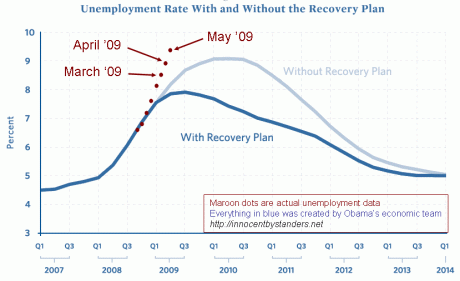
By the way, since we're talking about the stimulus I found this graph, which consists of the White House's original pitch for the stimulus, plus 5 months of data of what actually happened in terms of unemployment.

This should tell you how much the effect of the stimulus plan is understood by those who proposed it...

Dark blue line - the White House's estimation of unemployment with the stimulus plan.

Light blue line - the White House's estimation of unemployment without the stimulus plan. 

Red dots - what actually happened


So...you are faulting them that the economy was much worse than everyone predicted.  It seems like you should be making the opposite argument.  If anything, that means a stimulus package was more necessary than we thought.  Almost all economic data, particularly the rate of economic contraction we are going through, demonstrates that the closest parallel to this current economic crisis is the Great Depression.  In two years, unemployment rose 10% after the bubble burst that led to the Great Depression.  Without something like TARP and the programs like the stimulus that followed, it would have been highly likely we would have seen something comparable.

And unemployment is currently around 9.5-9.7% if you continue to extend over the "red line" on your graph, which means that you are already seeing unemployment reach a bottom.  It will break 10%, but I question if it will make it up to 11%.

Really TARP was one of the smartest decisions Bush ever made.  If you want a one way ticket to a depression, allowing the banking sector to collapse is the best thing you could possibly do. 


This is just crazy talk!


You have absolutely now evidence that TARP worked. None. In fact, you have a wealth of evidence that it didn't.


Being that you will die with the concept that your view of economics is right, with nothing in the world capable of shaking your beliefs, your only option is to make up how the world must have be, to try and fit your view of the course of events into it.


This idea by believers of your dogma that the wold "must have been worse" because your ideas didn't work is absolute bullshit.


Every indicator in the world suggests TARP did NOTHING. In fact, it was worse then nothing, because we now have to pay it back.


I mean if you look at the great depression, the slop of the unemployment line was constant. The line today is constant. To think that it would have exponentially shot up without TARP... unbelievable.


NJ5 said:

@akuma: Look at this quote from the link you posted:

"Japan has already engaged in extensive public works spending in an unsuccessful attempt to stimulate its economy."

How does that help your case that stimulus spending is the way to do it?

As for the unemployment numbers (besides the concerns with how the measure works), it should also be mentioned that the "bottoming out" is actually just a single month of data where unemployment increased by a small amount. Let's not argue too much over a single data point which may turn out to not mean much pretty soon.

@Avinash_Tyagi: I didn't say things will go downhill as fast or deep as in the Great Depression.

There's no false bottom, because there isn't a bottom. Where did you see a bottom?


Leading indicators are showing us near a bottom, as I pointed out earlier


Predictions:Sales of Wii Fit will surpass the combined sales of the Grand Theft Auto franchiseLifetime sales of Wii will surpass the combined sales of the entire Playstation family of consoles by 12/31/2015 Wii hardware sales will surpass the total hardware sales of the PS2 by 12/31/2010 Wii will have 50% marketshare or more by the end of 2008 (I was wrong!!  It was a little over 48% only)Wii will surpass 45 Million in lifetime sales by the end of 2008 (I was wrong!!  Nintendo Financials showed it fell slightly short of 45 million shipped by end of 2008)Wii will surpass 80 Million in lifetime sales by the end of 2009 (I was wrong!! Wii didn't even get to 70 Million)

TheRealMafoo said:
akuma587 said:


This is just crazy talk!


You have absolutely now evidence that TARP worked. None. In fact, you have a wealth of evidence that it didn't.


Being that you will die with the concept that your view of economics is right, with nothing in the world capable of shaking your beliefs, your only option is to make up how the world must have be, to try and fit your view of the course of events into it.


This idea by believers of your dogma that the wold "must have been worse" because your ideas didn't work is absolute bullshit.


Every indicator in the world suggests TARP did NOTHING. In fact, it was worse then nothing, because we now have to pay it back.


I mean if you look at the great depression, the slop of the unemployment line was constant. The line today is constant. To think that it would have exponentially shot up without TARP... unbelievable.

Oh boy, apparently you aren't smart enough to realize I was talking about multiple things in one post.

You are really going to argue that TARP didn't work?  Let's look at bank failures.

Great Depression:

http://www.livinghistoryfarm.org/farminginthe30s/money_08.html

As the economic depression deepened in the early 30s, and as farmers had less and less money to spend in town, banks began to fail at alarming rates. During the 20s, there was an average of 70 banks failing each year nationally. After the crash during the first 10 months of 1930, 744 banks failed – 10 times as many. In all, 9,000 banks failed during the decade of the 30s. By 1933, depositors saw $140 billion disappear through bank failures.

http://www.hyperhistory.com/online_n2/connections_n2/great_depression.html

1932:

10,000 banks have failed since 1929, or 40 percent of the 1929 total.

vs.

Now (article published on June 19th):

http://www.marketwatch.com/story/bank-failures-in-ga-nc-bring-2009-tally-to-39

SAN FRANCISCO (MarketWatch) -- Bank failures in Georgia and North Carolina have brought the number of failures in 2009 to 39, according to the Federal Deposit Insurance Corp. late Friday.


Even when not adjusting for the vastly increased number of banks in modern times, I don't really see how you can argue that TARP failed to prevent a substantial number of bank failures, which was the reason why it was created.  TARP was an overwhelming success.

I never claimed TARP would stop unemployment from rising.  But if you honestly think that unemployment would have not increased much faster if thousands and thousands of banks had to shut their doors, you need to have your head examined.

Not to mention the government would have had to pay the FDIC insurance of up to $250,000 on every account those banks had in them as well.


We had two bags of grass, seventy-five pellets of mescaline, five sheets of high-powered blotter acid, a salt shaker half full of cocaine, a whole galaxy of multi-colored uppers, downers, screamers, laughers…Also a quart of tequila, a quart of rum, a case of beer, a pint of raw ether and two dozen amyls.  The only thing that really worried me was the ether.  There is nothing in the world more helpless and irresponsible and depraved than a man in the depths of an ether binge. –Raoul Duke

It is hard to shed anything but crocodile tears over White House speechwriter Patrick Buchanan's tragic analysis of the Nixon debacle. "It's like Sisyphus," he said. "We rolled the rock all the way up the mountain...and it rolled right back down on us...."  Neither Sisyphus nor the commander of the Light Brigade nor Pat Buchanan had the time or any real inclination to question what they were doing...a martyr, to the bitter end, to a "flawed" cause and a narrow, atavistic concept of conservative politics that has done more damage to itself and the country in less than six years than its liberal enemies could have done in two or three decades. -Hunter S. Thompson

Avinash_Tyagi said:
NJ5 said:

@akuma: Look at this quote from the link you posted:

"Japan has already engaged in extensive public works spending in an unsuccessful attempt to stimulate its economy."

How does that help your case that stimulus spending is the way to do it?

As for the unemployment numbers (besides the concerns with how the measure works), it should also be mentioned that the "bottoming out" is actually just a single month of data where unemployment increased by a small amount. Let's not argue too much over a single data point which may turn out to not mean much pretty soon.

@Avinash_Tyagi: I didn't say things will go downhill as fast or deep as in the Great Depression.

There's no false bottom, because there isn't a bottom. Where did you see a bottom?


Leading indicators are showing us near a bottom, as I pointed out earlier

Here are the facts. Find me the leading indicators.

http://www.bea.gov/national/nipaweb/SelectTable.asp?Popular=Y


akuma587 said:
TheRealMafoo said:
akuma587 said:
NJ5 said:

By the way, since we're talking about the stimulus I found this graph, which consists of the White House's original pitch for the stimulus, plus 5 months of data of what actually happened in terms of unemployment.

This should tell you how much the effect of the stimulus plan is understood by those who proposed it...

Dark blue line - the White House's estimation of unemployment with the stimulus plan.

Light blue line - the White House's estimation of unemployment without the stimulus plan. 

Red dots - what actually happened


So...you are faulting them that the economy was much worse than everyone predicted.  It seems like you should be making the opposite argument.  If anything, that means a stimulus package was more necessary than we thought.  Almost all economic data, particularly the rate of economic contraction we are going through, demonstrates that the closest parallel to this current economic crisis is the Great Depression.  In two years, unemployment rose 10% after the bubble burst that led to the Great Depression.  Without something like TARP and the programs like the stimulus that followed, it would have been highly likely we would have seen something comparable.

And unemployment is currently around 9.5-9.7% if you continue to extend over the "red line" on your graph, which means that you are already seeing unemployment reach a bottom.  It will break 10%, but I question if it will make it up to 11%.

Really TARP was one of the smartest decisions Bush ever made.  If you want a one way ticket to a depression, allowing the banking sector to collapse is the best thing you could possibly do. 


This is just crazy talk!


You have absolutely now evidence that TARP worked. None. In fact, you have a wealth of evidence that it didn't.


Being that you will die with the concept that your view of economics is right, with nothing in the world capable of shaking your beliefs, your only option is to make up how the world must have be, to try and fit your view of the course of events into it.


This idea by believers of your dogma that the wold "must have been worse" because your ideas didn't work is absolute bullshit.


Every indicator in the world suggests TARP did NOTHING. In fact, it was worse then nothing, because we now have to pay it back.


I mean if you look at the great depression, the slop of the unemployment line was constant. The line today is constant. To think that it would have exponentially shot up without TARP... unbelievable.

You are really going to argue that TARP didn't work?  Let's look at bank failures.

Great Depression:

http://www.hyperhistory.com/online_n2/connections_n2/great_depression.html

1932:

10,000 banks have failed since 1929, or 40 percent of the 1929 total.

Now (article published on June 19th):

http://www.marketwatch.com/story/bank-failures-in-ga-nc-bring-2009-tally-to-39

SAN FRANCISCO (MarketWatch) -- Bank failures in Georgia and North Carolina have brought the number of failures in 2009 to 39, according to the Federal Deposit Insurance Corp. late Friday.

I am not saying that TARP didn't stop bad companies from failing, I am saying those companies not failing didn't do a fucking thing.

The Government is a totally different place today with respect to debt liquidation. Let those hundreds of banks file bankruptcy, have qualified people look at there books, and either wipe there debt and let them keep going, or if they are utter failures, dissolve them.

Your argument, is if TARP was not around, the exact same thing that happened in 1932 would happen today, and that's 100% inaccurate.