By using this site, you agree to our Privacy Policy and our Terms of Use. Close

Forums - Gaming - Halo 3 runs at 640p native XD

makingmusic476 said:
 

I did compare them. What I was saying was that you can't compare them based on number of shaders alone. You have to get into the tyope of shaders, ops per cycle, etc.

Also, yes, I am aware that not all of the shaders may be used at the same time in a non-unified architecture. That's why I said it's efficiency vs brute power and drew parallels between the shaders of the Xenos/RSX and the dedicated/unified RAM of the ps3/360.

Basically, you missed exactly what I was trying to say. I apologize for my miscommunication.

 It seems there is a further miscommunication. I was referring to things related to screen resolution, not texture resolution, and shaders are part of the texture buffer, not the frame buffer. So we both argued on completely wrong pages.


A flashy-first game is awesome when it comes out. A great-first game is awesome forever.

Plus, just for the hell of it: Kelly Brook at the 2008 BAFTAs

Around the Network

640p is still considered High Definition.


tordavis said:
640p is still considered High Definition.

 Plus the texture resolution, draw distance, polygon count, etc. is still far ahead of the 6th gen.


A flashy-first game is awesome when it comes out. A great-first game is awesome forever.

Plus, just for the hell of it: Kelly Brook at the 2008 BAFTAs

LordTheNightKnight said:
MikeB said:
@ LordTheNightKnight


Twice the shader power.

which every objective test (as in not trying to make Sony, Microsoft, or even Nintendo look better than the other) rates as higher capability


No, the Xenos is just more flexible. However the SPUs are also flexible in what ways they can help the overall more powerful RSX.

the XDR has a faster clock speed


XDR is higher clocked but also offers less latency than DDR2 / DDR3.

I didn't write that the Xenos was more powerful. I wrote that it was more capable. Last I checked, flexibility was a capability. So you countered your own point. Plus I did state that using the SPEs would allow greater graphics, so you tried to counter me with one of the very points I made. This makes me wonder if you even read my post properly.

The XDR comment just shows your ignorance. If it had faster latency than DDR3, then it would have been used as the RAM in the RSX, instead of GDDR3, as the combination of size, clock speed, and latency would make it ideal for VRAM. It doesn't have faster latency, and that's why it's just used for system RAM. It works fine for that, but if you can't get your facts straight, your "IMO" looks more like deliberate lying.


 XDR is quite a bit more expensive than DDR3 last time I checked.  It may have changed, but full clock speed memory has had a history of price elevation.


It seems the mods need help with this forum.  I have zero tolerance for trolling, platform criticism (Rule 4), and poster bad-mouthing (Rule 3.4) and you will be reported.

Review before posting: http://vgchartz.com/forum/rules.php

LordTheNightKnight said:
makingmusic476 said:
 

I did compare them. What I was saying was that you can't compare them based on number of shaders alone. You have to get into the tyope of shaders, ops per cycle, etc.

Also, yes, I am aware that not all of the shaders may be used at the same time in a non-unified architecture. That's why I said it's efficiency vs brute power and drew parallels between the shaders of the Xenos/RSX and the dedicated/unified RAM of the ps3/360.

Basically, you missed exactly what I was trying to say. I apologize for my miscommunication.

It seems there is a further miscommunication. I was referring to things related to screen resolution, not texture resolution, and shaders are part of the texture buffer, not the frame buffer. So we both argued on completely wrong pages.


So neither of us was right? What's the fun in that? :(


Around the Network
Entroper said:
makingmusic476 said:

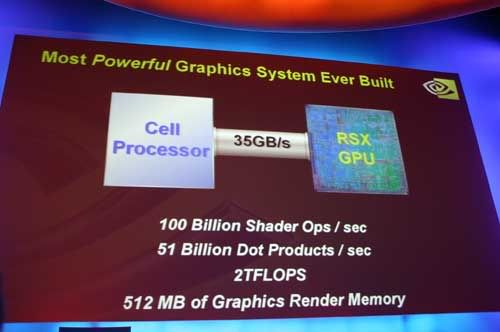
You can't just compare the number of pipelines between the two GPUs. The RSX only has 24 pixel shaders and 8 vertex shaders, compared to the 360's 48 unified shaders, but an individual unified shader is not as good as a dedicated shader for any specific task. The RSX's vertex shaders can handle 5 ops per cycle and the pixel shaders can handle 2 ops per sec, whereas all of the Xenos' shaders are only capable of 2 ops per second.

This leads to a a maximum of 136 ops per cycle for the RSX ((24 x 5) + (8 x 2) = 136) compared to a maximum of 96 ops per cycle for the Xenos (48 x 2 = 96). The fact that the RSX is clocked at 550mhz compared to just 500 for the Xenos also gives it an advantage.


Proofreading! You have that backwards, the pixel shaders handle 5 ops per cycle, the vertex shaders 2 ops per cycle (you did it in the right order when you did the math, though). And stop confusing "per cycle" with "per second". If these chips could only do a few ops per second, we'd be seeing pretty awful graphics. :) I'm not trying to give you a hard time, but these things can be confusing enough even with good proofreading. :)

What's also important is to look at what kind of "ops" you're talking about when you say 5 pixel shader ops per cycle on the RSX vs. 2 on Xenos. As I understand from the spec sheets (which may or may not be detailed enough for this kind of analysis), the RSX can do two vector ops per cycle and two scalar ops per cycle, plus fog, whereas Xenos does one vector and one scalar op per cycle. Well, the fog step happens at the very end of the shader -- the output fragment gets blended with the fog color. This doesn't happen every cycle, it just happens "free" at the end of the process. The same thing happens on Xenos, they just don't count it as a 'shader op' on the spec sheet, since it really isn't one. So what I see is 48 pipelines * (1 vector + 1 scalar) vs. 24 pipelines * (2 vector + 2 scalar) + 8 pipelines * (1 vector + 1 scalar). Which gives:

RSX: 56 vector + 56 scalar shader ops per cycle @ 550 MHz
Xenos: 48 vector + 48 scalar shader ops per cycle @ 500 MHz


I can see stating that the RSX is the more powerful chip, but let's not overstate it.


 You got me with the proofreading, lol.  When I wrote "per second" I was contemplating adding some calculations dealing with the 500 and 550 mhz clock speeds.  I decided against it, and threw in the line, "The fact that the RSX is clocked at 550mhz compared to just 500 for the Xenos also gives it an advantage."  I guess I just still had the word "second" on the brain.

Also, I was not aware of nVidia counting fog as it's own operation.  If this is true, then yes, the GPUs are far closer than I thought.


@ LordTheNightKnight

The XDR comment just shows your ignorance. If it had faster latency than DDR3, then it would have been used as the RAM in the RSX, instead of GDDR3, as the combination of size, clock speed, and latency would make it ideal for VRAM.


IMO be careful to make insults as it may backfire on you.

CPUs are optimized for low latency, GPUs are optimized for high throughput. The low latency of XDR Ram is far more beneficial to the Cell than it would be for the RSX. XDR RAM costs Sony more money, in any case having both the Cell and RSX access memory through dedicated buses is a huge benefit compared to the XBox 360 design.


Naughty Dog: "At Naughty Dog, we're pretty sure we should be able to see leaps between games on the PS3 that are even bigger than they were on the PS2."

PS3 vs 360 sales

@ sieanr

Funny you failed to mention UT3 being only 720p and only 30fps on the PS3 after you postulated that the 360 would perform best at those resolutions and framerates.

Care to discuss that?


AFAIK an earlier demo ran at 60 FPS and was confirmed to do so at a time when keyboard and mouse support was also confirmed. Locking the game to 30 FPS would IMO be sad as technically there's nothing preventing Epic to run the game at 60 FPS if adapting their engine enough to use enough power of the SPEs.

I think there may be commercial reasons for Epic to do so, rather than technical ones. It would probably cost them a little more to SPE optimise their engine and they may upset XBox 360 (which currently still enjoys a larger userbase) fans if they aren't able to push 60 FPS in time for the XBox 360 as well.


Naughty Dog: "At Naughty Dog, we're pretty sure we should be able to see leaps between games on the PS3 that are even bigger than they were on the PS2."

PS3 vs 360 sales

makingmusic476 said:
 

You got me with the proofreading, lol. When I wrote "per second" I was contemplating adding some calculations dealing with the 500 and 550 mhz clock speeds. I decided against it, and threw in the line, "The fact that the RSX is clocked at 550mhz compared to just 500 for the Xenos also gives it an advantage." I guess I just still had the word "second" on the brain.

Also, I was not aware of nVidia counting fog as it's own operation. If this is true, then yes, the GPUs are far closer than I thought.


 And therein lies the crux of my actual point, which is that the PS3 will likely have better graphics, due to the Cell, but since the rest of the parts are more or less equal to the 360's, the graphics will not be leaps and bounds better. Plus the resolutions will be about the same, as they have about the same frame buffer and pixel pushing power.


A flashy-first game is awesome when it comes out. A great-first game is awesome forever.

Plus, just for the hell of it: Kelly Brook at the 2008 BAFTAs

@ tordavis

640p is still considered High Definition


Neither 576p (for example God of War 2 - PAL version) nor 640p are considered to be HDTV specifications. Minimal HDTV standard is 720p.


Naughty Dog: "At Naughty Dog, we're pretty sure we should be able to see leaps between games on the PS3 that are even bigger than they were on the PS2."

PS3 vs 360 sales