By using this site, you agree to our Privacy Policy and our Terms of Use. Close

Forums - Sony - New PS3 board shown at CES: Smaller, cheaper but not small enough for slims

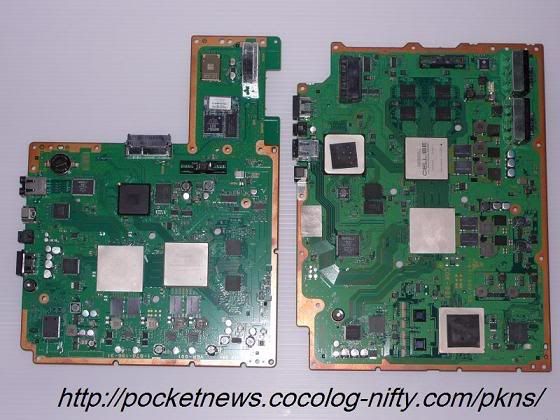
this is the one already in 80 and 160 gb


Around the Network

I'm not knowledgable on theses things.... but has the revision been turned around 90 degrees?

Because I see on the original in the top right of the photo are what look like the ports that the PS3 has under the flap thing... which means that is the front of the PS3 and thus the motherboard is shaped to fit the PS3 shape (wider that it is deep)

On the 2nd picture those ports are on the left hand side, but that is still of course the front of the console....which means that the board is actually deeper (front to back of PS3) than it is wide.... and there must then be some space cleared especially along the edge that the power button is.



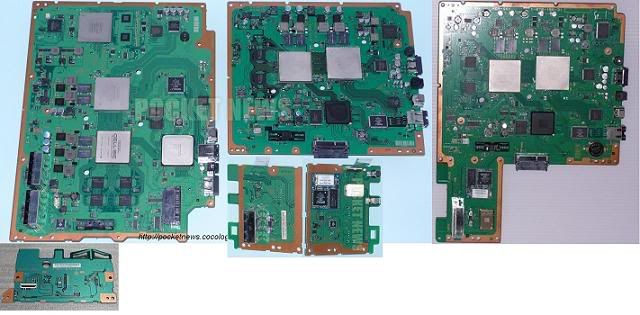
This article is wrong, it's not the latest mobo revision, the latest one has the wlan/bluetooth integrated into the main board. Below you can see how the latest one compares to the original one.


Below from left to right is a) the original mobo with wlan/bluetooth board, b) is the previous mobo mentioned in the article above with front and back of wlan/bluetooth board, and c) is the most recent mobo with integrated wlan/bluetooth board.


Smaller, cheaper but not small enough for slims


The size of the board isn't a problem for creating a slim PS3, the board is as slim as it can be already, what really needs to be shrunk is the cooling system. This is dependant on the size of the CPU and GPU dies. Sony are set to start production of 45nm Cell this year.

Below you can see how much the heat sink was reduced from the original 90nm CPU/ 90nm GPU through 65nm CPU / 90 nm GPU, and 65nm CPU / 65nm GPU.


Furukawa Electric Co Ltd exhibited a new heat sink for the PlayStation 3 (PS3), a game console developed by Sony Computer Entertainment Inc (SCE), at Techno-Frontier 2008. The exhibition took place from April 16 to 18, 2008, at Makuhari Messe in Chiba Prefecture, Japan.
The company defines the first heat sink mounted in the PS3, which was released in November 2006, as the first-generation product. And it already begun commercial production of the third-generation heat sink for the PS3. The third-generation product is characterized by its small size, light weight and low cost.

The heat sink developed by Furukawa Electric is used to cool the microprocessor "Cell" and graphics LSI "RSX." When Nikkei Electronics Teardown Squad disassembled the PS3 in November 2006, this heat sink, together with a large cooling fan whose diameter is more than 13cm, drew its attention (See related article).


The PS3, at first, is equipped with the Cell produced in 90nm process technology. But it was replaced with the Cell produced in 65nm process technology to reduce the cost and power consumption. Along with this change, Furukawa Electric reduced the size, weight and cost of the heat sink by, for example, decreasing the number of its components each time its generation changed.


Especially, the shift from the second generation to the third was drastic. In the first and second-generation products, a large heat sink cooled both the Cell and RSX. But they are cooled by separate heat sinks in the third-generation product.


Furthermore, copper heat pipes, which were used in the first- and second-generation heat sinks, are no longer used in the third-generation product. Five and two copper pipes were used in the first- and second-generation products, respectively. Furukawa Electric realized enough heat-radiation performance without using a heat pipe, the company said.


The first-, second- and third-generation products support power consumptions of about 200, 160 and 130-140W, respectively, for both the Cell and RSX.


The kinds of components are more than 20 for the first generation and about 10 for the second. But the third-generation product has only three kinds of components, a fin and pin made by aluminum and a thick aluminum plate used as a substrate. As a result, the weights of the first-, second- and third-generation products are about 700, 500 and 350g, respectively.


Link

The BD drive also needs reducing, Sony have been working on this:

Sony shrinks Blu-ray laser

25th January 2008 12:16 GMT
What do you get when you cross Sony with Japanese laser specialist Nichia? The answer’s a tiny blue-laser data reader module that paves the way for slimmer, cheaper and portable Blu-ray drives.


Sony’s new laser unit measures 14 x 7.4 x 3mm and is expected to be built into slimline Blu-ray drives that can be fitted into skinny laptops, in-car entertainment systems and handheld disc players, although it hasn’t mentioned anything about introducing the laser to Blu-ray drive in the PS3.
The module can read dual-layer Blu-ray Discs, but it's not capable of forming the basis for disc writers.
Mass-production of the laser is expected to start sometime this year, Sony said, but the electronics giant wouldn't reveal when it expects the first Blu-ray products featuring the new laser to become available.


Link


lol faulty information from Squilliam


Well, well. Thanks BKK2!



"We'll toss the dice however they fall,
And snuggle the girls be they short or tall,
Then follow young Mat whenever he calls,
To dance with Jak o' the Shadows."

Check out MyAnimeList and my Game Collection. Owner of the 5 millionth post.

Around the Network

Taking advantage of the 45nm manufacturing process and using smaller (laptop) disc-drives both Microsoft and Sony are in a position where they could probably reduce the size of their console by quite a bit ... Unfortunately, I suspect this would reduce the systems to the size of the Dreamcast, Gamecube, PS2, N64 and Playstation at launch, and not with what we typically consider a slim-line system.

Personally, I wouldn't be surprised if Sony and Microsoft waited until they took advantage of the 32nm process before they released a slim-line system.



Nice post BKK2, however I don't agree with this part:
The size of the board isn't a problem for creating a slim PS3, the board is as slim as it can be already, what really needs to be shrunk is the cooling system. This is dependant on the size of the CPU and GPU dies. Sony are set to start production of 45nm Cell this year.


Strictly speaking, that is true. However, I would think Sony would like to have it both slim and small... Making it just slim and the same area doesn't seem like a great idea.


My Mario Kart Wii friend code: 2707-1866-0957

Incidentally, first PS3 model (CECHA) weighed 5kg, the model I posted above (CECHL) weighs 4.05kg.



Thanks for clearing up this jibber-jabber BKK2. Good read.

I still say theres no price cut: Theres a new slim version released around April with a lower price than the current model.


NJ5 said:

Nice post BKK2, however I don't agree with this part:

The size of the board isn't a problem for creating a slim PS3, the board is as slim as it can be already, what really needs to be shrunk is the cooling system. This is dependant on the size of the CPU and GPU dies. Sony are set to start production of 45nm Cell this year.


Strictly speaking, that is true. However, I would think Sony would like to have it both slim and small... Making it just slim and the same area doesn't seem like a great idea.


True, but the current mobo is already quite a bit smaller than the original mobo, the reason it's currently just as long as the original is to accomodate the USB ports for the current case. It wouldn't be a major problem to reduce the length of the mobo by repositioning the USB ports for a different case. If you look at the pic with the three mobos you can see how much smaller the 40Gb mobo was than the original 60Gb mobo.