

I love the smell of blurred uncompressed textures in the morning!
Its horribly ironic that they use a media format that allows for uncompressed textures (at a terrible price) and then they go ahead and make their preferred method for AA a texture blurring scandal.
These are two different scenes from the same game (Saints Row II) and they are pretty much identical except for the type of Anti Aliasing used on the different consoles. Sony 1st party use this form of AA as well, so if there were comparable Xbox 360 versions of those games the same complaints could be raised as well.
When I look at these shots, the PS3 versions make me feel like my character isn't wearing his prescription lenses. Its not horrible by any means, but it does annoy me and it irritates my eyes a little when I look at the PS3 examples in comparison to the Xbox 360 examples. In the end I wish that Sony had sprung for a better GPU which can handle a similar MSAA spec to the Xbox 360, rather than relying on this technology. I do appreciate its subjective, many people will prefer the PS3 version and thats perfectly fine, there are pros and cons for both techniques but my personal preferrence is definately MSAA when possible.
Disclaimer: These are lossless images taken from a professional capture card so they can be considered accurate and representative. Also the systems in question ARE set up correctly.
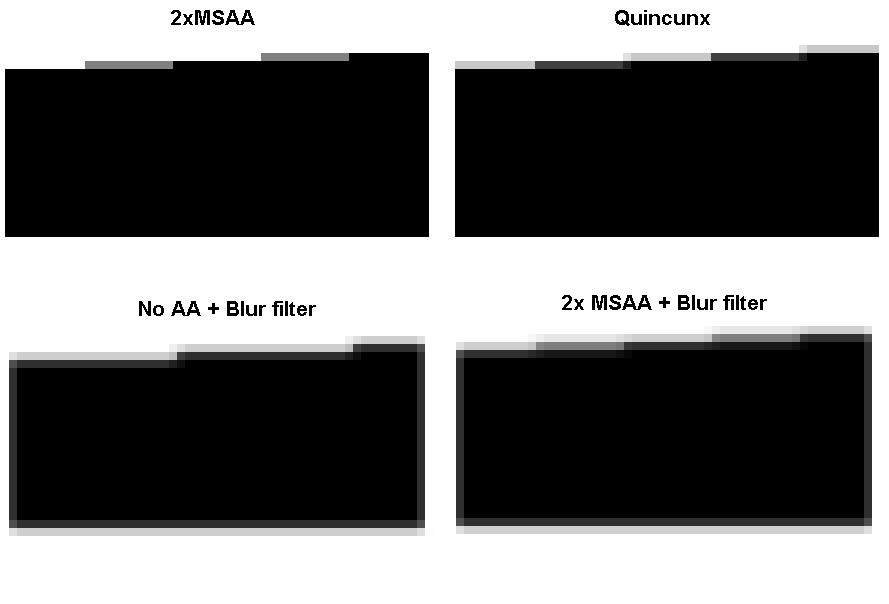
Quincunx AA: Two geometry sample points are used just like 2xMSAA (so the same storage cost), but it also uses 3 samples belonging to neighbouring pixels (regardless of a polygon edge) to the right and below of the original texture sampled point (see sample pattern image for clarity). The result is a blurring of the entire image, but higher perceived polygon AA. Consider a texture of higher frequency components, lots of different colour patterns. The current pixel's two geometry sample points indicate the pixel is entirely within one polygon. However, the three neighbouring sub-samples are still accounted for in the final pixel, hence the overall image blur.
MSAA: multiple geometry/sub-sample (reddish squares in below images) points with a particular weighting (surrounding the texture sample point, green square in below images) are used to determine the colour of the pixel being rendered. Sample positions can differ between AMD/nVidia. As RSX is based on the G70 architecture, the following sample patterns should apply. In the case of Xenos, it would not be unreasonable to assume that it uses the same patterns as ATI has used in the past (R300+).
The result for 2xMSAA is that there may be one intermediary shade in between polygon edge steps; one sample is found to be within one polygon (e.g. colour A), and the second sample is found in another polygon (e.g. colour B). If both sample points have equal weightings, the resultant pixel would be 50% colour A, 50% colour B. Obvious results are obtained when a polygon edge bisects the shortest imaginary line connecting the two geometry sample points. Hence, 2xMSAA for G70 will look slightly different to 2xMSAA for R520 (see sample positions below).
Heres an Example of how the patterns work
Tease.