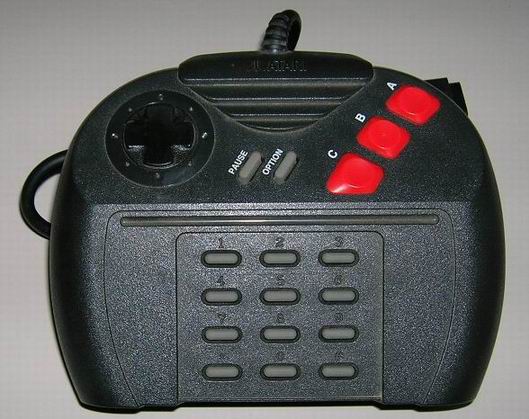
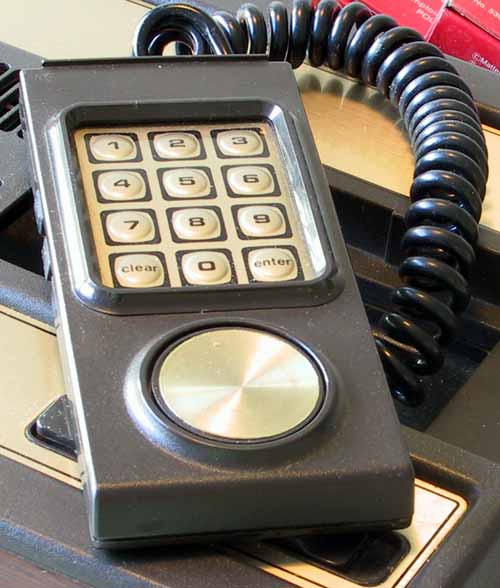
Ultimately more buttons only appeals to the hardcore gamer and developers, since for the developers it means they can add even more input options and for the hardcore gamer it means more complex games are possible. But to a non-hardcore gamer, the only thing that's really important is that the games are fun. To that end, more buttons is actually a detriment.
Buttons are just a single feature of many to consider. There are several values inherent in a controller: grip, complexity, ease of control, and intuitiveness. Let's look at each.
For grip, consider: the Atari 2600 joystick is really uncomfortable to use compared to the NES pad, which is mildly discomforting compared to the SNES pad, which is a bit lacking in extra grip compared to the PlayStation or N64 controller (though some prefer not having those grips). But that's about where the evolution of grip ends. We have gotten "good enough" for grip, possibly a bit over "good enough".
For complexity, consider: the 2600 had 1 button, and was considered very simple. The NES had 4 buttons, and was considered easy to use. The SNES had 8 buttons, and was seen as a bit tricky to get used to at first. The PS1 had 10 buttons initially, eventually expanded to 12. A lot of people I've shown a PS1 or PS2 controller to say it looks too complicated. So we've not only hit "good enough", we've actually overshot it.
For ease of control, consider: the 2600 joystick was stiff and largely unresponsive. The NES d-pad was comfortable enough, but lacked non-linear/analog precision. The N64 analog was quite suitable, if a bit too loose. The PS1/PS2 analog was also quit suitable, but a bit too tight. The GameCube analog was pretty much spot on. Nobody has made an an input method yet that overshoots the market, so presumably we have hit "good enough".
For intuitiveness, consider: the 2600 controller was very abstract; you gripped a stick and wiggled it around, and stuff happened. The NES d-pad was slightly more intuitive, but still abstract. The N64 and PS1 analog sticks were again slightly more intuitive, but still had you doing something you wouldn't do normally. For intuitiveness, we still have a long ways to go before we hit "good enough".
Now let's look at how the Wii Remote measures up to these values.
Grip: Closer to a SNES pad than an N64 or PS1 pad, when not counting the Nunchuk
Buttons: 7 on the Wiimote, 2 on the Nunchuk. Closer to what the SNES had.
Ease of Control: The pointer and Nunchuk analog stick both provide pretty standard control input that's easy to use.
Intuitiveness: Motion control is leaps and bounds ahead of the intuitiveness involved in moving an analog stick around, as is the pointer.
So what we get is: grip and buttons are behind the curve, but at the "good enough" points. Ease of control is right on par with the rest of the controllers out there, which also appears to be at the "good enough" point. Intuitively speaking, it runs circles around other controllers.
What we actually have with the Wii Remote is taking away of elements that have overshot the market, and improving elements that have undershot the market. In that sense, the Wii Remote is miles ahead of every other controller on the market that's trying to push more buttons, more analog sticks, and so on.