



By using this site, you agree to our Privacy Policy and our Terms of Use. Close

Forums - Politics - Israel-Hamas war, Gaza genocide

Israelis protest over settler killing of Awdah Hathaleen


Israeli protesters hold placards and portraits of activist Awdah Hathaleen at a protest in central Jerusalem on Sunday


Family of slain activist Awdah Hathaleen denied funeral as Israel withholds body

Fathi Nimer, the co-director of Palestinian Policy Network Al-Shabaka, says the withholding of the body of Awdah Hathaleen is a strategy to break the spirit of the Palestinian activist’s family and community.

“This is the denial of any form of closure for the family,” Nimer told Al Jazeera, adding that there are hundreds of Palestinian bodies held by the Israeli army in cemeteries. “This is a tactic to break the spirit of the village and to break the cycle of resistance that Awdah was inspiring.”

Hathaleen, a 31-year-old activist working to stop Israel’s expulsions of villagers of Masafer Yatta from their homes, was shot dead by an Israeli settler last week.

So far, Israeli authorities have refused to release his body for burial. They are demanding that the family agree to certain conditions for the body to be returned, including limiting the funeral to 15 people.

Nimer said it is unlikely that Hathaleen’s killing will bring any significant change, unless the international community applies a lot more pressure on Israel.

“These settlers don’t sprout out of nowhere. They are supported by the state, they have electricity, power, army support, and it’s not just individuals – so sanctions on individuals are not going to be the solution, neither are, unfortunately, marches,” Nimer said.

“There needs to be international actions to sanction Israel to stop this kind of behaviour.”


Awdah Hathaleen, left, with a group of his students


Israeli settlers ‘feel emboldened’ to attack and displace Palestinians in West Bank

Israeli settlers storming into a village … and trying to chase out communities have been an ongoing affair for weeks, months and even years, especially in those areas on the south hill of Hebron. You have similar happening in the areas around Nablus in the north of the occupied West Bank and also around Ramallah.

Now this is all part of a campaign to displace Palestinians. And if you look at the numbers, according to the United Nations humanitarian office, since the beginning of the year, there have been 740 settler attacks.

Since October 7, 2023, more than 48,000 Palestinians in the occupied West Bank have been forcibly displaced – the aim being that you displace the Palestinians and then you create settler outposts.

And now they’re emboldened as they have political cover within the Israeli government, very strong figures Itamar Ben-Gvir and the finance minister, Bezalel Smotrich, who can make or break Prime Minister Netanyahu.

They feel emboldened that they can go on [attacking and displacing Palestinians] without any kind of repercussions.


Around the Network

What is happening in the occupied West Bank?

Israeli military raids, killings, mass arrests and land grabs in the occupied West Bank have become a near-daily occurrence since the Hamas-led October attack in 2023. Here’s a recap:

  • According to the Office for the Coordination of Humanitarian Affairs (OCHA), at least 982 Palestinians have been killed since the start of the war in the Palestinian territory.
  • The Palestinian Prisoner’s Society says more than 10,700 Palestinians are currently in Israeli jails, including about 3,600 who are detained without charge.
  • Since October 7, 2023 and as of May 31, 2025, 6,463 Palestinians have been forcibly displaced following the demolition of their homes by Israeli forces, according to OCHA.
  • That figure does not include the approximately 40,000 Palestinians who have been displaced from three refugee camps in Jenin and Tulkarem, as a result of heavily militarised Israeli operations in the north of the occupied West Bank since January 2025.
  • Israel continues to expand and consolidate illegal settlements across the West Bank as part of the steady integration of these territories into the State of Israel. Earlier this month, Israel’s parliament passed a symbolic vote to apply sovereignty to the West Bank. While the motion has no legal implications, it could place the issue of annexation on the agenda of future debates in parliament.


Israeli settlers release livestock into Palestinian villages

Footage verified by Al Jazeera shows Israeli settlers releasing livestock into Palestinian villages in Masafer Yatta, south of Hebron in the occupied West Bank.

One clip shows an armed settler grazing sheep near a Palestinian home in the village of Shaab al-Batm, while another shows settlers releasing sheep into Khirbet al-Qawawis.

The Colonization and Wall Resistance Commission, a Palestinian government body, said in a statement published on Facebook that 1,821 attacks were carried out by Israeli forces and settlers in July, including 300 incidents in Hebron alone.

The commission said the attacks included “armed assaults on Palestinian villages, imposing facts on the ground, field executions, vandalism, land bulldozing, uprooting trees, property seizures, closures, and barriers that sever Palestinian geography”.


US House speaker visits illegal settlement in occupied West Bank

Mike Johnson has visited the illegal settlement of Ariel in the occupied West Bank.

Israeli newspaper Israel Hayom published a picture of the speaker of the US House of Representatives and his wife, Kelly Lary, next to Ariel Mayor Yair Chetboun. The publication said the image was taken after the two planted a tree.

According to Axios, it was a private visit organised by a pro-Israel advocacy group.


Hundreds in Turkiye protest against Israel’s starvation of Gaza


Hundreds of people gathered, chanting slogans and waving Palestinian flags outside the US consulate in Istanbul


Israeli opposition figure says Netanyahu ‘sacrifices everything’ to maintain power

Avigdor Lieberman, the leader of Israel’s ultranationalist Yisrael Beiteinu party, has launched a scathing attack on Benjamin Netanyahu, accusing him of dismantling Israel’s democratic foundations and isolating the country on the world stage.

In an interview with Israel’s Maariv newspaper, Lieberman said Netanyahu had “led us to political collapse worldwide”, asking: “How can a just war be turned into a war where all Israelis are outcasts in the world?”

His remarks come as Netanyahu faces increasing domestic unrest over his handling of the war on Gaza, and growing international scrutiny over war crimes and aid obstruction into the besieged enclave.

“There is an attempt to turn the state of Israel into an undemocratic state,” Lieberman warned, before questioning the government’s failure to return captives held in Gaza. “This is complete madness.”

He accused Netanyahu of sacrificing national values for political survival, saying that “the prime minister … sacrifices everything for his political survival.”

Australia announces $13m donation to Gaza aid

Australia’s Department of Foreign Affairs and Trade (DFAT) has announced that it is donating 20 million Australian dollars ($13m) to humanitarian organisations delivering food and medical supplies in Gaza.

DFAT said in a statement that the new support was due to “the announcement of new humanitarian corridors”.

Australia’s Minister for Foreign Affairs Penny Wong said that “Australia has consistently been part of the international call on Israel to allow a full and immediate resumption of aid to Gaza, in line with the binding orders of the International Court of Justice.

“The suffering and starvation of civilians in Gaza must end,” Wong said.

The announcement came a day after tens of thousands of Australians marched across the Sydney Harbour Bridge calling for Australia to pressure Israel to end its starvation of Palestinians in Gaza, including by imposing sanctions.

What new humanitarian corridors? Arms embargo, any sanctions yet?


US ambassador to Israel repeats disputed claims about Gaza aid

Mike Huckabee has claimed that the “real story of starvation in Gaza” lies not with the civilian population but with captives being held by Hamas.

“Will France, UK, & Canada condemn this?” the US ambassador to Israel wrote on X. “Why isn’t the massive amounts of food going in not shared with the very well fed members of Hamas?”

Huckabee also shared a graphic that stated “there is no policy of starvation in Gaza,” and that “Israel does not limit the amount of aid entering Gaza and has, in the past, facilitated the entry of up to 700 aid trucks per day, depending on UN and NGO supply.”

However, the UN agency for Palestinian refugees (UNRWA) has previously said that between 500 and 600 trucks of aid are required each day to meet minimum needs, yet that figure has rarely been reached.

The Integrated Food Security Phase Classification (IPC), a global hunger monitoring body, has also warned that the “worst-case scenario of famine” is now unfolding in Gaza. UN experts have accused Israel of using starvation as a weapon of war – a view echoed by rights groups, including Human Rights Watch.

The graphic shared by Huckabee further claimed that “UN-led aid distribution has stagnated after an initial increase, and the vast majority of it is diverted by Hamas.”

A USAID assessment in July found little evidence to support the assertion that humanitarian aid is being widely diverted by Palestinian armed groups.

Same playbook all throughout the genocide. Let in a bit of aid, make it impossible to distribute the aid, blame the UN and Hamas for not distributing / looting the aid.

Yes Israel has allowed sufficient aid in during the last ceasefire, the first couple days at least before Israel started harassing distribution and blocking aid again. That shows it's very much possible and it's all political will to prevent that from happening again.

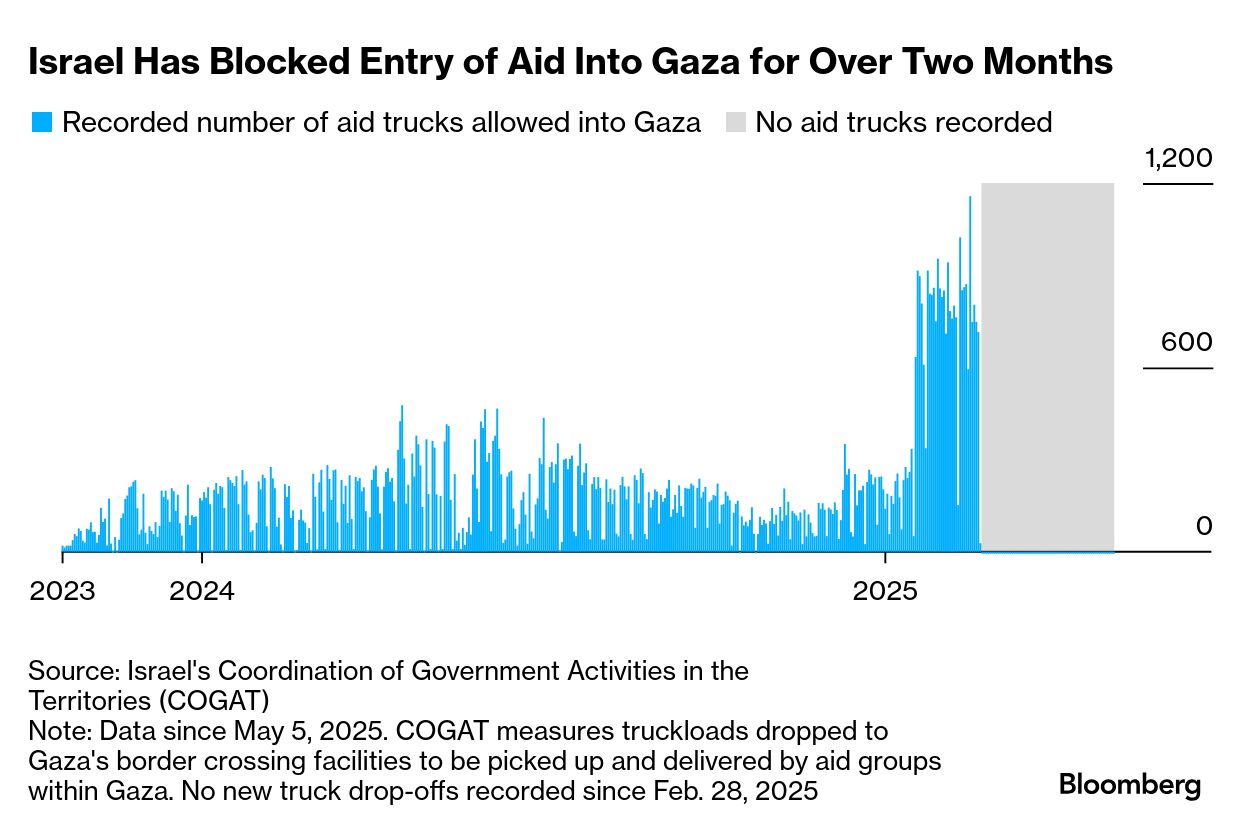
This was before the ceasefire in Februrari, touching at most 200 trucks per month a few times.


Here's Cogat's version


Counting half trucks if you compare the two (Where it touches 300 on the UNWRA chart it touches 600 on the COGAT chart) but showing that indeed it was no problem to let up to 1,200 (600 full trucks) into Gaza during the ceasefire. And then total blockade with currently COGAT claiming 100 trucks a day are passing the border. (out of 600 needed)

Israel allowing 14 percent of daily required aid to enter Gaza, GMO data shows

Gaza’s Government Media Office has told Al Jazeera that only 674 aid trucks have entered Gaza since Israel eased restrictions on July 27, averaging just 84 trucks per day.

Aid organisations say Gaza requires at least 600 trucks of aid and fuel a day to meet basic humanitarian needs – so the amount being allowed into the Strip is currently at 14 percent of the minimum required.


Gaza civilians face catastrophic hunger as aid falls short

The humanitarian situation in Gaza is nothing short of catastrophic, and UN agencies say two out of three famine thresholds have already been met.

It means that famine has become a very undeniable reality. Most of the people here are facing starvation-level conditions, with about 175 Palestinians in Gaza having died from hunger and malnutrition, most of them women and children.

Despite Israel’s latest announcement of easing aid access to Gaza, UN agencies say what is coming in is inadequate, as Gaza needs, according to the data, about 600 aid trucks daily. But what is getting in is a fraction of what’s needed, leaving civilians here quite vulnerable in dealing with the entire crisis.

These aid agencies, as well, stress that without immediate cessation of hostilities, Gaza is spiralling into an irreversible humanitarian collapse, and this has been pretty much clear given the collapse of law and order.


Most Palestinians are still risking their lives by going to the controversial aid centres that are run by the GHF.


‘We sleep hungry’: UNRWA worker recounts daily struggle in Gaza

Manar, a staff member with the UN agency for Palestinian refugees (UNRWA) in Gaza, says displacement, hunger, and exhaustion have become a relentless part of daily life.

“Every day I wake up not knowing what might happen,” she said in a testimony released by UNRWA. “We were forced to flee our home and since then life has never felt safe. And there is always the fear – fear of more bombing, fear of losing someone, being told to move again.”

Although she continues working, clean water and food are scarce. “I go to work, but my heart is there with my children. Even the simplest thing has become dreadful,” she said.

“There’s often no water for cooking or washing. Food is never enough. Sometimes we cook only rice, if we are lucky. Many nights, we sleep hungry. Our children cry because they are starving. As a mother, this breaks my heart.”

Manar described a desperate search for medicine amid the shortage due to Israel’s blockade.

“We walk for hours in the heat to find supplies. There are no cars, no buses, no help. We are exhausted, physically and emotionally. But we keep going. This is not just one day. This is our life.”


About water:

The daily water needs for humans vary, but a general guideline for healthy adults in temperate climates is about 15.5 cups (3.7 liters) for men and 11.5 cups (2.7 liters) for women.These are average recommendations and individual needs can fluctuate based on activity level, climate, health, and other factors.

15 liters minimum is standard including water use besides drinking (cooking/cleaning)

Gaza was down to 3-5 liters total per person per day in April. 
https://www.cbc.ca/news/world/gaza-palestinians-clean-water-israel-1.7507822
And it's only getting worse
https://www.unrwa.org/resources/reports/unrwa-situation-report-182-situation-gaza-strip-and-west-bank-including-east-jerusalem

As comparison we use about 61 gallons a day for 4 of us, 58 liters per person per day, cooking, cleaning, watering plants. Also some for drinking tea and water but also buy plenty to drink. 3-5 liters a day for all is hardly enough to stay alive in summer. It's 32c/33c all week in Gaza, no shelter.

Israel detaining 24 doctors from Gaza under harsh conditions, prisoner advocacy group says

The Palestinian Centre for Prisoners’ Defense said Israeli authorities continue to detain 24 doctors from Gaza in prison under harsh conditions.

The centre added in a statement that Israeli forces have arrested more than 400 medical workers since the start of the war in Gaza in October 2023, and that most of them were later released without charge.

Human rights reports have found that medical workers from Gaza have been subjected to torture and systematic humiliation while in Israeli custody, the centre said.


Around the Network

Two Palestinians killed near aid site in southern Gaza

Gaza’s ambulance service has reported that two people, including a woman, have been killed and more than 20 were injured after being shot near an aid site north of Rafah, in the south of the Gaza Strip.

Six people have been killed in the Gaza Strip since dawn on Monday, according to sources from hospitals in Gaza.


Israeli attacks kill several civilians in Gaza City and Beit Lahiya

Palestinian media reports that four people have been killed in an Israeli air attack that targeted civilians in the Shujayea neighbourhood of Gaza City.

Meanwhile, Al-Aqsa TV reports that a Palestinian was killed and others were injured when Israeli forces attacked a group of residents in the city of Beit Lahiya, northern Gaza.

At least eight Palestinians have been killed in Israeli attacks across Gaza since dawn on Monday, including two aid seekers, according to hospital sources.


‘I saw death to bring some flour for my children’

Many Palestinian parents in the Israeli-besieged Gaza Strip are risking their lives daily in a desperate search to find food for their forcibly starved children.

A mother named Zainab Dakka has shared her story of having to say goodbye to her children each time she leaves – not knowing if she will return:

“There was shooting and death, until I secured some flour, thank God. “I’m really happy, really really happy. I saw death to bring some flour for my children. Every day, they sleep while they are hungry. They want something good to eat.

“I kissed my sons and daughters (before going to get food aid); I didn’t know if I would return with food. Thank God, I got beans and some flour for the children, thank God.

“I wish every country would send flour to us. People go to get aid and they die. We don’t know whether they will return or not. I thought I would not come back to my children. That this would be my final day. But thank God, I returned safely and got them food.

“Who would feed me? I will go, once, twice, three times, four times, five times, until flour is secured. Even if I die, the most important thing is to secure flour for my children.

“If I don’t go, then we don’t eat. There is no work, there is nothing. If we don’t go to Zikim [aid distribution point], my children would keep crying. “No one will give you anything unless you go and risk getting killed trying to find some flour or something for your children. Everyone is out for themselves.”


Zainab Dakka stands outside her tent with her daughter and a bag of flour she brought back from an aid delivery, in Gaza City


At least 94 killed in Israeli attacks on Gaza in past 24 hours

The latest daily casualties update from the Health Ministry in Gaza is in.

At least 94 Palestinians were killed and 439 others wounded in the past 24-hour reporting period, it said in a statement. Among the dead were 29 people killed while attempting to collect humanitarian aid.

The ministry said the total number of people killed in Israeli attacks since the start of the war has now reached 60,933, with 150,027 wounded. Since March 18 alone, when Israel broke a ceasefire deal, Israeli attacks have killed 9,440 people and wounded nearly 38,000.

Civil defence crews continue to report that victims remain trapped under rubble and on roads inaccessible to ambulances.

Earlier, we reported that health officials also recorded five new deaths due to famine and malnutrition in the past day. The overall number of such deaths now stands at 180, including 93 children.


Israeli forces kill 41 people across Gaza since dawn

At least 41 Palestinians have been killed in Israeli attacks across Gaza since dawn, including 20 aid seekers, sources at Gaza hospitals tell Al Jazeera.


Palestinian Foreign Ministry urges UNSC to ‘halt genocide’

The Palestinian Foreign Ministry has called on the UN Security Council (UNSC) to “assume its responsibilities” by enforcing an immediate ceasefire in Gaza and conducting an official visit to the territory.

In a statement posted on social media, the ministry urged the council to “halt the crimes of genocide, displacement, and annexation against our people” and to implement the outcomes of a recent UN conference calling for a two-state solution.

The ministry warned that more than two million Palestinians in Gaza are “living in a tight death circle of killing, starvation, thirst, and deprivation of medicine, treatment, and all basic human rights”.

It also questioned the role of some Security Council members, accusing some states of “deliberately prolonging the war in service of various political agendas and interests”.

The ministry said a UNSC visit to Gaza is essential to “break the Israeli siege and blackout”, adding that delays in enforcing a ceasefire only serve “plans for the forced displacement of our people”.


Three die from Guillain-Barre Syndrome in Gaza

The Palestinian Ministry of Health in Gaza has confirmed three deaths from Guillain-Barre Syndrome (GBS), a rare nerve condition that can cause sudden muscle weakness or paralysis.

Two of the victims were children under the age of 15, who died after life-saving treatment became unavailable due to the ongoing blockade.

The ministry has warned of a sharp increase in infections and severe malnutrition, particularly among children, which it says has created a “fertile environment” for the uncontrolled spread of viruses.

In a statement, officials said the collapse of Gaza’s health and environmental systems poses a grave threat to Palestinians. “These are not just deaths… They are a warning of a real, potential infectious disaster.”

The ministry is calling on international and humanitarian organisations to urgently supply critical medicines and treatments, while it expects a limited number of WHO aid trucks with medicine to arrive in Gaza later today.


At least 56 people killed in Israeli attacks since dawn: Medical sources

Sources at Gaza’s hospitals tell Al Jazeera that 56 people, including 27 aid seekers, have been killed in Israeli attacks since dawn.

Sources at Gaza City’s al-Shifa Hospital also said three aid seekers were killed and 15 injured in a recent Israeli attack in northern Gaza.


Red Cross ‘appalled’ by videos showing captives in Gaza

The International Committee of the Red Cross (ICRC) has said it is “appalled by the harrowing videos” released by Palestinian groups showing Israeli captives held in Gaza.

“All forms of public exposure that humiliate persons deprived of liberty and endanger their safety must be avoided,” the ICRC said in a statement. “We have said from day one, and we reiterate, that all hostages must be released immediately and unconditionally.”

The comments come after Hamas and Islamic Jihad released separate videos showing two of the captives held in the enclave. One of them, Evyatar David, looks emaciated as he digs what he said is his own grave.

There are about 50 captives still in Gaza. At least 20 of them are thought to be alive. Hamas on Sunday said Israeli captives held in the besieged territory “eat what our fighters and all our people eat”, but added it is open to the ICRC delivering aid to them.

Red Crescent says Israeli forces kill Palestinians waiting for aid in central Gaza

Paramedics from the Palestine Red Crescent Society (PRCS) say they have recovered the bodies of two Palestinians and treated 11 injured people after Israeli forces targeted a group of civilians waiting for humanitarian aid in central Gaza.

In a statement posted to social media, the PRCS said the casualties occurred in the Netzarim Corridor, a stretch of land in central Gaza that Israeli forces have turned into a militarised zone.

Footage shared by the PRCS shows the aftermath. In one clip, medics carry a wounded man into the back of an ambulance before rushing him to a nearby medical facility.

Another video shows paramedics wrapping a body in a white blanket. Other footage captures a man with his arm in a sling being wheeled into hospital alongside other wounded people.

A day earlier, the PRCS said one of its own team members had been killed and two injured in what it said was an Israeli attack on its headquarters in Khan Younis.


Palestinians seeking aid at GHF point in central Gaza


Gaza needs ‘sustained food supply’ to reverse hunger crisis, Save the Children says

While the news of starvation coming out of Gaza is “nothing short of catastrophic for children who are being bombarded in tents and are really struggling to access basic supplies”, the extent of the suffering in the Strip is likely being underreported amid difficulties in reporting from the ground, a senior Save the Children official has said.

“Definitely it’s much worse for children who are terrified that they might be killed at any moment,” Ahmad Alhendawi, Middle East director of Save the Children International, told Al Jazeera from Amman in Jordan.

“The children we reach out to through our teams on the ground are telling us they are not only terrified of dying, they are terrified that even if they survive [an attack] they might not be found under the rubble. This is a catastrophic, apocalyptic reality for children in Gaza.”

Alhendawi said all impediments to aid reaching people in Gaza must be removed by Israel to begin to reverse a starvation crisis that is months in the making.

“This is about almost four months of this blockade, of starvation that has built over weeks and months and to come back from that point of extreme malnutrition and starvation requires a sustained supply of food and medical equipment and also food supplements for children in need,” he said.

“It’s possible to reverse some [of the damage done to children by hunger] but I’m afraid that some of this damage would be irreversible at this stage.”


Israeli-orchestrated starvation takes toll on children in Gaza

From tents to hospitals, the presence of starving and malnourished children is becoming more common in Gaza.

Mosab al-Dibs is among them. The 14-year-old has been at al-Shifa Hospital in Gaza City for about two months after suffering a severe head injury when an Israeli air raid struck his family’s tent in May.

The boy is largely paralysed and severely malnourished because the facility no longer has supplies to feed him. “Mosab now suffers from severe malnutrition,” his mother, Shahinaz al-Dibs, said. “He suffers convulsions as a result of a hit that affected his brain. Even his nerves are stiff.”

Due to an Israeli blockade, the UN says the impact of hunger, which has been building for months, is quickly worsening, especially in Gaza City and the north.

In recent weeks, only a trickle of aid has entered Gaza, leading to alarming levels of Israeli-orchestrated starvation. “During this period, the children suffered malnourishment due to starvation,” Suzan Marouf, a doctor at Friends of the Patient Hospital, said, adding that medics are struggling to provide care.

“There are not enough nutritional supplements. We have some children that we keep in the hospital to observe due to extreme malnutrition.”

Forced starvation stalking Gaza’s most vulnerable first

Months of an Israeli blockade in Gaza has affected children with pre-existing health conditions – and those wounded in Israeli attacks – the most. At a school-turned-shelter for displaced Palestinians in northern Gaza, Samah Matar cradles one of her sons.

Six-year-old Yousef and his four-year-old brother Amir have cerebral palsy and need a special diet. With little food in the past few months, their fragile little bodies have begun to shrink.

Youssef weighed 14kg (31lb) before the war. Now, he weighs 9kg (20lb). Amir, who weighed 9kg, is now less than 6 (13lb).

“These children have special feeding needs. Now, there is no baby formula or diapers, and I can hardly find flour for them. Sugar, the main ingredient in their meals, is unavailable,” Matar said. “Before the war, their health was excellent. They were provided with special meals, fruits, vegetables, and dairy products.”


A Palestinian child fills his schoolbag with leftover flour instead of books

While children across much of the world are enjoying their summer holidays, children in Gaza are preparing for another day of hunger, displacement and living under siege.

In a video verified by Al Jazeera, a Palestinian boy is seen bending down to scoop up leftover flour from the ground and place it carefully into his schoolbag.

“A child collects the remaining flour on the ground and puts it in his school bag, which was supposed to contain his school books and enable him to learn like the rest of the children of the world,” wrote Mohammed Al-Yaqoubi, the photographer and filmmaker who recorded the footage.

https://www.instagram.com/reel/DM5wm8bsim5