By using this site, you agree to our Privacy Policy and our Terms of Use. Close

Forums - Politics - Israel-Hamas war, Gaza genocide

Kushner unveils new plan for Rafah

The Rafah border crossing between Gaza and Egypt will reopen next week for two-way travel.

Israel, which controls the Gaza side of the crossing, has rejected reopening it until Hamas fulfils its ceasefire obligation of returning the remains of the last captive ‌held in the territory.

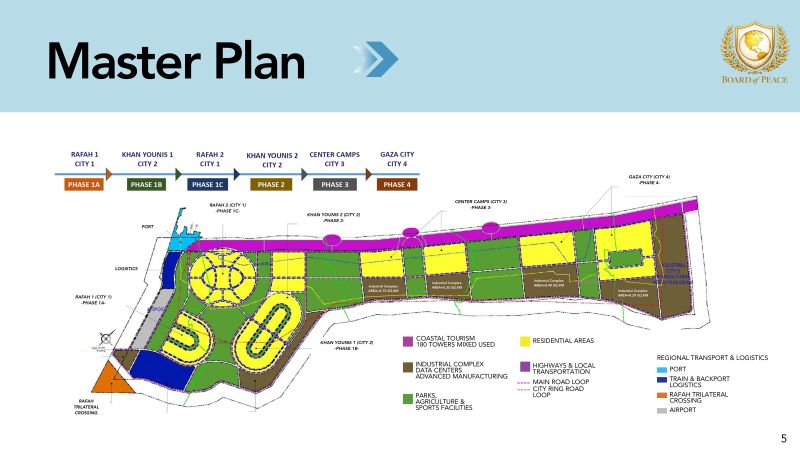
Trump’s son-in-law Jared Kushner presented a four-phase “master plan” for Gaza today, displaying maps showing coastal tourism zones, mixed-use towers, residential and industrial areas, with projections of more than $10bn in GDP by 2035, and 500,000 new jobs with at least $25bn in investments for modern utilities and public services.

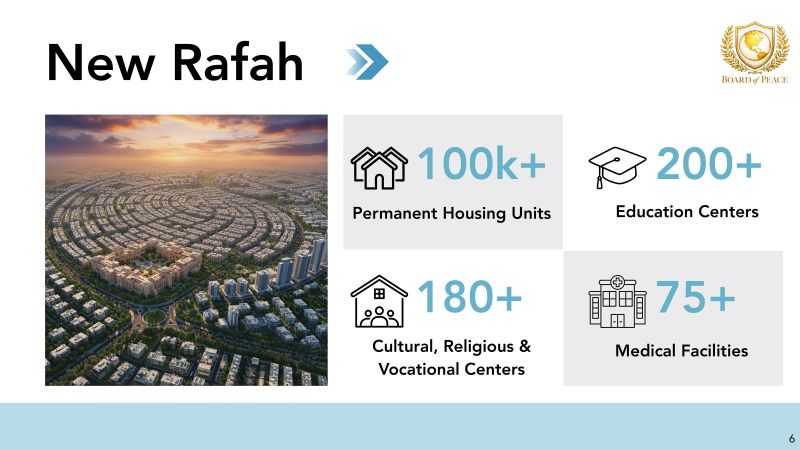
Plans for the new Rafah include more than 100,000 permanent housing units, at least 180 cultural and religious centres, 200-plus education facilities and 75-plus medical centres.


Gaza framed as a ‘planning’ site at Davos

Looking at what was presented in Davos, it was a sanitised, cosmetic image. Those shiny posters present Gaza more as a future investment project than as a place that needs immediate help and support for people who are on the verge of collapse.

That’s the problem. It is not being dealt with as a place where people are being killed and starved, and being pretty much cornered in every way possible by the acts that the Israeli military is conducting on the ground.

The danger stems from the fact that Gaza is being discussed as an investment and a planning site, rather than as a place where people are being killed on a daily basis – largely ignoring the displacement, the genocidal acts, the starvation and the misery.

Jared Kushner reveals there’s no plan B for “peace” in Gaza.

Plus: Andy Burnham’s path to PM has become a step clearer, Zack Polankski calls for Palantir to have no role in the NHS, and Starmer defiant over Greenland.


Around the Network

What’s happening in Palestine as politicians sign up for ‘Board or Peace’?

While international attention has focused on the launch of the proposed “Board of Peace”, killings and arrests have continued across Gaza and the occupied West Bank:

  • Medical sources at al-Shifa Hospital said four people have been killed by Israeli fire in Gaza City.
  • The Palestinian Health Ministry in Gaza said 11 bodies and seven wounded people were brought to hospitals across the enclave in the past 48 hours.
  • The Palestinian Civil Defence reported that an infant died from hypothermia in central Gaza amid an ongoing cold snap.
  • Israel’s National Security Minister Itamar Ben-Gvir approved gun licences for Israelis in 18 additional illegal settlements in the occupied West Bank.
  • Israeli forces detained Palestinians during raids near Jenin, Nablus and Hebron, as military operations in parts of the West Bank continued.
  • Israeli settlers entered the evacuated settlement of Tarsala, south of Jenin, under military protection, while dozens also raided the Al-Aqsa Mosque compound in occupied East Jerusalem.


How are Palestinians reacting to the ‘Board of Peace’?

Manal al-Qouqa, a displaced mother in Gaza said the “so-called peace council they talk about does not exist in reality”. 

“Every time they announce something regarding the Palestinian people, our suffering only increases,” she said.

“What peace are they talking about, when on the ground there is neither peace nor security? We are living a real tragedy. I wish it were like the 1948 Nakba that we once lived through – this is a new, modern Nakba, advanced in every aspect of life. There are no basic necessities for living.”

Suhail al-Hanawi, another displaced Palestinian said Netanyahu and Trump, both part of the board, “are the ones behind wars worldwide”.

“Regarding the Board of Peace and us, the displaced in the camp, there’s nothing tangible that makes us feel that anything will actually be fixed or that our suffering will be eased.”


The body of three-month-old Palestinian baby Shatha Abu Jarad, who died of cold weather according to medics, is carried by her uncle at al-Shifa Hospital in Gaza City


‘No one consulted us on Board of Peace’: Palestinian NGO chief

Amjad Shawa, director of the Palestinian NGOs Network in Gaza, says Palestinian civil society and official bodies are nowhere to be seen at discussions surrounding the newly formed “Board of Peace”.

“We were surprised, as Palestinian actors on the ground, after 10 years of work, and especially the last two years of work in Gaza, that no one consulted us about the plans for Gaza and its future,” he said before warning that, while leaders focus on ceremonies, conditions inside the Gaza Strip continue to deteriorate.

“At the time these leaders are holding ceremonies, Israel is using this period to continue its actions in Gaza.”

Shawa called on the US to exert real pressure on Israel to lift the blockade and allow crucial goods, particularly construction materials, into Gaza to enable early economic and social recovery.


This is not living, it is execution’

Displaced Palestinian Saed Na’im expressed scepticism over talk of peace and proposed development plans for Gaza in light of the Board of Peace summit in Davos.

“We hear about peace, but we don’t really know. We can’t see or feel anything tangible, and we don’t know when it will happen,” he told Al Jazeera.

“The situation is terrible tents in winter with freezing cold. A few days ago, nine children died from the cold. What are these tents? If it were for three months, people could endure it. But it’s been years and more years to come. This is not living, it’s execution.”


A displaced Palestinian man lights a fire near his family’s makeshift tent, near an area marked as ‘Yellow Line’ by the Israeli military, in east of Gaza City


UN says 230,000 women, girls face health service crisis

More than 230,000 girls and women, including nearly 15,000 pregnant women, in Gaza are facing limited access to reproductive health services because of Israeli military operations despite a ceasefire deal, the UN has said.

The spokesperson for the UN chief cited the UN Population Fund (UNFPA), which warned that “there is an increased risk of gender-based violence, child marriage, and exploitation of women and girls”.

Stephane Dujarric added that damage to health facilities, safe spaces and clinics, combined with displacement and flooding, has “sharply limited access to psychosocial support and medical care”.


Families in Gaza struggle to survive as they burn plastic for heat and cooking

For Sanaa Salah, who lives in a tent with her husband and six kids, starting a fire is a critical daily chore to cook and stay warm.

Her family has barely enough clothes to keep warm. She said the family cannot afford to buy firewood or gas, and that they are aware of the dangers of burning plastic but have no other choice.

“Life is very hard,” she said as her family members threw plastic and paper into a fire to keep it burning. “We cannot even have a cup of tea. “This is our life. We do not sleep at night due to the cold.”

Another Gaza resident, Aziz Akel, said firewood was too expensive. His family has no income, and they could not pay the seven or eight shekels (about $2.5) it would cost.

“My house is gone, and my kids were wounded,” he said. His daughter, Lina Akel, said he leaves the family’s tent early each morning to look for plastic in the rubbish to burn.


The Voice of Hind Rajab earns Academy Award nomination

The Voice of Hind Rajab, a film inspired by the final moments of a five-year-old Palestinian girl killed in Israeli fire in Gaza, has been nominated for an Academy Award in the Best International Feature Film category.

Directed by Tunisian filmmaker Kaouther Ben Hania, the film is based on the true story of Rajab, who was trapped in her family car on January 29, 2024, after it came under Israeli army fire in Gaza City. She was later found dead after nearly two weeks of uncertainty.

Rajab was travelling with her family, including 15-year-old cousin Layan Hamadeh, fleeing fighting in northern Gaza when they came under Israeli fire, according to the Palestine Red Crescent Society (PRCS).

The film centres on the real audio recording of Hind’s final phone call to the PRCS in which she pleaded for help.

The recording, widely shared on social media after her death, sparked international outrage and renewed calls for justice. Two paramedics who attempted to reach her were also killed when their ambulance was hit by Israeli strikes.


Australian, Palestinian lawyers seek police probe of Israeli president

Three Australian and Palestinian legal groups have formally called on the Australian Federal Police (AFP) to investigate Israeli President Isaac Herzog for his role in alleged war crimes amid reports he will visit Australia early next month.

The organisations said on Friday that they had written to “urgently alert” the AFP of their concerns “in light of serious and credible criminal allegations of incitement to genocide and advocating genocide” by President Isaac Herzog during Israel’s “military onslaught” in Gaza since October 7, 2023.

The Australian Centre for International Justice (ACIJ), Al-Haq, and the Al Mezan Center for Human Rights included a 10-page submission detailing the allegations against Herzog as well as Australia’s obligations under international law and its own domestic law.


“Where credible international findings indicate incitement to genocide and where domestic accountability has not occurred, Australia has both the legal authority and responsibility to act,” Rawan Arraf, executive director at the ACIJ, said in a statement.

Arraf also said that the Australian government would be showing a “blatant disregard” for its international legal obligations “by allowing Herzog to enter Australia without an AFP investigation”.

Shawan Jabarin, the general director of Al-Haq, noted that Herzog has said that there are “no uninvolved civilians in Gaza” and was the head of state as Israel killed 23,000 children and 1,000 babies “before their first birthday” in Gaza.

“Even the IVF clinic was bombed, destroying 4,000 human embryos and the hope of future life,” Jabarin added.

Herzog is due to visit Sydney on February 7, The Times of Israel newspaper reports, at the invitation of Australian Prime Minister Anthony Albanese in the wake of last month’s mass shooting that targeted a Jewish celebration at Bondi Beach and left 15 people dead.

Albanese told reporters in December that the Australian government had extended an invitation to Herzog “to honour and remember victims of the Bondi anti-Semitic terrorist attack and provide support for Jewish Australians and the Australian Jewish community at this time”.

However, Jewish Council of Australia executive member Ohad Kozminsky told Australian public broadcaster SBS last month that a visit from Herzog following the Bondi attack “will only inflame tensions and exacerbate division in our community”, considering he is the “head of a foreign country that has been committing genocide”.


Around the Network

180 skyscrapers for Gaza: Trump’s son-in-law Kushner unveils ‘masterplan’ for enclave’s reconstruction

https://www.cnn.com/2026/01/22/middleeast/kushner-trump-postwar-plan-gaza-board-peace-davos-intl-latam

“We have a masterplan. … There is no Plan B.”

Thus spake Jared Kushner, unveiling his vision for postwar Gaza in front of an audience of the World Economic Forum at Davos.

If it failed, he said, blame would be easy to ascribe. “If Hamas does not demilitarize, that will be what holds back the people of Gaza from achieving their aspirations,” he said.

Coastal tourism, an airport and a port


Jared Kushner presents a plan for post-war Gaza following a signing ceremony for the “Board of Peace” at the World Economic Forum on January 22, 2026 in Davos, Switzerland

Completely wiping out the remains and history of Gaza...


Kushner highlighted two urban developments, which he referred to as New Rafah and New Gaza.

At “New Rafah,” more than 100,000 permanent housing units would be built, along with over 200 schools and more than 75 medical facilities, he said. He expressed hope that the construction would be completed within two to three years. Work has already begun to remove the rubble, he said.


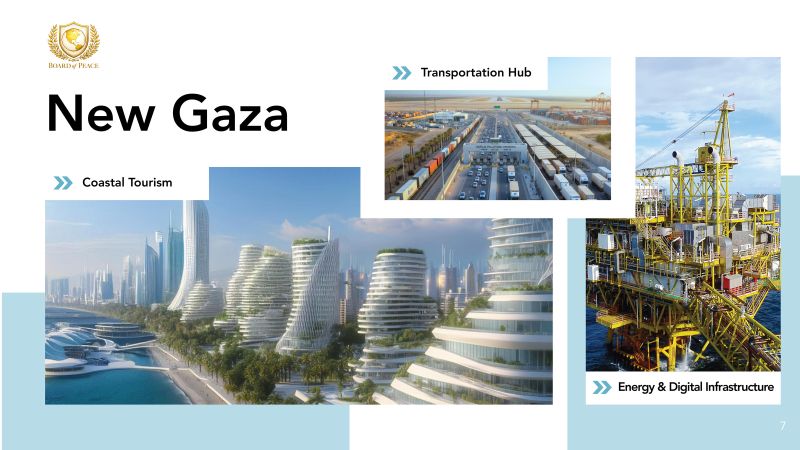
“New Gaza” is to be a center of industry, with the aim of achieving 100% full employment, Kushner said. Computer-generated images suggest a metropolis bearing a strong resemblance to Persian Gulf cities like Doha and Dubai, with gleaming waterside accommodations and office locations. 


This is what it reminds me of, but in a horizontal layout... Dystopian nightmare.


The city in Fritz Lang's 1927 film Metropolis is a towering, dystopian vision of 2026, split vertically by class: opulent skyscrapers for the elite above, and vast, mechanized underworlds for the oppressed workers below

Undoubtedly, the scale of the task is enormous, and the presentation was scant on details about how it would all be realized. Two years of Israeli bombardment, launched in response to Hamas’ attack on Israel on October 7, 2023, has left more than 80% of Gaza’s buildings damaged or destroyed.

Who’s going to pay for it?

Governments will make the first contributions, Kushner said, with initial announcements to come at a conference in Washington in the next couple of weeks.

He also appealed to the private sector to come forward, promising “amazing investment opportunities.” “I know it’s a little risky to be investing in a place like this, but we need you to come, take faith, invest in the people,” he said.

While senior Palestinian officials have been slow to react to Kushner’s presentation, criticism from elsewhere has highlighted a sense that their powerlessness is being exploited.

“Palestinians face a plan to eliminate their very presence, based on domestication, subjugation, and control,” Ramy Abdu, the Palestinian founder of the Euro-Mediterranean Human Rights Monitor group, posted on X.

...

It is not the first time Trump’s son-in-law has unveiled an ambitious vision for Gaza.

In 2019, he hosted a summit in Bahrain under the title, “From Peace to Prosperity,” which also imagined “a bustling commercial and tourist center in Gaza and the West Bank, where international businesses come together and thrive.”


Feet dragging, division and obstruction: What Israel really wants for Gaza

Israel has spent more than two years attacking Gaza in its genocidal war on the Palestinian enclave. It has destroyed the majority of its housing and infrastructure, and killed more than 70,000 Palestinians, leaving the rest of Gaza’s population facing a harsh winter with inadequate food, medicine, and shelter.

And yet Israeli Prime Minister Benjamin Netanyahu – for whom the International Criminal Court has issued an arrest warrant for war crimes committed in Gaza – this week joined US President Donald Trump’s “Board of Peace”, established to oversee the reconstruction and governance of Gaza.

It opens up the question of what Netanyahu – and Israel – actually want from the Palestinian territory, and whether they want the territory to rebuild or just want a continuation of the status quo.

Ahead of Netanyahu lies a difficult journey, observers say. With Israeli elections looming later this year, he must appear to the world and the Israeli public as working with US ambitions for Gaza.

But he also needs to maintain his governing coalition, which relies in part on elements, such as his Finance Minister Bezalel Smotrich, who are not just opposed to the reconstruction of Gaza, but also opposed to the ceasefire in a territory that he and his allies – as religious Zionists – regard themselves as divinely entitled to settle upon.

So far, things do not seem to be going entirely Netanyahu’s way. He has failed to delay the transition to the second phase of Trump’s three-phase ceasefire plan, despite Hamas’s refusal to disarm. Similarly, despite his objections, Gaza’s Rafah crossing is due to open in both directions, allowing people in and out of the enclave, next week. Lastly, his protestations against Turkiye and Qatar joining the Board of Peace, and potentially deploying forces to Gaza as part of a proposed International Stabilisation Force, also appear to have been overruled by the US.


Settlement or security

At home, Netanyahu’s cabinet remains divided on Gaza. On Monday, Smotrich not only slammed US proposals as “bad for Israel”, but on Monday, called for the US base in southern Israel responsible for overseeing the ceasefire to be dismantled. Meanwhile, others in the Israeli parliament have primarily focused on the upcoming elections, aiming only to galvanise their political base, regardless of ideology.

Netanyahu continues to insist that Hamas will be disarmed, and the Israeli military is working on razing territory all along the border with Gaza, creating a buffer zone deep into the coastal enclave.

Even if Hamas does not completely lose all its weapons, it has been weakened, and pushing Palestinians further away from the Israeli border allows the Israeli government to project the image of security for its population.

The Israeli public, exhausted after more than two years of war, largely relegates the consequences of Israel’s actions to the back pages of national media.


“The public is deeply divided on Gaza and the Board of Peace,” said American-Israeli political consultant and pollster Dahlia Scheindlin. “Though there’s a minority bloc favouring resettling Gaza, most of Israeli society is splintered. People typically view Gaza with a mixture of fear and a need for security, driven entirely by the events of October 2023. They want Israel to remain in Gaza in some form and don’t trust outsiders to handle it. At the same time, there’s hope that US involvement could achieve what two years of war couldn’t.”

“However, nearly everyone starts from the same point: Anything is better than going back to war,” Scheindlin said.

“They don’t have a strategy, and everything is chaos,” peace campaigner Gershon Baskin said, referring to Israel’s leaders. “They’re in election mode and only speaking to their base. I went to the Knesset yesterday. It’s like watching lunatics in a house of madness. It’s a disaster.”

For much of the public, Palestinians remain invisible. “They don’t exist. Israel has probably killed more than 100,000, but the majority of Israelis don’t know or care what’s going on the other side of the border. We even dispute there’s a border; it’s just ours,” Baskin said. “We don’t even see it on TV. All they show are old clips on loop. You can find images of Gaza on social media, but you have to go looking for it.

“Most Israelis don’t.”


Palestinians walk through the destruction caused by the Israeli air and ground offensive in the al-Shati camp, in Gaza City



Divided politics

Many Israeli leaders agree on one thing – that there will not be a Palestinian state.
How to reach that goal, or the details that accompany it and how Gaza fits into it all, are open to interpretation.

Irrespective of the outcome of the US-backed Gaza ceasefire process, Israel will remain alongside a territory, Gaza, against whose population it is accused of genocide. Currently, according to analysts within Israel, there appears to be no plan for the coexistence that geography dictates, only the unspoken suspicion that outside powers, in this case the US, are not really capable of determining how best to achieve it.

Even Israel’s commitment to US plans is open to question, with Netanyahu – when safely outside of Trump and his team’s earshot – framing the ceasefire’s second phase as a “declarative move”, rather than the definite sign of progress described by US envoy Steve Witkoff.

“The genocide hasn’t stopped. It’s continuing; it’s just moved from active to passive,” said Israeli lawmaker Ofer Cassif. “Israel is not bombing Gaza as before, but now it is leaving the people there to freeze and starve. This isn’t happening on its own. This is government policy.”


Rights advocates welcome Canada’s exclusion from Trump’s ‘Board of Peace’

Mark Carney should not join US plan for Gaza that ‘makes mockery of Palestinian self-determination’, rights groups say.


As world leaders discuss Gaza's reconstruction, Palestinians continue to suffer under Israeli attacks and aid restrictions

Canadian human rights groups have welcomed Donald Trump’s decision to revoke an invitation for Prime Minister Mark Carney to join the United States president’s so-called Board of Peace, saying Canada should not take part in a “colonial scheme”.

The National Council of Canadian Muslims (NCCM) said on Friday that “it is a relief that Canada is no longer welcome” on the Trump-led board.

“At a time of mass war crimes and humanitarian disaster in Gaza, Canada should be trying to align with international law and human rights,” the group said on social media.

“The ‘Board of Peace’ makes a mockery of Palestinian self-determination and Canada should have nothing to do with it.”

That was echoed by the advocacy group Canadians for Justice and Peace in the Middle East (CJPME), which said Carney’s participation would have given the board “undeserved legitimacy”.

“Canadians want to see principled opposition to Trump’s power grab, not mixed messages,” the organisation said on X.


Trump announced late on Thursday that he had withdrawn an invitation to Carney to join what the US president said would be “the most prestigious Board of Leaders ever assembled, at any time”.

Trump did not say why his invitation to Carney to join the Board of Peace was rescinded.

But the move came just days after the Canadian prime minister said during a well-received speech in Davos that a US-led world order faced a moment of “rupture” amid coercion and threats. The Canadian prime minister’s remarks drew the ire of Trump, who warned Carney during his own Davos address that “Canada lives because of the United States”.

I would have rather had Carney reject his invitation, but this works too. 


Israeli drone strike kills two children collecting firewood in Gaza

Two children have been killed in an Israeli attack in northern Gaza in the latest violation of its ceasefire deal with Hamas in the Palestinian enclave.

Medical sources in Gaza on Saturday said the children belonging to the same family were killed when an Israeli drone struck civilians gathering firewood near Kamal Adwan Hospital in northern Gaza.

Severe fuel shortages have forced many Palestinians to search for fuel wherever they can amid low temperatures that drop as low as 10 degrees Celsius (50 degrees Fahrenheit) at night these days.

Palestinians living in makeshift tents have little protection from strong winds and rain, as most shelters are made of thin canvas and plastic sheets.

Israel continues to block or limit the number of vital aid entering the territory, such as tents, mobile homes or materials to fix tents, in violation of the ceasefire it agreed with Hamas in October, as well as its obligations under international law as the occupying power in the Strip.


In a related development on Saturday, the Palestinian Health Ministry in Gaza said the number of child deaths caused by cold weather since the start of the current winter season has risen to 10 with the death of another child.

“The child, Ali Abu Zour, aged three months, died due to severe cold at Al-Aqsa Martyrs Hospital,” without specifying the date of death. The ministry added that the death “raises the number of child fatalities caused by cold weather since the beginning of the winter season to 10”.