By using this site, you agree to our Privacy Policy and our Terms of Use. Close

Forums - Politics - Israel-Hamas war, Gaza genocide


US capture exposes Palestinian Authority’s hidden support for Venezuelan dictator Maduro - opinion

Venezuelan President Nicolas Maduro said he spoke by phone to Palestinian Authority President Mahmoud Abbas on Sunday about the situation in Gaza, and pressed for the establishment of a humanitarian aid corridor to help the local population. On social media platform X, Maduro condemned what he called "indiscriminate attacks on the civilian population by Israel, causing thousands of deaths and injuries," which he said crossed "the line of respect for international humanitarian law."


Around the Network

As expected, Mamdami turned pro-Israel. Pack it up, you Hamas supporting terrorist.


numberwang said:

As expected, Mamdami turned pro-Israel. Pack it up, you Hamas supporting terrorist.

Yeah seems like he caved under pressure

https://www.politico.com/news/2026/01/09/we-support-hamas-chants-put-mamdanis-israel-stance-at-center-stage-00720393

Of course his hands are tied as the US has designated Hamas as a terrorist organization, making no distinction between the political side engaging with the peace process and the side promoting armed resistance. Plus the public has been indoctrinated with "Hamas wants to kill all Jews" which is mostly pushed by Zionists, not Hamas. Hamas has cleared up their charter since 2017 to make it explicit that their struggle is against Zionist occupation, not against Jews in general.

But Mamdani doesn't want to get into that, rather just have people chant something else... Which will be seen as anti-semitic anyway.

And of course the sale of stolen Palestinian land which sparked these protests is buried.


Hamas says it will dissolve its Gaza government when new Palestinian body takes over

https://www.thestar.com/news/world/middle-east/hamas-says-it-will-dissolve-its-gaza-government-when-new-palestinian-body-takes-over/article_d7573412-1885-5508-8a60-6ad2a2803e25.html

Meanwhile, the post-ceasefire death toll continued to rise in Gaza, with Israeli gunfire killing three Palestinians, according to Palestinian hospital officials.


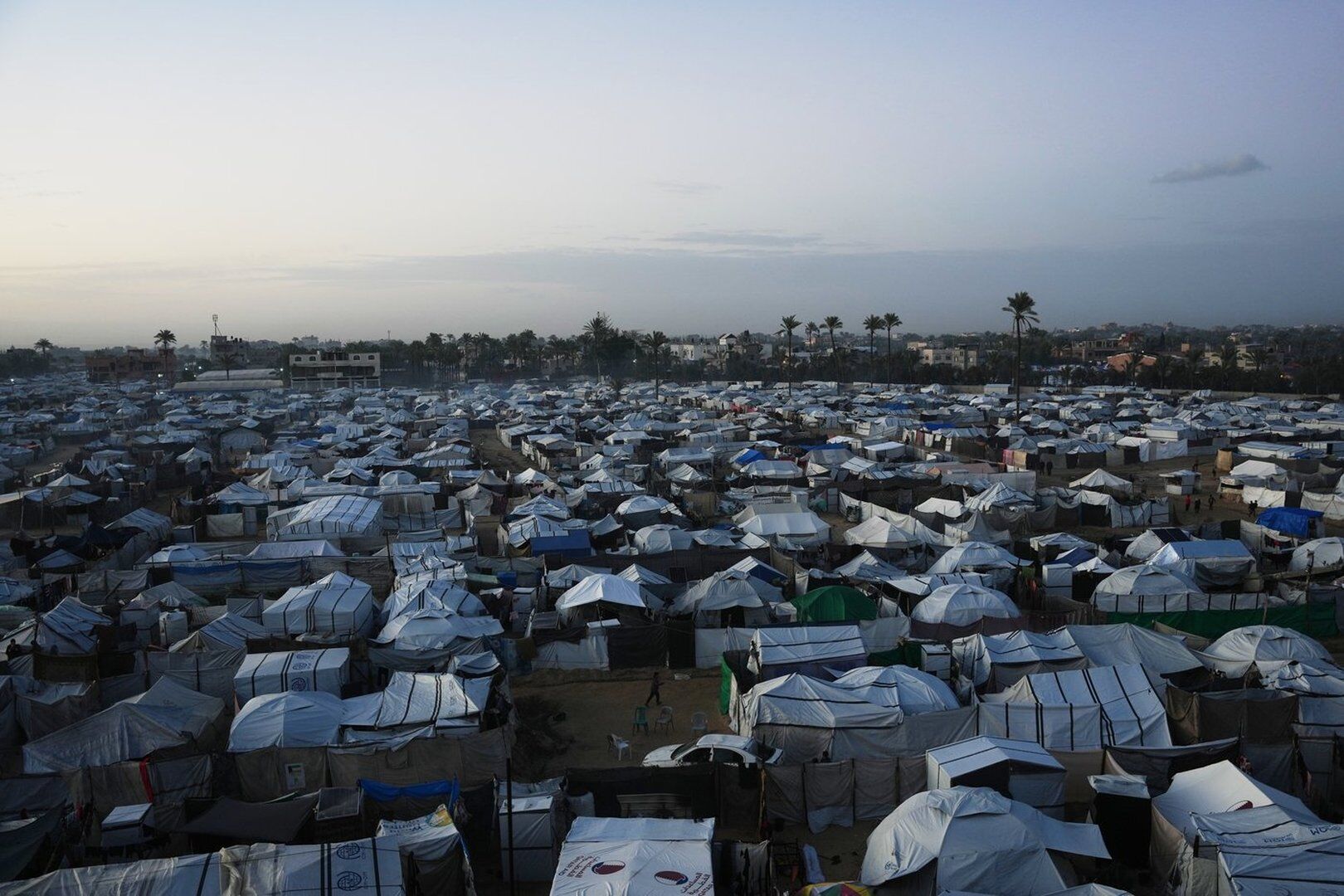
A tent camp for displaced Palestinians stretches across an area in Deir al-Balah, in the central Gaza Strip, Saturday, Jan. 10

Hamas said Sunday it will dissolve its existing government in Gaza once a Palestinian technocratic leadership committee takes over the territory, as mandated under the U.S.-brokered peace plan. But the group gave no specifics on when the change will occur.

Hamas and the rival Palestinian Authority, the Palestinians’ internationally recognized representative, have not announced the names of the technocrats, who are not supposed to be politically affiliated, and it remains unclear if they will be cleared by Israel and the U.S.

The “Board of Peace,” an international body led by Trump, is supposed to oversee the government and other aspects of the ceasefire that took effect on Oct. 10, including disarming Hamas and deploying an international security force. The board’s members have not been announced.

Meanwhile, the post-ceasefire death toll continued to rise in Gaza, with Israeli gunfire killing three Palestinians, according to Palestinian hospital officials.

The ceasefire began with a halt in fighting and the release of hostages held in Gaza in exchange for thousands of Palestinians held by Israel. The deal is still in its first phase as efforts continue to recover the remains of the final hostage left in Gaza.

An Egyptian official, who spoke on condition of anonymity to discuss closed-door information, said Hamas was sending a delegation to talks with Egyptian, Qatari and Turkish officials about moving to the second phase.


Future Gaza governance in flux

In comments posted on his Telegram channel Sunday, Hazem Kassem, a Hamas spokesman, called for speeding up the establishment of the technocratic committee.

The Egyptian official said Hamas will meet with other Palestinian factions this week to finalize the committee’s formation. The Hamas delegation will be chaired by top negotiator Khalil al-Hayya, the official said.

Trump has said the “Board of Peace ” will monitor the committee and handle the disarmament of Hamas, the deployment of an international security force, additional pullbacks of Israeli troops and Gaza’s reconstruction. The U.S. has reported little progress on any of these fronts, though the members of the board are expected to be announced this week.

Israeli Prime Minister Benjamin Netanyahu said Thursday that Bulgarian diplomat Nickolay Mladenov has been selected as the board’s director-general. Mladenov is a former Bulgarian defense and foreign minister who served as U.N. envoy to Iraq before being appointed as the U.N. Mideast peace envoy from 2015 to 2020. During that time, he had good working relations with Israel and frequently worked to ease Israel-Hamas tensions.

Also Sunday, Israel’s Foreign Minister Gideon Saar met in Jerusalem with Japanese Foreign Minister Toshimitsu Motegi. Saar said Israel was committed to enforcing Trump’s plan, while Motegi expressed Japan’s willingness to play an active role in the ceasefire.


Fourth Palestinian baby freezes to death in Gaza since November

In the bitter cold of a Gaza winter, two-month-old Mohammed Abu Harbid has become the latest victim of Israel’s genocidal war that has stripped Palestinians of shelter, warmth and survival.

Zaher al-Wahidi, director of health information at the Ministry of Health, told Al Jazeera the infant died from severe hypothermia at al-Rantisi Children’s Hospital.

His death brings the number of children who have frozen to death in the enclave since November 2025 to four, and 12 since the start of the genocidal war in October 2023.

As severe depression brings torrential rain and freezing winds to the coastal enclave, thousands of displaced families are facing a catastrophic humanitarian emergency, with the most vulnerable paying the highest price.


Incubators without batteries

At al-Awda Hospital in the Nuseirat refugee camp, a newly opened neonatal ward is fighting a losing battle to keep premature babies alive.

The ward, established in early 2026 to meet soaring demand, receives about 17 infants daily. But Ahmed Abu Shaira, a medical staff member, says they are operating with one hand tied behind their back.

“We face many dilemmas, including a scarcity of medical equipment,” Abu Shaira told Al Jazeera Mubasher correspondent Talal al-Arouqi. “Some incubators come to us without batteries … the occupation forces the entry of incubators without batteries.”

This is a death sentence in a facility plagued by chronic power outages. During Al Jazeera’s visit, the electricity cut out more than five times in less than an hour.

“We try to reach a certain temperature for the child, but every time we do, the power cuts,” Abu Shaira explained. Without the internal batteries that Israeli restrictions have banned, the incubators go cold the instant the generator fails.


Compounding the crisis is a lack of medication to help premature lungs develop and a severe shortage of baby formula.

“We are now receiving babies born before 37 weeks … due to early labour caused by the mothers’ poor health,” Abu Shaira added. “These babies are prone to hypothermia … which can lead to death.”


‘Just a piece of cloth’

A mother, exhausted and surrounded by sick children, described their shelter as a “piece of cloth” that hides them from view but protects them from nothing.

“I can’t even get medicine for my sick daughter … every time the wind blows, the tent snaps,” she said.

Their daughter, Waad, huddled in a tracksuit donated by a charity, has only one wish: a better tent. “I wish they would bring us a ‘dome tent’ to protect us from the cold and rain,” Waad told Al Jazeera. “We [nearly] drowned last night … I wish I could go back to school.”

Her mother recalled a terrifying moment when Waad fell ill at night. “She was vomiting from her mouth and nose, and I couldn’t even find a light to see her … I didn’t know how to help her.”

As the winter conditions worsen, the family’s plea is simple yet desperate: “We appeal to anyone with a conscience … send us caravans, send us tents … anything to cover us from the cold.”


Around the Network

Somali minister says Israel plans to expel Gaza Palestinians to Somaliland

Somalia’s Defence Minister Ahmed Moalim Fiqi has accused Israel of planning to forcibly displace Palestinians to the breakaway region of Somaliland, denouncing the alleged plan as a “serious violation” of international law.

In an interview with Al Jazeera on Saturday, Fiqi said Somalia has “confirmed information that Israel has a plan to transfer Palestinians and to send them to [Somaliland]”.

His comments came against the backdrop of longstanding fears raised by Somali officials that Israel intended to forcibly expel Palestinians from Gaza to Somaliland, reports that the self-governing region and Israel have denied.


Israel’s military base in Gulf of Aden

The Somali minister also accused Israel of seeking to establish a military base on the Bab al-Mandeb Strait, which connects the Gulf of Aden to the Red Sea, saying Israel “wants to create a military base to destabilise the region”.

A Somaliland official said those discussions were taking place, contradicting an earlier denial from its Ministry of Foreign Affairs and International Cooperation. Deqa Qasim, an official in the ministry, told Israel’s Channel 12 that an Israeli military base is “on the table and being discussed”, though its establishment depends on the terms.

Houthi leaders have said they would consider any Israeli presence in Somaliland, just across from the Gulf of Aden, a threat and a possible military target.

Somaliland President Abdirahman Mohamed Abdullahi, known locally as Cirro, sought to assuage fears among neighbouring countries, saying Israel’s recognition of Somaliland was not directed against anyone, during a speech welcoming the establishment of relations with Israel.

When Saar visited Hargeisa, the capital of the breakaway region, last week, a Somaliland readout said security was among the topics discussed during the meeting.

The visit drew immediate condemnation from 22 countries and the Organisation of Islamic Cooperation (OIC) in a joint statement that called Saar’s January 6 trip a “clear violation” of Somalia’s sovereignty and territorial integrity.


Fiqi’s comments came amid continuing international outcry over Netanyahu’s decision in December to recognise Somaliland, a breakaway part of Somalia comprising the northwestern portion of what was once the British Protectorate.


Israel kills Palestinian in Hebron, raids Nablus, East Jerusalem wedding

A Palestinian man has died from gunshot wounds after Israeli forces opened fire on his vehicle in Hebron, amid escalating violence against Palestinians in the occupied West Bank as Israel’s genocidal war on Gaza shows no signs of abating.

Shaker Falah al-Jaabari, 58, succumbed to his injuries on Sunday morning after being shot the previous night in eastern Hebron, according to the Palestinian Ministry of Health.

The Israeli army said forces opened fire at a vehicle that accelerated towards soldiers in the Haret al-Sheikh neighbourhood; however, in a later statement, the military acknowledged that an initial review found no evidence that the incident was an intentional attack.

Israeli authorities seized his body following the shooting, the Palestinian Wafa news agency reported. The Palestine Red Crescent Society told Al Jazeera that its crew was prevented from reaching the man.


The killing came as Israeli forces besieged a house in the Old City of Nablus on Sunday, with undercover units infiltrating neighbourhoods before military vehicles stormed the city from multiple directions. Two Palestinians were arrested as troops deployed across several areas and live gunfire echoed through the eastern market, according to Palestinian security sources cited by Wafa.


In a separate incident, Israeli forces raided a Palestinian wedding in occupied East Jerusalem, firing live ammunition and stun grenades at attendees. Several men were arrested, including the groom, with footage showing soldiers inside the hall and security forces throwing stun grenades as guests were forced outside.


The violence coincides with a landmark UN human rights report released on Wednesday, labelling Israeli policies as resembling “apartheid”, the first time a UN rights chief has used the term.

Volker Turk called for Israel to “dismantle all settlements”, describing a “systematic asphyxiation of the rights of Palestinians in the West Bank”. Hours after the report’s publication, Israel cleared the final hurdle to begin constructing the controversial E1 settlement project near Jerusalem.

A government tender published on Tuesday seeks developers for 3,401 housing units on land that critics say would effectively bisect the West Bank and prevent the establishment of a contiguous Palestinian state.


Settlement expansion drives mass displacement

Al Jazeera correspondent Nida Ibrahim, reporting from a Bedouin camp in Ras al-Auja being dismantled under Israeli orders, described it as “one of the largest shepherding communities in the West Bank”.

She noted that 26 families had already left, with 20 more preparing to depart. “The other location is completely unknown; they still don’t know where they’re going to go,” Ibrahim said, adding that Israeli settlers were “coming in and intimidating people” as filming took place.

More than half a million Israeli settlers now live in West Bank settlements, which are considered illegal under international law. Since October 7, 2023, Israeli attacks have killed more than 1,100 Palestinians in the West Bank and arrested some 21,000 during the period.


Israel advances ‘fatal’ settlement plan for occupied East Jerusalem

Israel is set to advance two major illegal settlement plans for occupied East Jerusalem, which Palestinian officials and experts warn will serve as the final blow to hopes for a contiguous Palestinian state.

The Jerusalem governorate announced on Sunday that Israeli authorities will discuss approving 9,000 settlement units on the ruins of the Qalandiya airport, also known as Atarot, and a separate project in Sheikh Jarrah to displace 40 families.

The Trump factor

The Atarot plan was briefly shelved in December 2025 but has now returned to the table. According to Khalilieh, the timing is directly linked to the shifting geopolitical landscape following the recent meeting between Israeli Prime Minister Benjamin Netanyahu and United States President Donald Trump.

“The meeting … served as a green light for continued settlement expansion,” Khalilieh told Al Jazeera.

“The American position, which treats Jerusalem as being outside any negotiation process … has encouraged the occupation to put this project into direct implementation,” he added, noting that international criticism has been reduced to mere “verbal objections without any deterrence”.


Severing the north

The airport project is not just about housing; it is a strategic chokehold, Khalilieh said. He explained that the Atarot settlement is one of the three major axes designed to complete the “Greater Jerusalem” vision:

  • North: The Atarot project will link East Jerusalem with the Givat Zeev settlement bloc, effectively severing the city from Ramallah.
  • East: The E1 plan aims to create a bridge between East Jerusalem and the Maale Adumim bloc.
  • South: Expansions in Har Gilo and the new Nahal Heletz settlement will connect the city to the Gush Etzion bloc.

“This will increase the area of Jerusalem … by adding 175sq km [68sq miles],” Khalilieh said.


Encirclement of the Old City

In parallel, the “Nahalat Shimon” plan in Sheikh Jarrah targets the historic “Holy Basin” area north of the Old City. “This falls under the old-new Israeli efforts to expand the settlement ring around the Old City,” Khalilieh said.

The goal, he argued, is to dismantle geographical continuity between Palestinian neighbourhoods like Silwan, the Mount of Olives, and Sheikh Jarrah, transforming them into “isolated population islands”.

“Today, the takeover of the Old City has begun through this ring … aiming to empty these areas gradually through intensified demolitions.”


‘Silent transfer’

Khalilieh warned that Israel is using neutral planning terms like “urban renewal” and “land settlement” to camouflage a policy of forced displacement.

“Development for Israelis means demolishing Palestinian homes under the guise of ‘building without a permit’,” he said, noting that more than 300 Palestinian homes were demolished in East Jerusalem in 2025 alone.

He also pointed to the unification of the “Arnona” property tax, which forces residents of neglected Palestinian neighbourhoods to pay the high rates as those in affluent Israeli areas.

“This puts them under cumulative pressure to leave Jerusalem … it constitutes a silent forced transfer.”


Is it too late?

Khalilieh stressed that legal and diplomatic intervention must happen “before construction begins”, as reversing facts on the ground is politically “nearly impossible”.

He called for activating provisional measures at the International Court of Justice (ICJ) and targeting international companies involved in the projects.

“The problem, first and last, is a political dilemma, not a legal one,” he concluded. “Early intervention is crucial … to freeze these projects until the political situation can be addressed.”



Israeli quadcopter kills three in Gaza’s Khan Younis; police chief slain

Three Palestinians have been killed in the southern Gaza Strip in Israel’s latest violation of October’s ceasefire in its genocidal war on the besieged enclave, according to sources in Gaza, as an anti-Hamas militia has claimed an attack that has killed a senior security officer.

An Israeli quadcopter drone struck down three Palestinians in Khan Younis on Monday, the sources told Al Jazeera.

According to the sources, a Palestinian woman was also wounded by Israeli gunfire in the al-Batn al-Sameen area of Khan Younis. The attacks came after Israeli army forces carried out air strikes and shelling across several parts of the enclave on Monday.

The three people killed were identified as Wissam Abdullah Salem al-Amour, Mahmoud Subhi Breika and Atef Samir al-Bayouk, the Palestinian news agency Wafa reported.

IDF has demolished over 2,500 buildings in Gaza since start of ceasefire — NYT

https://www.timesofisrael.com/liveblog_entry/idf-has-demolished-over-2500-buildings-in-gaza-since-start-of-ceasefire-nyt/

Israel has razed over 2,500 buildings in the Gaza Strip since the ceasefire with Hamas took effect in October, according to a report in the New York Times.

The report says most of the demolitions have been on the Israeli side of the so-called Yellow Line demarcating the areas of control in Gaza, with the Israel Defense Forces telling the US newspaper that it is dismantling tunnels and buildings that have been booby-trapped.

https://www.nytimes.com/interactive/2026/01/12/world/middleeast/israel-cease-fire-gaza-demolition.html


Hamas Calls for National Unity as Fatah Boycotts Cairo Talks on Gaza Administration

https://www.palestinechronicle.com/hamas-calls-for-national-unity-as-fatah-boycotts-cairo-talks-on-gaza-administration/

Hamas spokesperson Hazem Qassem said on Monday that the movement has presented “positive and advanced” positions aimed at organizing the Palestinian political situation, following Egypt’s invitation to Palestinian political groups to meet in Cairo to discuss the second phase of the Gaza ceasefire agreement and the possible formation of a technocratic committee to administer the Strip.

According to Al-Jazeera, Qassem urged the leadership of the Palestinian Authority to rise to what he described as a historic moment and move toward national consensus. 

He reportedly warned that no Palestinian faction should attempt to exploit the crisis in Gaza or obstruct efforts toward unity, stressing that Israel is targeting all components of the Palestinian political and social fabric across multiple arenas.

Qassem called for a unified national position to confront what he described as unprecedented threats to the Palestinian cause.

In response, the Fatah movement said on Sunday that any committee established to administer the Gaza Strip must derive its legitimacy from the sovereign institutions of the State of Palestine, announcing that it would not participate in the planned Cairo meeting.

In a statement issued by Fatah spokesperson Abdel Fattah Dawla, the movement said the legitimacy of any Gaza administration—regardless of its composition or designation—must be linked to the recognized authority of Palestinian state institutions.

Fatah emphasized that Gaza is an inseparable part of the Palestinian state and its political and legal system, which encompasses both the Gaza Strip and the occupied West Bank, including Jerusalem.

The statement added that any serious and meaningful inter-factional dialogue must be grounded in clear principles, including recognition of the Palestine Liberation Organization as the sole legitimate representative of the Palestinian people, adherence to international legitimacy, and the establishment of a unified political system, legal framework, civil and security institutions, and a single authority over arms.