By using this site, you agree to our Privacy Policy and our Terms of Use. Close

Forums - Politics - Israel-Hamas war, Gaza genocide

While the world's attention is on Trump's deflection from the Epstein files by kidnapping Maduro, CNN launches a renewed dehumanization push.

Former Israeli hostage recounts sexual abuse in Hamas captivity and fear of becoming a ‘sex slave’

https://www.cnn.com/2026/01/04/middleeast/israeli-hostage-gaza-sexual-assault-intl

While still consistently ignoring the very real patterns of systematic torture and sexual abuse in Israeli prisons, as well as everything else that's going on right now.


Israel comes up with more nonsense as well

Jordan is the Palestinian state the world refuses to see - opinion

https://www.jpost.com/opinion/article-882007

Yes Jordan has 2.39 million Palestinian refugees registered with UNWRA out of a population of 11.7 million. You might as well say Israel is a Palestinian state as its occupied territories include 5.3 million Palestinians out of a total population 15.5 million (10.2 million in Israel, 73% Jewish, 21% Arab)

Meanwhile the 'ceasefire' continues to be violated 

3 Palestinians killed by Israeli gunfire in southern Gaza despite ceasefire

https://www.middleeastmonitor.com/20260104-3-palestinians-killed-by-israeli-gunfire-in-southern-gaza-despite-ceasefire/

The Israeli army killed three Palestinians on Sunday and carried out a series of airstrikes across various parts of the Gaza Strip, Anadolu reports.

One Palestinian was killed after an Israeli drone opened fire in an area from which the army had withdrawn under the ceasefire agreement northwest of the city of Rafah in southern Gaza, a medical source told Anadolu.


The Israeli army also killed a fisherman, another medical source said. According to local sources, Israeli naval forces fired gunshots off the coasts of Khan Younis and Rafah in southern Gaza earlier Sunday.

On the northwestern outskirts of Rafah, a medical source said another Palestinian was shot in the head by Israeli forces, describing his condition as “critical.”​​​​​​​ Local sources said that the area where the Palestinian was injured is among those from which the Israeli army withdrew under the ceasefire agreement.

A 15-year-old boy was killed by Israeli gunfire in the Joura Al-Lout area, south of the city of Khan Younis in southern Gaza, from which the army had withdrawn under the agreement, a medical source told Anadolu.

Another Palestinian sustained a gunshot wound to the thigh after the Israeli naval opened fire off the coast of Deir al-Balah in central Gaza, medical sources and eyewitnesses told Anadolu.

Israeli warplanes also carried out a series of airstrikes on various areas north and west of Rafah.

Meanwhile, the Israeli army carried out demolitions of residential buildings in eastern Khan Younis, accompanied by artillery shelling of areas that are under its control under the agreement.

Separately, Israeli warplanes launched a series of airstrikes on different areas in northern Gaza and east of Gaza City.

In central Gaza, Israeli military vehicles opened indiscriminate fire toward the eastern areas of the Bureij refugee camp.

Since the ceasefire agreement came into effect on Oct. 10, the Israeli army has committed hundreds of violations, killing 420 Palestinians and wounding 1,184 others, according to the Health Ministry. The ceasefire halted Israel’s two-year war that killed nearly 71,400 Palestinians, most of them women and children, injured more than 171,200 others, and left the enclave in ruins. But despite the ceasefire, Israel’s deadly attacks on Gaza continue.


Around the Network

Trump's 'regime change' in Venezuela will only embolden Netanyahu to attack Iran again.
It's pretty much the same script, setting up Iran for civil war.

How Israel is Manufacturing Civil Unrest in Iran as a Path to War – Analysis

https://www.palestinechronicle.com/how-israel-is-manufacturing-civil-unrest-in-iran-as-a-path-to-war-analysis/

What began as a series of genuine protests, stemming from Iranian economic grievances, has now transformed into a fully fledged Israeli intelligence operation that seeks to destabilize Iran. It is therefore no coincidence that on the day of the Israeli PM’s departure from the United States, President Trump issued a threat to intervene militarily.

In order to analyze what is currently going on inside Iran, it is important not to beat around the bush; there is an ongoing regime change effort inside the country that Israel is chiefly responsible for. Demonstrating this is not difficult either.

On December 28, shopkeepers came to the streets in locations across Iran to protest government mismanagement that has led to a worsening of the country’s inflation crisis, originally triggered by Western economic sanctions.

During the first few days of the demonstrations, nothing out of the ordinary, beyond a few isolated instances, had occurred. In fact, when hostile elements popped up inside the protests, there were filmed instances of them being kicked out by the crowds themselves and being accused of being agents.

Protests regularly occur across Iran for a range of reasons and end with no violence. For example, a protest took place in early December, where around 5,000 people allegedly marched at the South Pars oil facility, marked as the largest of its kind for the entire year. Yet, on social media, old videos from 2022 and 2019 were being circulated alongside AI-generated clips and photos, depicting a nationwide revolution.


Israel openly behind the unrest

Former Israeli Prime Minister Naftali Bennett then published a video message asserting his solidarity with the alleged revolution that was said to be occurring. At this point, nothing major was even happening in Iran. But the message was clear: Israel was about to turn up the heat.

Later, the offspring of Iran’s deposed Shah would get in on the action, claiming for the dozenth time this year that “the regime is falling” and that he is “returning.” Reza Pahlavi, who the Israelis have dubbed the “Crown Prince” since his visit to Tel Aviv in 2023, is an aspiring dictator seeking to reinstate a hereditary monarchy, while also advocating for the exact opposite system, a democracy.

On New Year’s Day, the intelligence operatives went into overdrive, coordinating riots and armed attacks through Telegram groups, shooting at security forces, tearing down statues and posters, setting stores, cars, and even police officers on fire, all as Israel’s coordinated propaganda campaign expanded online. Israel’s Persian-language account on X (formerly Twitter) even published an AI-generated image of Iranian police using a water cannon against a protester.

Iranian opposition media outlets even began declaring that cities had “fallen to the revolution,” that Islamic Revolutionary Guard Corps (IRGC) forces were fleeing, and that Ayatollah Khamenei had fled Tehran, none of which was true, evidently.

Then came along former US Secretary of State Mike Pompeo, who commented, “Happy New Year to every Iranian in the streets. Also to every Mossad agent walking beside them…”. In other words, nobody is even bothering to hide what this is.


No popular support for the protests

During the 2022 protests, sparked by the death in police custody of Kurdish-Iranian Mahsa Amini, there were proven influences on this movement by foreign intelligence and media agencies seeking to achieve regime change. However, these protests enjoyed clear popular support from different elements of Iranian society, who all rallied behind the “Woman, Life, Freedom” banner.

In 2022, as with past major protests when major unrest broke out, the popular element was clear; there were countless publicly issued statements and protests organized publicly at different times and locations.

This time is the complete opposite. Out of nowhere, a single masked man, a small armed group carrying weapons, or a group of thugs will emerge to attack security forces, storm a police station, set a business or car on fire, etc. All of Iran’s major unions, which were originally backing the shopkeeper protests, have now also condemned the ongoing riots.

There is an absence of any unifying slogans, an absence of any kind of real cause, and the economic grievances are not the driver of the violent incidents. The violence appeared to be most prevalent in western Iran and among minority groups, and then, suddenly, violent incidents occurred in isolated instances across the country. An armed militant group even attempted to breach the border of Iran’s Sistan and Baluchistan province.

Within the first two days of violence during the new year, attempts were made to overrun police stations, government buildings, and armories, but all appear to have failed. Yet on January 1, two Iranian police officers were murdered, one was also left in a coma after rioters beat and stabbed him, and three rioters were shot dead.

A member of Iran’s volunteer Basij paramilitary force was executed by six masked thugs while he was operating in a civilian capacity, unarmed. The family of the 22-year-old had even been forced to lie that he was a member of the Basij after threats were made to attack his funeral. In Qom, on January 2, a man carrying an improvised handheld explosive was shot dead as he attempted to hurl the device at security forces. Ambulances were even pelted with stones near the Iranian capital.

What Can We Expect?

There is no need to pretend otherwise; it is crystal clear that this is an attack on Iran using agents on the ground. It should be judged similarly to how the Israelis used such agents during the 12 Day War back in June of 2025. Israel even admitted that over 100 foreign Mossad agents were used inside Iran to take down the nation’s air defenses and target missile launch sites during the opening wave of airstrikes.

In fact, most of the Israeli attacks carried out during the war were not carried out from the air, but by agents on the ground. These agents used drones, guided missiles, and carried out a broad range of activities on Israel’s behalf. Thousands of them were later caught for participating in such actions.

The Israelis are clearly attempting now to use their agents to inflict instability. If they see any success, they will only accelerate their plot. At their disposal are al-Qaeda-linked terrorist groups that act in areas like Sistan and Baluchistan; they also have Kurdish armed separatist movements that they work with and can trigger to act, in addition to various armed cells that undoubtedly still exist throughout the country.


Question is will Trump support another attack on Iran, or stick to looting Venezuela for now.



Israel extends Gaza occupation beyond ‘yellow line’ in north, bombs south

The Israeli military has spent the past 24 hours expanding the so-called “yellow line” in eastern Gaza, particularly in eastern Gaza City’s Tuffah, Shujayea, and Zeitoun neighbourhoods, according to Al Jazeera teams on the ground, squeezing Palestinians into ever smaller clusters of the enclave.

The Israeli army’s actions on Monday are also pushing it closer to the key artery of Salah al-Din Street, forcing displaced families sheltering near the area to flee as more of them come under intensive threat, as Israel’s genocidal war on Gaza shows no signs of abating.

Israel now physically occupies more than 50 percent of the Gaza Strip.

Since the ceasefire took effect, Israeli attacks have killed at least 414 Palestinians and injured 1,145 in daily truce violations despite the ceasefire deal mediated by the United States on October 10.

Al Jazeera’s Hani Mahmoud, reporting from Gaza City, said, “The ongoing Israeli attacks on the ground, the expansion of the ‘yellow line’ are meant to eat up more of the territory across the eastern part, really shrinking the total area where people are sheltering.”

“Everyone is cramped here. The population here not just doubled but tripled in many of the neighbourhoods, given the fact that none of these people is able to go back to their neighbourhoods. We’re talking about Zeitoun, Shujayea, as well as Tuffah,” he added.

“It was not until the past few minutes that the sounds of hums, the drones buzzing, faded away, but it had been going on for the past night and all of yesterday. Ongoing explosions that could be heard clearly from here,” Mahmoud said.


Intense artillery bombardment and helicopter fire also resumed on Monday in the areas south of the besieged enclave, north and east of the cities of Rafah and Khan Younis.


On Sunday, Israel launched more attacks into parts of Gaza outside its direct military control. At least three Palestinians were killed in separate Israeli attacks in Khan Younis, medical sources told Al Jazeera.

A five-storey building belonging to the al-Shana family in the Maghazi camp in central Gaza collapsed. It had been subjected to Israeli bombing at the end of 2023.

Civil Defence teams are searching for missing people under the rubble. The Wafa news agency reported that at least five people were injured.


Israeli push to make Rafah crossing ‘one-way exit’

Expectations have heightened around the possible reopening of the Rafah crossing, fuelling both desperate hope and deep fear.

For many in Gaza, there is some hope it could offer a lifeline, allowing the sick and wounded to access medical care, reuniting separated families, and giving some people a rare chance to move in or out of the Strip. Some also see it as a potential sign of easing restrictions.

But fears remain strong. Many worry the opening will be limited and temporary, benefitting only a few. Others fear it could become a one-way exit, raising concerns about permanent expulsion, effectively Israeli ethnic cleansing, and whether those who leave will be allowed to return.

“Until this moment, there’s nothing on the ground other than the headlines we’ve been reading over the past couple of days, the expectation now that within days the Rafah crossing is going to open and allow for movement in and out of Gaza. So far, we know the Israeli military is pushing for Rafah to be just a one-way exit,” Al Jazeera’s Mahmoud reported.

After months of uncertainty, people in Gaza who have suffered unimaginable loss and destruction are cautious. Even the possibility of relief comes with questions and little trust in what will happen next.

The Israeli military continues to block a large amount of international humanitarian aid amassing at the Gaza crossings, while maintaining that there is no shortage of aid despite testimonies by the United Nations and others working on the ground.


New draft law seeks to extend Israeli control over antiquities in Palestinian areas

Israel is preparing a revised draft law aimed at expanding its control over antiquities and heritage sites in the occupied West Bank, including areas under Palestinian civil authority, Hebrew media outlets reported.

According to Israeli reports, the latest version of the draft law was uploaded to the Knesset website last Wednesday ahead of planned discussions. The proposal would extend Israeli authority over antiquities in Areas A and B of the West Bank, where the Palestinian Authority exercises civil control.

The draft includes dozens of notes and observations indicating that several clauses still require clarification or further definition before the bill can be submitted to a Knesset committee for a vote.

One of the annotations notes that the bill’s main sponsor, Likud member of parliament Amit Halevi, has requested that the legislation also be applied to the Gaza Strip.

The original version of the bill, first introduced in 2023, proposed transferring responsibility for antiquities in the occupied West Bank to the Israel Antiquities Authority, which currently oversees archaeological sites in territories occupied by Israel in 1948.

According to the Hebrew-language newspaper The Times of Israel, the revised proposal has drawn widespread criticism from Israeli professional archaeologists. Many have accused the ruling right-wing coalition of attempting to impose de facto annexation through control of antiquities and heritage management.

Under the Oslo Accords, Israeli involvement in antiquities in the West Bank is formally limited to Area C, which makes up around 60 per cent of the territory and remains under full Israeli civil and military control. Areas A and B are designated for Palestinian civil administration, with the Palestinian Authority also responsible for security in Area A.


Netanyahu Battles Coalition Crisis amid Haredim Draft Dispute – Report

Israel’s governing coalition is facing a deepening crisis that could lead to its collapse, amid escalating disputes over a law exempting ultra-Orthodox Jews (Haredim) from military service, according to Israeli media cited by Al-Jazeera.

The Israeli newspaper Yediot Aharonot reported on Sunday that Prime Minister Benjamin Netanyahu is leading efforts to keep his government afloat until as close as possible to the next elections, the report stated.

Officially, general elections in Israel are scheduled for the end of October 2026 unless early elections are called.

The report, citing informed sources, stated that Netanyahu has been focused in recent days on managing what it described as a “containment battle” within the coalition, by supporting National Security Minister Itamar Ben-Gvir despite “legal objections,” according to Al-Jazeera Arabic.


‘Borrowed Time’

In late November, 16 former Israeli judges and security officials announced their opposition to a bill to execute Palestinian prisoners, proposed by Ben-Gvir’s Jewish Power party and passed by the Knesset (parliament) in its first reading. They argued that the bill “would endanger the lives of Israelis,” according to Israel’s Channel 12, the Al-Jazeera Arabic report stated.

Meanwhile, Netanyahu is working to push Finance Minister Bezalel Smotrich to move forward with preparing the 2026 budget, according to the newspaper.

According to sources, the threat by the ultra-Orthodox parties to withhold support for the budget if the draft exemption law is not passed “revealed the fragility of the coalition and confirmed that its continued existence is now based on borrowed time.”


This comes at a time when political assessments indicate that the Israeli political system has effectively entered an election campaign atmosphere, according to the same sources.


Possible Early Elections

Ynet News reported that Netanyahu hopes to keep the coalition intact “until the latest possible date” ahead of elections, “but he may have little room to maneuver.” It noted that Netanyahu has “instructed aids to prepare for elections as early as June.”

Analysts at Yediot Ahronot believe that the issue of exempting Haredim from military service has become the main issue threatening to end the current government’s term, according to Al-Jazeera Arabic. Netanyahu fears that passing any version of the law will weaken his electoral base, while the Haredim realize that going to early elections could put them in a weaker negotiating position.

According to the same newspaper, assessments indicate that whether or not the Knesset is dissolved in the coming months, the political scene in Israel is heading towards a heated election phase, with increasing difficulty in maintaining the stability of the existing coalition.


Haredim Clash with Police

On Sunday, clashes broke out between Israeli police and ultra-Orthodox Jewish protesters outside a recruitment office in Jerusalem, Al-Jazeera reported.

These clashes are part of a broader protest movement led by the Haredim against military conscription, which began after the Supreme Court’s 2014 ruling that mandated military service for them and prohibited financial aid to religious institutions whose students refused to enlist.

The Haredim constitute about 13 percent of Israel’s population of approximately 10 million. They justify their refusal to serve by claiming to dedicate their lives to Torah study and fearing that integration into secular society would threaten their religious identity.

For decades, they have evaded conscription upon reaching the age of 18 by repeatedly obtaining deferments under the pretext of studying at religious seminaries, until they reached the exemption age, which is currently 26, the report stated.


Around the Network


Israeli forces raid Birzeit University in the occupied West Bank

Israeli forces raided Birzeit University in the occupied West Bank, firing live ammunition to disperse students during a protest and film screening. At least three students were injured as troops entered the campus and classrooms.

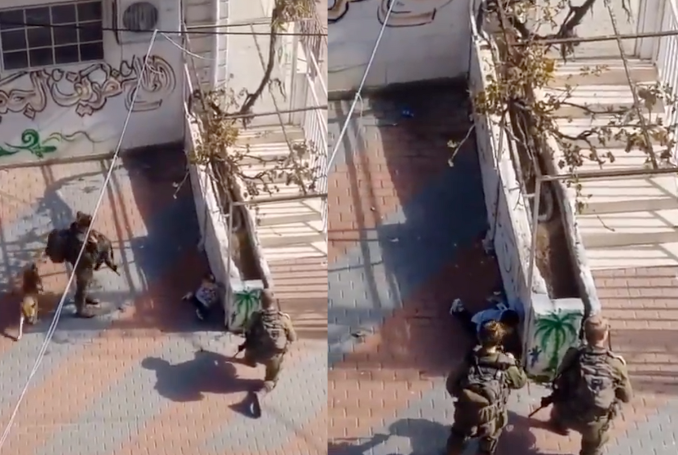
Israeli Soldiers Detain, Intimidate Palestinian Toddler during Curfew in Hebron


Israeli soldiers detained and intimidated a two-and-a-half-year-old Palestinian boy in Hebron.

Video footage shared by Voice of Palestine Radio shows a two-and-a-half-year-old boy standing pressed against a wall beside a stairway leading to a residential building in the Makbarat Al-Ras neighborhood. The child appears visibly distressed as a male and a female Israeli soldier stand a short distance away in a firing stance, aiming their weapons in his direction.

Areej al-Jaabari, a Palestinian human rights activist who recorded the incident, told Anadolu news agency that the child was held in place for more than 15 minutes. According to al-Jaabari, the toddler had stepped out of his home to cross the street to a nearby shop, unaware that strict security measures were in force in the area. 

She said the neighborhood had been placed under a full curfew from Friday evening through Saturday, the weekly day off for Israeli settlers, a practice imposed since the start of Israel’s war on Gaza in October 2023. Because the child crossed the street in violation of these restrictions, he was detained and intimidated “like any other resident would be, including the elderly or the sick,” al-Jaabari said.


Five-storey building damaged during war collapses in central Gaza

At least two people have been killed after a five-storey building collapsed in central Gaza. The building was damaged during Israel’s genocidal war on Gaza, but many returned to live there because they had nowhere else to stay.


Israel kills two in Gaza as Palestinians call for Rafah crossing to open

Israel has launched intense artillery and helicopter attacks on southern Gaza despite a United States-brokered ceasefire, bombing a tent housing displaced Palestinians and killing a five-year-old girl and her uncle, according to officials.

The killings on Monday brought the number of Palestinians killed by Israeli forces since the truce came into effect in October to at least 422, according to Gaza health authorities.

The Nasser Medical Complex in southern Khan Younis said the deadly Israeli strike hit a tent in the coastal al-Mawasi area, and that four others, including children, were also wounded.

Israel’s military said it struck a Hamas fighter who was planning to attack Israeli forces “in the immediate timeframe”. But the military did not provide evidence for the claim, and it was not clear if its statement referred to the tent attack.

Despite the ceasefire, Israeli forces have continued near-daily attacks on Gaza and have maintained restrictions on the entry of humanitarian aid. Much of the enclave has been devastated by Israel’s genocidal war, with roughly 88 percent of buildings damaged or destroyed, Palestinian officials say. Most of Gaza’s two million people are now living in tents, makeshift shelters or damaged buildings in areas vacated by Israeli troops.

The Palestinian Civil Defence said on Monday that another Palestinian home damaged in earlier Israeli strikes collapsed in the central Maghazi camp, killing a 29-year-old father and his eight-year-old son. The rescue service said in a subsequent statement that it was unable to respond to requests to remove hazards caused by damaged buildings because of a lack of equipment and continuing fuel shortages.

Last edited by SvennoJ - on 06 January 2026

Economic survival in Gaza decimated by Israeli counts on small initiatives

After more than two years of Israel’s genocidal war on Gaza, the daily unbearable churn of mass death and mourning, with homes, hospitals and schools destroyed, the besieged Palestinian territory also faces the fastest and most damaging economic collapse on record.

That is according to the United Nations, which says Gaza’s unemployment rate has reached 80 percent.

Yet despite Israel’s suffocating blockade on the Strip, Palestinians are improvising businesses to survive. For many people, survival now depends on skills and small initiatives, rather than formal jobs.

Widowed and responsible for a household of five, Um Mohammed al-Jarjawi relies on knitting to provide for her family – and sometimes passes on her skills to the next generation. Every day inside her home, al-Jarjawi prepares food for her grandchildren. Moments later, she heads out to work.

“I started learning knitting when I was 10 years old,” she told Al Jazeera. “Later, I attended courses at specialised centres. I discovered that I was skilled at the craft and began training others. “After my husband passed away, I needed to support my household. I focused on working to provide for my family while improving my skills.”

Small-scale businesses have expanded, ranging from solar-powered phone-charging stations to women knitting baby clothes. They provide households with short-term means of survival, but it is not enough to restore economic stability or generate sustainable, protected employment.

With 70 percent of electricity networks destroyed, Gaza’s power system has collapsed, forcing people to improvise. For Wasim al-Yazji, a makeshift solar-powered charging station is a fragile lifeline that provides some income – but cannot solve the power crisis.

“I opened this charging station to help my family with basic needs, some food and small expenses. I try to support my household through it,” al-Yazji told Al Jazeera. His home used to have a supermarket beneath it, but it was destroyed. “My charging station depends on solar panels, so if the sun doesn’t shine, the charging power is weak and I can’t work for days. Sometimes a whole week passes under clouds without any income,” he said.


Wasim al-Yazji stands next to his makeshift charging station

Gaza’s labour market has virtually collapsed, with the UN reporting that the enclave now faces one of the highest unemployment rates in the world. For many young men and women, jobs are nowhere to be found, forcing them to pace the streets or wait endlessly for a chance to work.

“I’ve been looking for a job for months,” Mohammed Shatat told Al Jazeera. “Even temporary work is hard to find. Every day feels the same… I go from place to place, asking, hoping, but there’s nothing.”

Families are finding ways to survive amid the devastation and destruction, but these informal ventures are no solution to the economic crisis: With hundreds of thousands of people still out of work, unemployment remains a tremendous challenge across the Strip.


Gaza waits as reports suggest Rafah crossing may reopen

Palestinians in Gaza have told Al Jazeera they are cautiously optimistic after hearing the Rafah crossing could soon reopen, after more than two years. As Al Jazeera’s Hani Mahmoud reports, the crossing represents access to medical care, education, and family reunification.


Qatar slams ‘political blackmail’ as Israel hinders Gaza’s Rafah crossing

The Qatari Ministry of Foreign Affairs says Doha is engaged with mediators to reopen the Rafah crossing into besieged Gaza and deliver aid while Israel creates roadblocks. Communications are ongoing, Foreign Ministry spokesman Majed al-Ansari said at a news conference on Tuesday, although more details were not immediately available.

“We are working with mediator[s] to ensure we reach the second phase of Gaza ceasefire. We demanded that humanitarian aid is not used as a political blackmail,” al-Ansari said. He added that there are a number of “complications” that require effort from all parties to resolve.

This comes amid Israeli reports that Israel and the United States may consider refraining from reopening the crucial crossing on the border with Egypt until the body of the last Israeli held in Gaza is discovered and handed over to Israel.

Reopening the Rafah crossing was a condition of the first phase of the ceasefire that went into effect on October 10. But it has remained closed as humanitarian groups say Israeli restrictions continue to hamper aid deliveries, a clear violation of the agreement.

The crossing had long been Gaza’s only connection to the outside world until the Israeli military occupied the Palestinian side in May 2024. The latest rumour of a potential reopening came on Thursday when the Israeli public broadcaster Kan reported that Israeli authorities were preparing to reopen the crossing in “both directions” following pressure from US President Donald Trump.

A two-way reopening would mark a shift from an earlier Israeli policy that stated the crossing would open “exclusively for the exit of residents from the Gaza Strip to Egypt”. The policy drew condemnation from regional governments, including Egypt and Qatar as officials warned against the ethnic cleansing of Gaza.


In the West Bank, the IDF does the school shootings

Israeli assault on Palestinian university wounds dozens in West Bank raid

Dozens of people were wounded after Israel’s army opened fire with live rounds, sound grenades, and tear gas at a prominent university in the occupied West Bank as students sat in classrooms and roamed the campus.

Israeli soldiers smashed open the university’s gates as panicked students and staff watched in shock on Tuesday.

Three of the injured were shot in the legs, according to the Palestine Red Crescent Society. Five people suffered tear gas inhalation, and three were hit by flying shrapnel.

“I handed back my exam paper empty, left my faculty building, and saw them in front of me. They threw sound grenades so I tried to escape and saw some teachers trying to talk to them. Then they shot live fire,” law student Youssef Sharawneh told Al Jazeera.

Mustafa Rimawi, an engineering student, denounced the Israeli attack by troops. “These days Palestinian people don’t have rights. They attack Gaza and the West Bank – universities and homes alike. Even mosques are not safe,” he said.

In a statement, Birzeit University said the attack “constitutes a flagrant and deliberate violation of the sanctity of universities and educational institutions”, the official Wafa news agency reported.

“Storming the campus in broad daylight and transforming it into a military zone reflects a systematic policy aimed at intimidating students, undermining their right to education, and targeting Palestinian consciousness,” it said.

The Palestinian Ministry of Health said 11 people arrived at the Istishari Arab Hospital in Ramallah for treatment.

The Israeli raid followed a student event in solidarity with thousands of Palestinian prisoners held incommunicado in Israeli jails, and coincided with a screening of the film “Hind Rajab”, a six-year-old girl shot dead by troops during the genocidal war on Gaza.


Israeli forces stormed the campus shortly before the screening. The Israeli army said it targeted a “gathering in support of terrorism” at the university.


‘Started shooting’

Reporting from Birzeit University, Al Jazeera’s Nida Ibrahim said in total 41 people were wounded in the attack with 11 hospitalised.

“It was unprecedented. People are telling us they’ve never seen anything like it. We are talking about the first time for an Israeli raid inside the campus where the students are taking their classes, and while the Israeli forces started shooting live ammunition, not just tear gas,” Ibrahim said.

“[For Palestinians] living under occupation, with limited options with so many restrictions, they rely on education to have jobs, to have a life, to sustain their families. But now we’re looking at a state of worry among many students. No place is immune from Israeli assaults.”

Palestine’s Ministry of Education and Higher Education condemned the violent incursion and said the attack disregarded all international norms and conventions when it comes to education facilities.

The assault will not “break the will of Palestinian students or staff”, the ministry said, calling on the International Association of Universities, the Association of Arab Universities, and international human rights organisations to denounce the Israeli shooting.

‘Nail in the coffin’

Meanwhile, Israel on Tuesday cleared the final hurdle before starting construction on a controversial settlement project near East Jerusalem that would effectively cut the occupied West Bank into two, according to a government tender.

A tender seeking bids from developers clears the way to begin construction of the E1 project. The anti-settlement monitoring group Peace Now first reported the tender. Yoni Mizrahi, who runs the group’s settlement watch division, said initial work could begin within the month.

Settlement development in E1, an open tract of land east of Jerusalem, has been under consideration for more than two decades, but was frozen because of US pressure during previous administrations.

The international community overwhelmingly considers Israeli settlement construction in the West Bank to be illegal and an obstacle to peace.

The E1 project is especially contentious because it runs from the outskirts of Jerusalem deep into the occupied West Bank. Critics say it would prevent the establishment of a contiguous Palestinian state in the territory.


Israeli Finance Minister Bezalel Smotrich, a far-right politician who oversees settlement policy, has long pushed for the plan to become a reality.

“The Palestinian state is being erased from the table not with slogans but with actions,” Smotrich said in August when Israel gave final approval to the plan. “Every settlement, every neighbourhood, every housing unit is another nail in the coffin of this dangerous idea.”


Press association condemns Israel’s continued ban on media access to Gaza

An international media association has denounced the Israeli government’s continued refusal to lift its ban on unrestricted media access to Gaza, despite the ceasefire in the embattled enclave.

The Foreign Press Association (FPA) issued a statement on Tuesday expressing its “profound disappointment” with the government, which had told the Supreme Court two days earlier that the ban should be maintained due to “security reasons”.

Israel, which has barred foreign journalists from independently entering Gaza since the war started in October 2023, was responding to an FPA petition seeking free and unfettered access for foreign journalists to the devastated territory.

The organisation, which represents journalists from international news organisations working in Israel, Gaza and the occupied West Bank, pledged to submit a “robust response” to the court in the coming days.

“Instead of presenting a plan for allowing journalists into Gaza independently and letting us work alongside our brave Palestinian colleagues, the government has decided once again to lock us out. This comes even when a ceasefire is now in place,” the FPA statement said.

The Israeli government, which has allowed only a limited number of journalists embedded with its military to work in Gaza on a case-by-case basis, said its court submission was “based on the position of the defence establishment”, noting that allowing journalists into the enclave could hinder the search for the remains of the last Israeli captive.

The FPA submitted its petition to the court in September 2024. The court has granted several extensions to the government.

Last month, it set January 4 as a final deadline for the government to present a plan for media access to Gaza.

The International Federation of Journalists has reported that Palestine was the deadliest place to work as a journalist in 2025, reporting that 56 Palestinian media professionals were killed over the course of the year.


Since the war broke out, nearly 300 journalists and media workers have been killed in Gaza, according to Shireen.ps, a monitoring website named after Al Jazeera’s veteran correspondent Shireen Abu Akleh, who was killed in the occupied West Bank in 2022.


Health of Palestine Action hunger strikers deteriorating, supporters say

https://www.theguardian.com/uk-news/2026/jan/06/health-palestine-action-hunger-strikers-deteriorating-supporters-say

Palestine Action-affiliated prisoners taking part in a hunger strike have shown an alarming deterioration in their health as one of them has entered the third month of refusing food, supporters have said.

Heba Muraisi, 31, who is on day 65 of her hunger strike, is said to be suffering from muscle spasms and breathing problems, while Kamran Ahmed, on day 58, has reported intermittent hearing loss.

The third remaining prisoner taking part in the protest is Lewie Chiaramello, 22, who has type 1 diabetes and so has been fasting every other day for 44 days.

Dr James Smith, an emergency physician and lecturer at University College London, said the three were already “well into the critical phase”, which he described as beyond three weeks, and he warned that “things can decline very quickly and irreversibly”.


Let’s be clear: if the Palestine Action hunger strikers die, the government will bear moral responsibility

https://www.theguardian.com/commentisfree/2026/jan/07/palestine-action-hunger-strikers-government

The three remaining hunger strikers have been convicted of nothing. Yet with astonishing cruelty, ministers refuse to listen to their reasonable demands
...

The limbo of remand is often devastating to prisoners’ wellbeing. Government figures, for example, show that the rate of suicide among remanded prisoners is more than twice that among sentenced prisoners. Extreme periods of remand like these are an offence against justice.

This is one aspect of what campaigners call “process as punishment”, an approach that now dominates the treatment of protest groups. Even if you are never convicted of a crime, your life is made hell if you dare, visibly and publicly, to dissent.

The three prisoners, and others charged with the same offences, are being held under “terrorist conditions”. This means they are allowed only minimal communications and visits. They’ve also been banned from prison jobs for “security reasons”, denied books, newspapers, library and gym visits and subjected to “non-association orders”. In October, Muraisi was suddenly transferred from HMP Bronzefield, 18 miles from London, where her family lives, to New Hall prison in Yorkshire, which is too far away for her sick mother to visit. After she had been moved, she was told it was because of the risk of association with another prisoner on the same wing at Bronzefield.

Yet none of the hunger strikers has been charged with, let alone sentenced for, terrorist offences. They have been charged with ordinary criminal offences, such as burglary, criminal damage and violent disorder. Muraisi and Ahmed are alleged to have broken into a factory run by Elbit Systems, Israel’s largest weapons manufacturer, and damaged equipment, while Chiaramello is alleged to have entered RAF Brize Norton during a protest in which Palestine Action sprayed warplanes with paint. These events took place before Palestine Action was proscribed as a terrorist group, a highly controversial decision that is being challenged in court: the decision is expected very soon. But never mind the presumption of innocence, never mind the presumption against retrospective application of the law: because the CPS says there is a “terrorism connection”, they’re being treated as if they were convicted terrorists.