By using this site, you agree to our Privacy Policy and our Terms of Use. Close

Forums - Gaming - Apple A9X: The Mobile Processor That Outperforms a Wii U?

To add to my last post, Nintendo launched the New 3DS in October of 2014 in Japan, January 2015 in Europe and February 2015 in North America:
https://en.wikipedia.org/wiki/New_Nintendo_3DS

That means it would be THE most idiotic business strategy to have the NX being yet another portable system. The smartest thing Nintendo could do here is to expand its software sales, but without alienating all the New 3DS customers. At the same time, they MUST make it as simple as possible for 3rd parties to port XB1/PS4/PC games which means it's a MUST to include an X86 CPU in the NX for traditional console games. The cheapest way to achieve this strategy is to go with an AMD APU for the NX. What that means is Nintendo should combine the AMD APU with an ARM CPU/SoC so that the NX could play all the traditional multi-platform PS4/XB1/PC games + the entire 3DS/new 3DS library. That would at least provide some uniqueness factor to the NX, but not allow it to cannibalize the sales of the New 3DS since portables do not directly compete with home consoles. At the same time, it would address the core audience of traditional home gamers as well. 

Sony failed with the PS4+Vita eco-system since you couldn't play Vita games on PS4 without the Vita. Vita itself was a failure since Sony's 1st party games can't hope to compete with Nintendo's. If Nintendo learns from all the mistakes of the PS4+Vita integration, it could really make a much better well-rounded gaming home console. Allowing the NX to play the entire library of 3DS/New 3DS games will be huge and it would also mean the NX could integrate well with the successor of the New 3DS in 4-5 years from now.

If the NX only has the ARM SoC, it will be a failure because future traditional home games will be made on x86 => Vulkan/DX11/DX12 APIs, and no ARM SoC can hope to have XB1 level of graphics by 2016. Furthermore, combining an x86 APU + ARM SoC in the NX would put Nintendo in a unique position compared to MS/Sony to sell games of Japanese developers like Konami that are 99% committed to mobile (including Android) gaming. 


Around the Network
BlueFalcon said:

To add to my last post, Nintendo launched the New 3DS in October of 2014 in Japan, January 2015 in Europe and February 2015 in North America:
https://en.wikipedia.org/wiki/New_Nintendo_3DS

That means it would be THE most idiotic business strategy to have the NX being yet another portable system. The smartest thing Nintendo could do here is to expand its software sales, but without alienating all the New 3DS customers. At the same time, they MUST make it as simple as possible for 3rd parties to port XB1/PS4/PC games which means it's a MUST to include an X86 CPU in the NX for traditional console games. The cheapest way to achieve this strategy is to go with an AMD APU for the NX. What that means is Nintendo should combine the AMD APU with an ARM CPU/SoC so that the NX could play all the traditional multi-platform PS4/XB1/PC games + the entire 3DS/new 3DS library. That would make the console truly epic and allow and it would not cannibalize the sales of the New 3DS since portables do not directly compete with home consoles.

Sony failed with the PS4+Vita eco-system since you couldn't play Vita games on PS4 without the Vita. Vita itself was a failure since Sony's 1st party games can't hope to compete with Nintendo's. If Nintendo learns from all the mistakes of the PS4+Vita integration, it could really make a much better well-rounded gaming home console. Allowing the NX to play the entire library of 3DS/New 3DS games will be huge and it would also mean the NX could integrate well with the successor of the New 3DS in 4-5 years from now.


Two words:

Unified

Platform. 

Nobody can support two distinct hardware platforms any longer. Not Nintendo, not Sony. 

N3DS owners are a tiny niche base anyway ... Nintendo always releases a late gen revision for their portables before retiring it ... the N3DS is nothing more than what the DSi/DSi XL was to the DS (and GB Micro before it). If you bought a Nintendo portable that late in the life cycle that's your fault for thinking it'd be supported like a new platform. Sorry, but buyer beware, do 10 minutes of research on the internet next time for anyone who's choked about that.  


Soundwave said:

You do realize the A5X (the Vita processor) and the A9X are the same architecture right? So yes you can compare those two directly. 

I wasn't saying running them at the exact same fidelity as the home console either, I said running them at a lowered resolution, like say 960x540 (1/4th the pixel draw) with a 50GB/sec memory bandwidth for the portable would be possible I think. You don't need a 1080P display for a 5-6 inch screen, PS4 games on Vita's 540p screen look very nice as is. 

I don't think Western developers are going to give a damn about Nintendo just because they release a me-too PS4 with zero userbase. They're going to need something else going for it, if it can handle their PS4/X1 engines but offer those games to the portable Nintendo fanbase (the one that has 5x more userbase than the piddly console), then sure I could see some interest from some Western devs too. 

I'm just not counting on some miracle here where Nintendo somehow becomes the darling of the third party circuit in the West. 

1. No they are not! The Vita has an ARM cortex A9 processor with a PowerVR SGX543MP4+ while the A9X sports a custom ARM core designed by Apple engineers and a GPU from the PowerVR series 6XT ... 

2. Resolution isn't the only thing to worry about. Developers have to worry about hitting fixed function bottlenecks where edge setup, rasterization, and texture sampler capabilities are more sparse plus PS4 is feature level 12_0 capable whereas PowerVR series 6XT isn't even DX10 compliant! Porting between the PS4 and Nintendo's new NX is a lot less trivial than you think it is ...

3. What is Apple gonna do about the power consumption issues ? 


Eddie_Raja said:


ESRAM will always be a major bottleneck no matter what.  It is only 32MB, and a 1080p buffer takes double that space to have any amount of detail on screen.  

But again:  8.000 GB vs 0.032 GB.  Yeah I know which one matters more.


You don't fit an entire frame into the ESRAM. You go with a tiled approach, that's the entire point of it, you still get the speed benefit, whilst using a smaller memory footprint.
It will only be a bottleneck IF a develeper decides to use it... And uses it incorrectly.

You are looking at it from a perspective that it somehow holds the machine back, it doesn't, it's a feature developers can use to extract more performance, not one that hinders performance. There is a difference, learn it please.

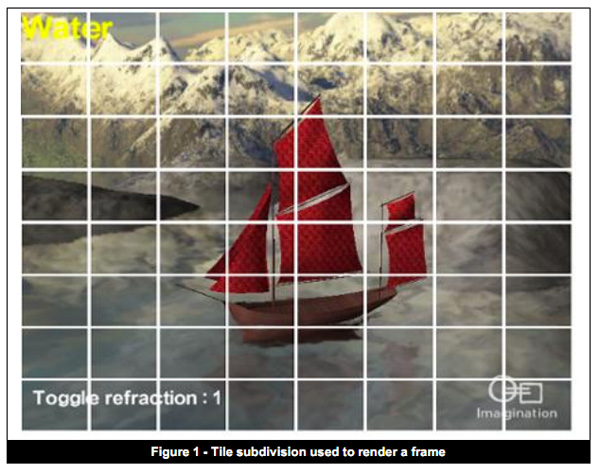
Basically... With Tiled based rendering you do this:


The frame is divided into much smaller ones, allowing you to use a fraction of the memory in a single pass, this is why super fast but tiny caches of a few megabytes such as eDRAM and ESRAM have shown to still be extremely beneficial.

The other benefit to this is that culling can become more efficient and more aggressive which farther boosts bandwidth and processing efficiency, there is a reason why the mobile world uses it to great success, because they are bandwidth constrained.

The downside however is that ESRAM/eDRAM is costly, it consumes transisters and electricity which could be better spent on more CPU Cores or more Pixel Shaders.


www.youtube.com/@Pemalite

Pemalite said:
Eddie_Raja said:


ESRAM will always be a major bottleneck no matter what.  It is only 32MB, and a 1080p buffer takes double that space to have any amount of detail on screen.  

But again:  8.000 GB vs 0.032 GB.  Yeah I know which one matters more.


You don't fit an entire frame into the ESRAM. You go with a tiled approach, that's the entire point of it, you still get the speed benefit, whilst using a smaller memory footprint.
It will only be a bottleneck IF a develeper decides to use it... And uses it incorrectly.

You are looking at it from a perspective that it somehow holds the machine back, it doesn't, it's a feature developers can use to extract more performance, not one that hinders performance. There is a difference, learn it please.

Basically... With Tiled based rendering you do this:


The frame is divided into much smaller ones, allowing you to use a fraction of the memory in a single pass, this is why super fast but tiny caches of a few megabytes such as eDRAM and ESRAM have shown to still be extremely beneficial.

The other benefit to this is that culling can become more efficient and more aggressive which farther boosts bandwidth and processing efficiency, there is a reason why the mobile world uses it to great success, because they are bandwidth constrained.

The downside however is that ESRAM/eDRAM is costly, it consumes transisters and electricity which could be better spent on more CPU Cores or more Pixel Shaders.

Dude you still have to shuffle stuff from much slower ram into the ESRAM and hope it can give it a nice speed boost.  The bandwidth on the 8GB acts as a massive bottleneck.


Prediction for console Lifetime sales:

Wii:100-120 million, PS3:80-110 million, 360:70-100 million

[Prediction Made 11/5/2009]

3DS: 65m, PSV: 22m, Wii U: 18-22m, PS4: 80-120m, X1: 35-55m

I gauruntee the PS5 comes out after only 5-6 years after the launch of the PS4.

[Prediction Made 6/18/2014]

Around the Network
Soundwave said:

Screen could be 1280x720 (HD), some games like those with XB1 complexity could just run at 960x540. 99% of people wouldn't know any better, 99% of people who played Call of Duty (the most popular "HD" game from last gen) couldn't tell that it was running at a sub-720p resolution on their 50-inch 1080P displays. 

I'd bet most Vita owners aren't aware that a good chunk of their games run at sub native resolutions too. 

The remote play feature on the Vita though at least to me shows that PS4 graphics can look quite nice even on the Vita's 540p display. A lot of its depends on not using a display that's complete shit too. It the display is half way decent, most people won't know any better. 

Nintendo uses such terrible quality LCD displays though it's like from something out of your grandma's $99 portable Wal-Mart DVD player from 2003. 


Because, of all companies, Nintendo is the one who would spend the extra money providing a more expensive, tablet-sized screen, only to have those games not even use the boosted resolution. Nintendo, who had no problem letting thr 3DS use the crappy screen it uses in order to meet their priority of a 3D screen instead.

Right.

No. And with the 540p screen, it goes right back to Nintendo not having a product that is seen as "superior to the competition," because while people may not notice the different in a sub-resolution game, they can read the difference between a high end tablet marketed as having a 1080p screen with a 4K camera, and a gaming tablet with a 540p screen and an unmentionable camera.

They'll use a 3DS/XL-sized 540p/720p glasses-free 3D screen for the top screen, which will be far less pricey than a 720p giant tablet screen, and a lower res bottom screen, likely 540p. The NXDS, from a hardware POV, will be very iterative of the N3DS. Likely a real second analog nub. Definitely no major revamp like a gaming tablet. Again, the major change is happening in the firmware, not the hardware. Games like Smash 4 and HWL are practice for what will soon be every game on NX.


Eddie_Raja said:

Dude you still have to shuffle stuff from much slower ram into the ESRAM and hope it can give it a nice speed boost.  The bandwidth on the 8GB acts as a massive bottleneck.


No. It doesn't.
You have this thing called "Prediction" where you predict the data you are going to require ahead of time, it's a technique which has been used to varying degree's for decades, extremely effective on fixed-hardware devices such as consoles for obvious reasons.
Converesly, both devices will be streaming a significant amount of data not from Ram, but from mechanical and optical disc storage which is stupidly slow, we saw that put to great use last generation.

The real limitation to the Xbox One is not Bandwidth, it's actually the reduced GPU resources used to draw all the pretty things on your screen.
Look at other GPU designs in the PC space as an example, AMD Fury has an abundance of bandwidth, more than any other graphics card to ever exist, more than several Geforce cards combined... Yet has minimal benefit from it. Why? Because there is not enough hardware to make use of such a wide and fast highway.
Bandwidth dosn't do any form of data processing, Ram doesn't calculate anything, it's importance is secondary to a point.

Keep in mind that the consoles are only rendering at 720P - 1080P, last century, low-end resolutions, you don't need 300Gb/s of bandwidth, there is only so much bandwidth you need before it's completely useless.
And because the Xbox One has less hardware resources than the Playstation 4, it also needs less bandwidth.

Culling, Tiled Based Rendering, Compression helps remove the bandwidth barrier, the eSRAM just lends a helping hand and forces the need for the former.

Also, both consoles do not have 8Gb of Ram dedicated to gaming, games will never use 8Gb on the current generation of consoles, more like 5-6Gb is the expected amount available for games even with optimizations to the OS and Software stacks later on... That 5-6Gb will not be completely dedicated to relatively bandwidth-intensive graphics tasks either.

That is not allot of memory to play with at the end of the day, I have a 7 year old PC with more.


www.youtube.com/@Pemalite

spemanig said:
Soundwave said:

Screen could be 1280x720 (HD), some games like those with XB1 complexity could just run at 960x540. 99% of people wouldn't know any better, 99% of people who played Call of Duty (the most popular "HD" game from last gen) couldn't tell that it was running at a sub-720p resolution on their 50-inch 1080P displays. 

I'd bet most Vita owners aren't aware that a good chunk of their games run at sub native resolutions too. 

The remote play feature on the Vita though at least to me shows that PS4 graphics can look quite nice even on the Vita's 540p display. A lot of its depends on not using a display that's complete shit too. It the display is half way decent, most people won't know any better. 

Nintendo uses such terrible quality LCD displays though it's like from something out of your grandma's $99 portable Wal-Mart DVD player from 2003. 


Because, of all companies, Nintendo is the one who would spend the extra money providing a more expensive, tablet-sized screen, only to have those games not even use the boosted resolution. Nintendo, who had no problem letting thr 3DS use the crappy screen it uses in order to meet their priority of a 3D screen instead.

Right.

No. And with the 540p screen, it goes right back to Nintendo not having a product that is seen as "superior to the competition," because while people may not notice the different in a sub-resolution game, they can read the difference between a high end tablet marketed as having a 1080p screen with a 4K camera, and a gaming tablet with a 540p screen and an unmentionable camera.

They'll use a 3DS/XL-sized 540p/720p glasses-free 3D screen for the top screen, which will be far less pricey than a 720p giant tablet screen, and a lower res bottom screen, likely 540p. The NXDS, from a hardware POV, will be very iterative of the N3DS. Likely a real second analog nub. Definitely no major revamp like a gaming tablet. Again, the major change is happening in the firmware, not the hardware. Games like Smash 4 and HWL are practice for what will soon be every game on NX.


Most people can't reeeeeally tell screen resolution. As long as you use a decent quality screen, which nowadays is cheap (thanks Apple). 

A Vita screen looks as good as some 1080P displays to the average joe. As long as it looks "nice and shiny" they will think it's a high resolution. And a chip that powerful could legitimately run Wii U+ visuals at full 1080x720 too. A good 1280x720 panel will have a nice pixel density at 6.5 inches or lower and most people won't notice the games that are running sub-native resolution. I have an 8-inch Samsung 1280x720 res tablet and HD content still looks great on it.

Almost no iPad/iPhone games run at native resolution either, nobody really notices. People will notice the graphics are really impressive though and that the engines are the same next-gen engines on their modern consoles. 

I don't think they're using dual screen, but I'm not going over that again, I think we've done that to death. I think in general NX will be a complete break from the Wii-DS era. It was fun while it lasted, but very bitter at the end probably by Nintendo's standards and all these cycles eventually come to an end. 

To be honest I wouldn't be shocked if NX is more radical than even what I'm proposing. I think Nintendo internally is going through some radical upheaval. For example I don't think Mr. Miyamoto and some of the older guard were too happy about the smartphone change, but they got voted down by internal pressure. That really does explain his sour comments towards casuals a few months ago, because he knows he ultimately failed to keep that audience for Nintendo. 


Soundwave said:

Most people can't reeeeeally tell screen resolution. As long as you use a decent quality screen, which nowadays is cheap (thanks Apple). 

A Vita screen looks as good as some 1080P displays to the average joe. As long as it looks "nice and shiny" they will think it's a high resolution. And a chip that powerful could legitimately run Wii U+ visuals at full 1080x720 too. A good 1280x720 panel will have a nice pixel density at 6.5 inches or lower and most people won't notice the games that are running sub-native resolution. I have an 8-inch Samsung 1280x720 res tablet and HD content still looks great on it.

Almost no iPad/iPhone games run at native resolution either, nobody really notices. People will notice the graphics are really impressive though and that the engines are the same next-gen engines on their modern consoles. 

I don't think they're using dual screen, but I'm not going over that again, I think we've done that to death. I think in general NX will be a complete break from the Wii-DS era. It was fun while it lasted, but very bitter at the end probably by Nintendo's standards and all these cycles eventually come to an end. 

To be honest I wouldn't be shocked if NX is more radical than even what I'm proposing. I think Nintendo internally is going through some radical upheaval. For example I don't think Mr. Miyamoto and some of the older guard were too happy about the smartphone change, but they got voted down by internal pressure. That really does explain his sour comments towards casuals a few months ago, because he knows he ultimately failed to keep that audience for Nintendo. 


I think you're vastly overexadurating how stupid people are.

They can't tell the difference between a 2016 high end tablet clearly marketed with a 1080p screen and a gaming tablet marketed with a 540p screen? You're literally saying that people are too stupid to read what's on a box. The Wii U gets a ton of shit for being too weak, and that system can still play games at 1080p 60fps, but a tablet with a big fat 540p screen in 2016 will go unnoticed and "99% of people won't tell the difference?" Give me a break. People already complain that the Wii U's gamepad picture qualitly is ugly as shit, and that streams games far more demanding than anything on smartphones or the Vita at the same 540p resolution.

I think the NX will be a break from the Wii-DS, in firmware. In hardware, no. It'll be an iterative upgrade. No tablet. No portable console. And there's definitely internal change happening. But not the sort that'll produce a gaming tablet to replace a dual screen handheld that's part of a unified platform meant to share games seamlessly when the home console is still dual screened.


BlueFalcon said:

To add to my last post, Nintendo launched the New 3DS in October of 2014 in Japan, January 2015 in Europe and February 2015 in North America:
https://en.wikipedia.org/wiki/New_Nintendo_3DS

That means it would be THE most idiotic business strategy to have the NX being yet another portable system. If the NX only has the ARM SoC, it will be a failure because future traditional home games will be made on x86 => Vulkan/DX11/DX12 APIs, and no ARM SoC can hope to have XB1 level of graphics by 2016. Furthermore, combining an x86 APU + ARM SoC in the NX would put Nintendo in a unique position compared to MS/Sony to sell games of Japanese developers like Konami that are 99% committed to mobile (including Android) gaming. 

You need to realise that New 3DS is revision of 3DS, not completely new console. Also, Sony released Super Slim PS3 one year before PS4 launch, Micorsoft release Xbox 360 E in same year when Xbox One is released. So no, that isnt at all the most idiotic business strategy if the NX being yet another portable system.

Console are x86 but all other devices on which you can play game are ARM. We already know how many games we have on phones and tablets, how many games Indies realasing on those platforms, even some big 3rd parties, also Vita is ARM and have solid 3rd party support especially in Japan. So again no, NX will not be failure if only will have ARM SoC, but of course that better solution would be x86 for home console.