By using this site, you agree to our Privacy Policy and our Terms of Use. Close

Forums - Gaming - Where did modern day gaming really come from?

JazzB1987 said:


Japan with its mentality wanted to make good products not like the US with its E.T shit etc.   thats why I feel like todays gaming is shit again. Its way to westernized and completely forgetable (with some random coincidental sparks of creativity)  and the biggest disaster here is that japan tries to mimic the western style because they think its the right thing to do (thank god sometimes stuff like BravelyDefault shows up and reminds japanese developers that being japanese is great)


This made me laugh, as it's utterly and completely fictitious.  The sheer amount of bad games Japan makes is astounding.  They create an absolute ton of niche, throwaway products of low quality that are designed to appeal to a very narrow audience who will buy them no matter what.  This is a Japanese thing, not a western thing, and it's also true of media outside of games.  True, some Japanese publishers tried to make "western" styled games which felt flat and devoid of personality because they could not accurately capture the feel, but that hardly precludes the fact that they make plenty of bad games on their own.

As for modern gaming, I think the Japanese arcade situation needs to be given a lot of credit.  Fighting games in the 80s and early 90s were absolutely on fire.  Gaming companies were fighting hard with one another and, as a result, were innovating at a substantial pace.  Remember, the PC Engine was more popular in Japan than the Famicom, as it had many arcade titles Nintendo did not.  Had Nintendo's cut-throat business practices not killed it, who knows what would have happened.  Gaming crashed in the US, sure, but it was still moving forward in Japan at a rapid pace.


Around the Network
robzo100 said:


  • Arcades started in America and pinball machines were essential their predecessors.  But when did Arcades start in Japan?  And was the overlap unrelated?

I'd guess arcade fever hit Japan somewhere at release of Space Invaders. Not that it was the first arcade in Japan as many Japanese "gaming companies" (or essentially a coinop machines manufacturers or operators) at the time worked on that market well before that, Sega and Namco to name the few. You might aware of Sega's EM machine Periscope, in the US known as Midway's Sea Wolf afair, it's even known over here as "Sea Fight". And of course we have Pachislots since pre-War years all over Japan.

If you're interested in American arcades well-well before the EM machines and pinballs, I'd suggest a vol. 1 of never finished Illustared Historical Guide to Arcade Machines by Richard M. Bueschel. If you're interested in Pinballs -- Pinball Book by Marco Rossignoli.

robzo100 said:
  • But why Japan?  Why did home console gaming appeal so much to Japan and the US?  Was it beause they were economically stable enough to have a financially able customer base?  Why didn't Europe catch on fire with this new entertainment like America (maybe "American consumerism?).

Europe did catch on this new entertainment and in fact had quite a few development studios and strong communities in the early years of what you call modern-day gaming. But it was a PC-land in the early 1980s, the time arcade golden age was at near end and home consoles never pick up in there until Sega's efforts.


*checks Mnementh's profile*

*checks d21lewis' profile*

*checks alabtrosMyster's profile*


You know... we need to have these retro-chats more often.  It feels great not being the oldest person here for a change.


Augen said:

Why in film fiction of the time it is Weyland-Yutani in Aliens and it is Nakatomi Plaza in Die Hard or Marty's boss in Back to the Future II.


"McFRY!!"

In retrospect, what's funny about that movie is that my suspension of disbelief has no problem with all the far out stuff like holograms and hoverboards - my mind can accept that stuff as part of some hypothetical future reality.

But when Fujitsu says, "Read my fax!" and printed sheets of paper pop out of fax machines all over the house, it instantly breaks the illusion.  It suddenly feels like what it actually is - a late 80s/early 90s movie extrapolating based on the tech of the day.


Augen said:

it may seem odd in 2014...


Yeah, and that's another thing!  There's only one year left - where's my flying car?

*cough*

And in an attempt to tie this into the topic... games where you have to use your hands still aren't considered to be "like a baby's toy."


ColdFire - The man with no name.

Shadow1980 said:

Consoles as we know them today actually started in the second generation.

...

It was the Atari 2600, released the following year, that really established console gaming as a major sales force in America.


I don't know if you saw my earlier comments but that's basically what I thought.

Having said that, I came across something unexpected regarding the following...


Shadow1980 said:

The Fairchild Channel F, released in 1976, was the first console to have interchangeable ROM cartridges...


I was also under the impression that the first generation were all dedicated consoles with no removable media.  But on the Odyssey's Wiki entry, I came across this...


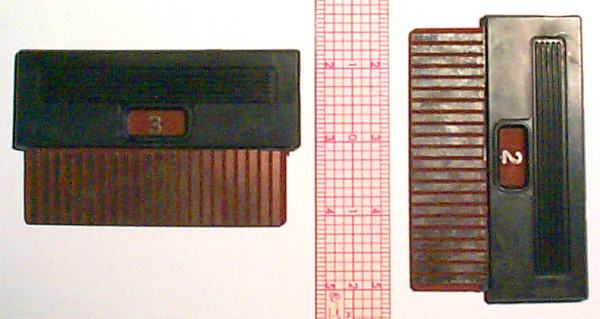
The Odyssey uses a type of removable printed circuit board, called a game card, that inserts into a slot similar to a ROM cartridge slot; these do not contain any components but have a series of jumpers between pins of the card connector. These jumpers interconnect different logic and signal generators to produce the desired game logic and screen output components respectively.


Now, I realize it's not talking about an actual ROM cartridge here, but what exactly is it talking about?  The way I read it, I think it's saying that the game isn't on the card itself; it's still built into the platform, but the card... "unlocks" it?  Kind of like a key?

Am I interpreting this correctly?  That is, the card isn't a form of removable media as such because nothing is actually stored on it.  Instead, the console is hardwired to perform certain tasks, and the card simply... what?  Closes the loop?  Completes the necessary circuits?

Is that what it's saying?


ColdFire - The man with no name.

said:


Augen said:

Why in film fiction of the time it is Weyland-Yutani in Aliens and it is Nakatomi Plaza in Die Hard or Marty's boss in Back to the Future II.


"McFRY!!"

In retrospect, what's funny about that movie is that my suspension of disbelief has no problem with all the far out stuff like holograms and hoverboards - my mind can accept that stuff as part of some hypothetical future reality.

But when Fujitsu says, "Read my fax!" and printed sheets of paper pop out of fax machines all over the house, it instantly breaks the illusion.  It suddenly feels like what it actually is - a late 80s/early 90s movie extrapolating based on the tech of the day.

It boggles my friends mind that in my busines I use a fax machine every single day due to number of older clients associated with accounts placing orders that feel intimidated by websites. 


Around the Network
Augen said:
said:

Augen said:

Why in film fiction of the time it is Weyland-Yutani in Aliens and it is Nakatomi Plaza in Die Hard or Marty's boss in Back to the Future II.


"McFRY!!"

In retrospect, what's funny about that movie is that my suspension of disbelief has no problem with all the far out stuff like holograms and hoverboards - my mind can accept that stuff as part of some hypothetical future reality.

But when Fujitsu says, "Read my fax!" and printed sheets of paper pop out of fax machines all over the house, it instantly breaks the illusion.  It suddenly feels like what it actually is - a late 80s/early 90s movie extrapolating based on the tech of the day.

It boggles my friends mind that in my busines I use a fax machine every single day due to number of older clients associated with accounts placing orders that feel intimidated by websites.


Oh, don't get me wrong.  I realize that faxes are still used.  It's just that in the 1980s, they seemed like such a cool, futuristic technology.  "Decades from now, these things will be everywhere!  Every household will have a fax machine in every room!  They're so handy... so convenient!  How could anyone think otherwise?"

Yeah, except that in the interim, we've come up with other technologies that are even handier and more convenient.  Now when we look back at the printed fax, we think of it as the rather quaint way we used to do things before we came up with a more efficient system.

But, of course, we couldn't have known that.  This was before the web, as we think of it, even existed.  At the time, it really did seem like this was going to be the big communications technology of the future.  "You mean I can scan in a sheet of paper here and it will print out for someone on the other end?  Wow!  That's so... Star Trek!"

Actually, this is part of the reason why the whole "Future of Gaming" meme annoys me so much.  I don't mind people being excited about new tech or whatever, but lately it seems like every time someone comes up with a new way of doing something, people go out of their minds and declare it to be "The Future of Gaming!"

And it might be!  But, statistically speaking, it probably won't be.  People try new things all the time.  Some of them catch on; most of them don't.  Remember the Nintendo Power Glove?  I'm sure there were people back in the day who thought that was the future of gaming right there - that ten years down the track, that was how everyone would be gaming!

Fortunately they were wrong.

Anyway, yeah... I guess what I'm saying is that we have a history of being way too hasty about these things.  Not every current trend is "The Future!"  In fact, chances are that most of them will be completely forgotten ten years from now, just like 90% of ideas that have fallen by the wayside over the years.

Now, don't mistake my meaning.  I'm not a total killjoy.  There absolutely will be cool new things that will take off and legitimately become the future (both in gaming specifically, and technology in general).  All I'm saying is that we don't have a great track record for predicting which ideas those will be.

It's easy to get swept up in the excitement of new and novel things - I do it myself - but if history has taught us anything, it's taught us that just because we're ecstatic about the latest piece of tech, it doesn't mean that anyone's going to care in ten years time.  Odds are that it will simply be one of many such ideas that either never took off at all, or was made redundant by something better.

For that illustration, just see the aforementioned fax machine.  Back in the 80s, it really did seem like a sure thing that faxes would dominate the future of business and electronic communications.  Then the internet happened.


ColdFire - The man with no name.

Shadow1980 said:

Having never owned an Odyssey (my first console was the Intellivision)...


No way!  You had one of those?  That's awesome!  I was an Atari guy, myself.  Atari does what Intellivision... wait, that's not how it goes.


Shadow1980 said:

... I can't say for sure, but that seems about right. Here's what those "game cards" looked like:

I don't think they carried any game data of their own, but rather did act as a sort of "key" to switch the system over to other game types.


Cool!  Thanks for that.

I wonder if they worked on a similar principle to punch cards.  If so then I suppose you could say they were kind of a data storage medium, even if it was only in the form of jumpers which either connected or didn't connect a bunch of circuits.  In a sense, that's actually the most fundamental form of data storage in digital computing.  The difference being that, in this case, the "data" was physical rather than virtual.

Actually, correct me if I'm wrong, but isn't that the basis of programming?  I'm not a computer scientist but I've read a little about this so bear with me.

My understanding is that early computers tended to be hardwired for dedicated tasks and the only way to reprogram them for something else was to physically rewire them.  Obviously, computers no longer have this limitation, but what we do today via software is effectively the same thing.

The idea is that when we use a piece of software, the temporary digital construct the computer creates is a "virtual rewiring" of the system's outputs for a specific task.  Theoretically, I could hardwire the computer to do exactly the same thing if I knew how and where to physically connect every logic gate.

So, fundamentally, a game card with a row of jumpers designed to open and close the circuits necessary to perform a specific task is actually a rudimentary form of programming, is it not?

All of this is assuming, of course, that this is even how the console worked.  I'm imagining that it had some kind of raw output, and that by closing the loop on the right combinations of circuits, the game cards were effectively a method of "on-the-fly" programming (as opposed to physical rewiring), allowing the output to be quickly repurposed for different behaviours.

But yeah, that's my layman's understanding of the fundamentals of computer science and how it may apply to this.  Feel free to correct me if I'm wrong - this isn't my field by any stretch.


ColdFire - The man with no name.