









|
Shadow1980 said: Having never owned an Odyssey (my first console was the Intellivision)... |
No way! You had one of those? That's awesome! I was an Atari guy, myself. Atari does what Intellivision... wait, that's not how it goes.
|
Shadow1980 said: ... I can't say for sure, but that seems about right. Here's what those "game cards" looked like:
I don't think they carried any game data of their own, but rather did act as a sort of "key" to switch the system over to other game types. |
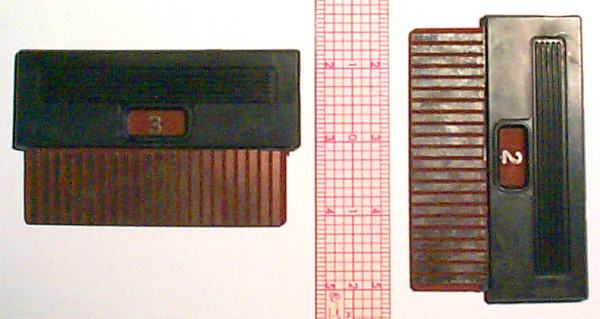
Cool! Thanks for that.
I wonder if they worked on a similar principle to punch cards. If so then I suppose you could say they were kind of a data storage medium, even if it was only in the form of jumpers which either connected or didn't connect a bunch of circuits. In a sense, that's actually the most fundamental form of data storage in digital computing. The difference being that, in this case, the "data" was physical rather than virtual.
Actually, correct me if I'm wrong, but isn't that the basis of programming? I'm not a computer scientist but I've read a little about this so bear with me.
My understanding is that early computers tended to be hardwired for dedicated tasks and the only way to reprogram them for something else was to physically rewire them. Obviously, computers no longer have this limitation, but what we do today via software is effectively the same thing.
The idea is that when we use a piece of software, the temporary digital construct the computer creates is a "virtual rewiring" of the system's outputs for a specific task. Theoretically, I could hardwire the computer to do exactly the same thing if I knew how and where to physically connect every logic gate.
So, fundamentally, a game card with a row of jumpers designed to open and close the circuits necessary to perform a specific task is actually a rudimentary form of programming, is it not?
All of this is assuming, of course, that this is even how the console worked. I'm imagining that it had some kind of raw output, and that by closing the loop on the right combinations of circuits, the game cards were effectively a method of "on-the-fly" programming (as opposed to physical rewiring), allowing the output to be quickly repurposed for different behaviours.
But yeah, that's my layman's understanding of the fundamentals of computer science and how it may apply to this. Feel free to correct me if I'm wrong - this isn't my field by any stretch.
ColdFire - The man with no name.


