


ethomaz on 14 May 2013
Intel is not abandoning the low PC market... they are focusing in all markets.
And Inte have cheaper APUs too... you know.











Intel is not abandoning the low PC market... they are focusing in all markets.
And Inte have cheaper APUs too... you know.



| ethomaz said: Intel is not abandoning the low PC market... they are focusing in all markets. And Inte have cheaper APUs too... you know. |
nope, intel does not have APUs.
There is no intel equivalent to AMD's APU aside from separate GPU/CPUs









LOL, that's not disruption. That's floundering about for a reason to exist.
Disruption is what tablets are doing to PCs, and ARM is doing to Intel. AMD isn't even on the map in either category anymore.
Goes to show how smart they were to buy ATI. It's just about the only part of AMD that's viable anymore.

"The worst part about these reviews is they are [subjective]--and their scores often depend on how drunk you got the media at a Street Fighter event." — Mona Hamilton, Capcom Senior VP of Marketing
*Image indefinitely borrowed from BrainBoxLtd without his consent.


theprof00 said:
nope, intel does not have APUs. There is no intel equivalent to AMD's APU aside from separate GPU/CPUs |
APU is just a name... APUs exists years ago.
Intel have APUs... in fact Intel have a lot of CPU + GPU together... some Ivy Bridge CPUs are APUs.
Eg.
Core i3-3225
Сore i3-3220
Pentium G2120
Pentium G2020
Celeron G1620
There are more.


ethomaz said:
APU is just a name... APUs exists years ago. Intel have APUs... in fact Intel have a lot of CPU + GPU together... some Ivy Bridge CPUs are APUs. Eg. Core i3-3225 There are more.
|
What I mean is that intel's onboard gpu is far below what amd provides.
An AMD APU can subsist rather sufficiently without a gpu, whereas a sandy or ivy bridge has a lot of trouble with graphical computation.
It's like old onboard (mobo) video cards with intel. Those old Intel HD5XXXX xTreme onboards that were pretty much just there to connect to a monitor.


|
theprof00 said: What I mean is that intel's onboard gpu is far below what amd provides. |
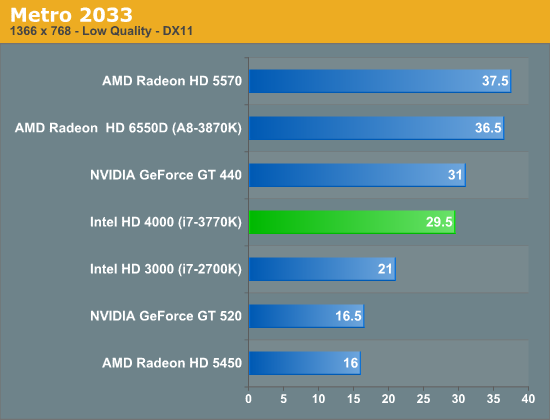
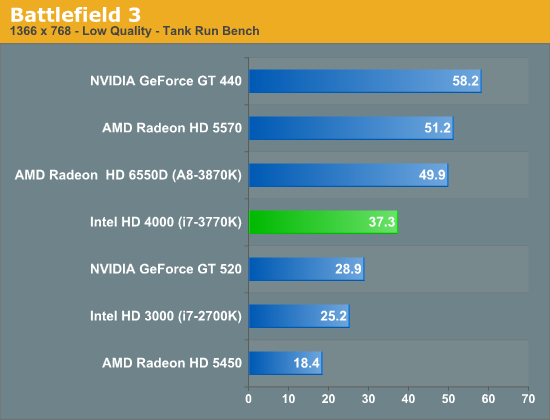
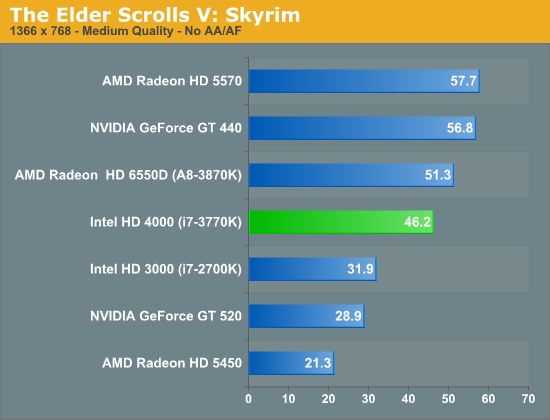
I agree Intel's GPUs are weak compared to AMD but the CPU is a lot stronger... and we are talking about low-end PC, cheaper one... not high-end... so the Intel's APUs didn't do that bad compared to AMD's APUs.
All Ive Bridge APU uses Intel HD 4000 clocked at 650Mhz with turbo from 1050-1150Mhz.



theprof00 said:
The difference is that the APU suffices for both cpu and gpu, whereas someone buying an old high tech intel will still have to work out money for a gpu, meaning it will never be able to match value |
Wait... as somebody who is planning to put it in their computer they already have? That's all i can get from your saying buying an old high tech intel.
Nobody is going to buy an APU for that...
Chances are if your looking to upgrade your computer... your prebuilt CPU will be fine ESPEICALLY if we're talking a bargain upgrade. You'd just be paying more for a CPU that doesn't offer an upgrade/might even be basically the same cpu.
APU's in desktops will pretty much just be for prebuilt only.
As for the new AMD APU's that will eventually come out being better then the current itel integrated graphicss...
Well yeah. Your talking future product vs current product. I'd hold my horses on speculation until you see what else Intel has in regards to if Intel has anything extra planned for the Iris line...
and well, since Apu's are meant for prebuilts... if companies will make use of AMD Apu's outside of Laptops, and other "harder" to modify hardware.




Intel have been making server and super computer CPUs for years. They are still the leaders in the PC space and are not going anywhere any time soon in fact the lack of competition from AMD is allowing both Nvidia and Intel to keep prices high and improve margins.
Nvidia may be expanding into other areas but that doesn't mean they are going to suddenly stop making GPUs for desktops any time soon. Even with APUs (or whatever you want to call them) from both AMD and Intel have eaten a lot of the low end market. The mid tier cards and up is still a profitable market.
The only player who may drop out of the PC gaming hardware market any time soon is AMD.

 @TheVoxelman on twitter


| zarx said: Intel have been making server and super computer CPUs for years. They are still the leaders in the PC space and are not going anywhere any time soon in fact the lack of competition from AMD is allowing both Nvidia and Intel to keep prices high and improve margins. Nvidia may be expanding into other areas but that doesn't mean they are going to suddenly stop making GPUs for desktops any time soon. Even with APUs (or whatever you want to call them) from both AMD and Intel have eaten a lot of the low end market. The mid tier cards and up is still a profitable market. The only player who may drop out of the PC gaming hardware market any time soon is AMD. |
Eh, Intel isn't going to drop dead, but their margins are being threatened, some might say collapsing:
http://online.wsj.com/article/SB10001424127887324030704578427062777641762.html
PC sales are going nowhere but down, and if Intel is going to earn any ground in mobile, it's going to have to accept smaller margins than it commands for PC parts.
NVIDIA's in a different position. People who buy discrete GPUs are the top-end users, who are generally the last customers to succumb to disruption. More importantly, it's carved out a strong position in mobile SoCs, which probably won't ever be as lucrative as selling PC silicon can be, but at least it has growth opportunity.
"The worst part about these reviews is they are [subjective]--and their scores often depend on how drunk you got the media at a Street Fighter event." — Mona Hamilton, Capcom Senior VP of Marketing
*Image indefinitely borrowed from BrainBoxLtd without his consent.

About Us |
Terms of Use |
Privacy Policy |
Advertise |
Staff |
Contact
Display As Desktop
Display As Mobile
© 2006-2026 VGChartz Ltd. All rights reserved.


