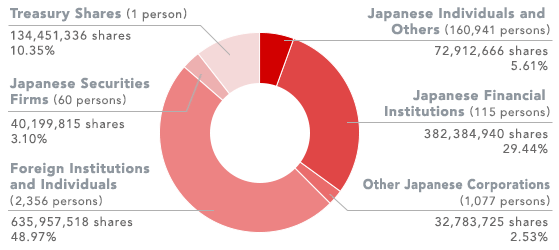
It's not that difficult to figure out, you simply have to understand how investors think. The broader market of investors and shareholders don't look at stability or long-term trends, they look for growth and large profit margins in the short-term, neither of which Nintendo are posting now. Nintendo haven't been posting growing revenues or profits or sales since 2009, so investors won't jump on board.
Combined with Nintendo not moving into the fastest growing sector of the games industry--the mobile market--investors just aren't interested. Investors want maximum return for minimal investment as quickly as possible. Nintendo don't operate that way; if they did, Animal Crossing would be free to play and Virtual Console at the least would be available across smartphones. That will make short-term money, but could easily jeopardize their long-term position, as Iwata noted at an investor's briefing when asked why Nintendo had yet to move into mobile.
Nintendo's market value is less an indication of whether or not Nintendo are doomed or even able to make a profit, but rather a bigger indication of whether or not Nintendo are growing their business. As someone noted, Nintendo's share price remained relatively stable (and low) across 1994 to 2005--because the core size of Nintendo's business didn't rapidly alter. Their home console business gradually declined, their portable business stayed stable. What happened across 2006 to 2009? Nintendo's business boomed. Wii represented an enormous amount of growth in their home console business, as DS did for their handheld business. Now to investors, it didn't matter how many total units those systems sold, it mattered how many were sold per year. DS and Wii both sold phenominally well on a yearly basis and grew in sales on a yearly basis across 2006 to 2008. This was accompanied by huge growth in revenue and profit, assisted by a weak yen and relatively strong dollar, as well as strong economic conditions across Nintendo's main markets.
Investors looking at Nintendo now see several signs that mean they aren't a good bet for short-term investment, the type of investment you typically get in today's world: as I said, maximum return for minimum investment as rapidly as possible, so you can put your money into other baskets. Right now, Nintendo's yearly sales are shrinking. They are struggling to return to profit, their revenue is down. Without a large profit margin, many investors won't look at Nintendo twice. Combined with all the investment advice suggesting you throw your money at mobile companies--which despite lower revenues and total sales than Nintendo, post relatively higher profit margins and faster growing revenues--Nintendo's share price will not increase. What's happened in the last 2 days? A more complete picture of Wii U's launch has been completed. It's by no means bad. It's not a weak launch--but it IS a smaller launch than the Wii, which gives another signal to investors that Nintendo aren't growing their business, and therefore aren't worth investing in.
Nintendo probably won't be able to attract many investors this generation. Their business was over-valued at the peak of the DS/Wii boom because of the size of Nintendo's growth: Nintendo being nearly as valuable as Toyota just doesn't reflect reality. Similarly, Nintendo's declining share prices right now don't mean that Nintendo are in any immediate danger, it just means Nintendo aren't growing their business. Obviously Nintendo will want to grow their business. But they can't post the kind of growth they got from moving from selling 20 million home consoles in 5 years to selling 60 million home consoles in three years, with corresponding higher software sales. They can't post the kind of growth they posted in their handheld business, selling 30 million units per year as they did with DS, moving on from GBA. It just isn't possible. They'd have to sell at rates that simply can't be supported by the current console market. Finally, the strong yen is yet again the bane of Nintendo's finances. The yen was weak during the boom, inflating the share prices of Japanese export-led businesses. The yen is now strong, making export-led Japanese companies far weaker than they were six years ago. It means Nintendo can't post large profit margins on their revenue, making their share price even weaker than it normally would be during a console transition, or even weaker than it should be for a company like Nintendo. Without growth, without large profit margins, Nintendo just aren't attractive to the vast majority of investors. Not when there are easier, safer, quicker bets to be made in the mobile market in the near-term. If anyone doesn't mind holding into stock for a few years in the hope the yen weakens, then you might make a fair bit of money.