By using this site, you agree to our Privacy Policy and our Terms of Use. Close

Forums - Politics - Cut the taxes of rich conservatives, and raise them on all liberals. Problem solved!

Kasz216 said:

Wait, how does that work... your counting the income that came in and just applying it all directlty as "military" while cutting away all the excess in other spending as not military.  How the heck does that make sense.


Either way... I do like the Australian model quite a bit.  Australia mostly seems to only spend money it has.

The thing is... you don't seem to quite get WHY Australia succeeded where the US failed.

You spend more on social security and tax the rich higher... well so does every Europeon state that failed during the global crissis and are at worse place then the US Is now!

Everything you highlighted as to why you think Australia did better is also true in the failing europeon countries.


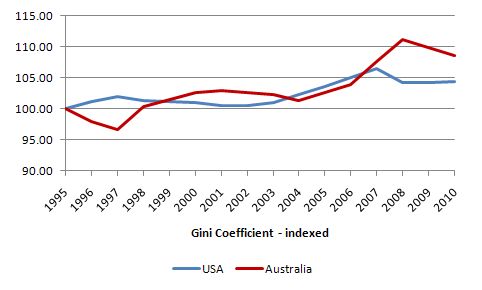
By the way... while your gini coefficent is lower... it's worth noting... it's grown more percentage wise due to Australias growth. (Using the incomplete less then optimal household gini coefficent, but It's all the data i can find on Australia.)

Yet you guys never had a huge crash and this was despite your higher rich people taxes and lack of mega rich.  Thought steep rises were supposed to cause that.


Why did Australia avoid the 2008 recession?  Well, for one.  Your housing never burst...

partical due to the Australian central bank RAISING interest rates to cut off cheap capital.

Your debt level was low,

You have been increasingly more tied to Asia in trade with China as your second biggest export partner.

And plenty of more reasons.   The article where I got the chart from is pretty informative.

http://www.cbsnews.com/8301-505125_162-51352693/how-australia-ducked-the-crisis/


As for Health... not really.  There isn't much your overlooking.  Human Services is just mostly meant to reflect the fact that they care about people as well as keeping the people healthy.

The US government just sucks at negotiating prices, because they tend to instead use it to win over lobbying groups... and have HUGE government beuracracy.

For example.  Our main Medical assosiation was AGAINST the Obama healthcare reforms... until Obama agreed to stop cutbacks in what medicare and medicaid pay docotors for procedures.

Expectations for care are much different... the US tends to be "overtreated" and written perscriptions for everything.

Not to mention cultural factors which, while Australia isn't great at, the US is worse... like obesity.

Oh and the real kicker... cost to be a doctor.  In the US, that's 4 years of undergraduate, 4 years of medical school, followed by AT LEAST 3 years of interning.

So you start being a doctor at like.... 30.  With like 100,000-200,000 worth of student loans owed to the government who you can't deafult to.

Also, we don't count education in our spending, because while we do have a department of education... most of are education spending and funding is done directly by the state governments.

Something worth noting in all that.. our state governments do way more "non defense" spending then everywhere else.


The housing bubble bursting in America caused the GFC. It was the aftershocks of the burst bubble that went around the world. The reason why Australia's housing prices didn't drop the way others did was because we didn't go into recession. In other words, you have the cause and effect backwards.

And I never claimed that increased inequality caused crashes. I said that inequality increases in the leadup to a crash. Did you notice the downturn in inequality after 2008? That happened because, between 1996 and 2007, the Australian equivalent of the Republicans held government. In 2007, the Australian equivalent of the Democrats took power, stopping a pattern of rising inequality. Notice that, in America, when Democrats take power, inequality still rises? Your system is screwed up.

It's true that there are other factors in why Australia avoided the GFC-triggered recessions. But the point I was making wasn't that higher taxes saved us, but that they didn't make us more vulnerable. We were able to survive, despite the higher taxes that modern conservative thinking claims causes economic instability.

You bring up lobbying groups. That's quite a bag of worms, so I won't go into it too much, but it's one of the biggest problems with the American system as it currently stands.

By the way, your system of having states be nearly independent entities is another part of America's problem. I understand the reasoning - each state then has to compete, etc, etc... but government is not, and should not be, like a private company. State governments should be complementary to the federal government. Indeed, America's insistence on competition at every level is a MAJOR issue. Consider, for instance, that Australia doesn't have local "school boards". We have a national curriculum, to ensure that all students are taught to a certain minimum level (they can go beyond the curriculum, it sets the minimum).

And if it costs a lot of money to become a doctor in America, then maybe that's a failing of your system, right there? Education costs in Australia are much lower, you get automatic loans from the government while studying that you don't have to pay off until you're earning more than a certain amount, and to be honest, even that's too expensive. Tertiary education should be free to the student (within reason - say, the first undergraduate course plus the first postgraduate course should be free), because they earned their right to study through their efforts at school. But that's neither here nor there.

You may have noticed, by now, a common thread running through my entire argument - America's system is screwed up, it needs to be fixed, not just shrunk.


Around the Network
Aielyn said:
Kasz216 said:

Wait, how does that work... your counting the income that came in and just applying it all directlty as "military" while cutting away all the excess in other spending as not military.  How the heck does that make sense.


Either way... I do like the Australian model quite a bit.  Australia mostly seems to only spend money it has.

The thing is... you don't seem to quite get WHY Australia succeeded where the US failed.

You spend more on social security and tax the rich higher... well so does every Europeon state that failed during the global crissis and are at worse place then the US Is now!

Everything you highlighted as to why you think Australia did better is also true in the failing europeon countries.


By the way... while your gini coefficent is lower... it's worth noting... it's grown more percentage wise due to Australias growth. (Using the incomplete less then optimal household gini coefficent, but It's all the data i can find on Australia.)

Yet you guys never had a huge crash and this was despite your higher rich people taxes and lack of mega rich.  Thought steep rises were supposed to cause that.


Why did Australia avoid the 2008 recession?  Well, for one.  Your housing never burst...

partical due to the Australian central bank RAISING interest rates to cut off cheap capital.

Your debt level was low,

You have been increasingly more tied to Asia in trade with China as your second biggest export partner.

And plenty of more reasons.   The article where I got the chart from is pretty informative.

http://www.cbsnews.com/8301-505125_162-51352693/how-australia-ducked-the-crisis/


As for Health... not really.  There isn't much your overlooking.  Human Services is just mostly meant to reflect the fact that they care about people as well as keeping the people healthy.

The US government just sucks at negotiating prices, because they tend to instead use it to win over lobbying groups... and have HUGE government beuracracy.

For example.  Our main Medical assosiation was AGAINST the Obama healthcare reforms... until Obama agreed to stop cutbacks in what medicare and medicaid pay docotors for procedures.

Expectations for care are much different... the US tends to be "overtreated" and written perscriptions for everything.

Not to mention cultural factors which, while Australia isn't great at, the US is worse... like obesity.

Oh and the real kicker... cost to be a doctor.  In the US, that's 4 years of undergraduate, 4 years of medical school, followed by AT LEAST 3 years of interning.

So you start being a doctor at like.... 30.  With like 100,000-200,000 worth of student loans owed to the government who you can't deafult to.

Also, we don't count education in our spending, because while we do have a department of education... most of are education spending and funding is done directly by the state governments.

Something worth noting in all that.. our state governments do way more "non defense" spending then everywhere else.


The housing bubble bursting in America caused the GFC. It was the aftershocks of the burst bubble that went around the world. The reason why Australia's housing prices didn't drop the way others did was because we didn't go into recession. In other words, you have the cause and effect backwards.

And I never claimed that increased inequality caused crashes. I said that inequality increases in the leadup to a crash. Did you notice the downturn in inequality after 2008? That happened because, between 1996 and 2007, the Australian equivalent of the Republicans held government. In 2007, the Australian equivalent of the Democrats took power, stopping a pattern of rising inequality. Notice that, in America, when Democrats take power, inequality still rises? Your system is screwed up.

It's true that there are other factors in why Australia avoided the GFC-triggered recessions. But the point I was making wasn't that higher taxes saved us, but that they didn't make us more vulnerable. We were able to survive, despite the higher taxes that modern conservative thinking claims causes economic instability.

You bring up lobbying groups. That's quite a bag of worms, so I won't go into it too much, but it's one of the biggest problems with the American system as it currently stands.

By the way, your system of having states be nearly independent entities is another part of America's problem. I understand the reasoning - each state then has to compete, etc, etc... but government is not, and should not be, like a private company. State governments should be complementary to the federal government. Indeed, America's insistence on competition at every level is a MAJOR issue. Consider, for instance, that Australia doesn't have local "school boards". We have a national curriculum, to ensure that all students are taught to a certain minimum level (they can go beyond the curriculum, it sets the minimum).

And if it costs a lot of money to become a doctor in America, then maybe that's a failing of your system, right there? Education costs in Australia are much lower, you get automatic loans from the government while studying that you don't have to pay off until you're earning more than a certain amount, and to be honest, even that's too expensive. Tertiary education should be free to the student (within reason - say, the first undergraduate course plus the first postgraduate course should be free), because they earned their right to study through their efforts at school. But that's neither here nor there.

You may have noticed, by now, a common thread running through my entire argument - America's system is screwed up, it needs to be fixed, not just shrunk.

1) No, you still have the cause and effect wrong... what prevented the housing collapse in australia was housing scarcity.  Unlike most western nations who have more then enough houses.

2) You mean... the downturn 1 year after the downturn in the US. 

3) Modern conservatives don't think high taxes on the risk bring instability.  They think it slows growth. 

4) It's not that States need to compete that states are split up.  They're split up because of how huge the US is.   The United States is more like the Europeon Union then it is Australia.

As for a National Curriculiam.  That's one of those edges against the middle fights.  A lot of people argue that such curriculums hurt racial minorities by putting them in classes they can't succeed in or ones not tailored towards getting them up to speed with everybody else.   Bush was actually the first president to push for it.  Obama is the second.

5)  American Education is expensive... but it's mostly worth it.  Unlike public schools... the universites are still top notch.  You have your top notch foreign schools that can compete... but there is a reason why the US is still so dominante in journal publications, and only being caught up with by the Chinese.

Really the problem is more length then it is cost, most other countries let you become a doctor long before you can in the US.  (Well and forth rate schools who still charge an arm and a leg.)

The problem with free college for all is... well everybody will want to go to college, will go to college, then will be depressed as hell when the reality hits them their degree is worthless and they're working back at a wendys.


6) Shrinking is the first way to fixing.  In an ideal world... a Libretarian would come in and knock EVERTHIYNG down.  Then everything could be rebuilt from the bottom up.

It's impossible to reform anything in the US government... because reform would require those who support to programs to admit they're flawed.

The only way to get reform is to remove and replace... or have a GIANT disaster that can't be ignored anymore.  Like why the VA hosptials got reformed. 


Aielyn said:
thranx said:
Are you not argueing that some poeple should pay more than others, ie the rich should have taxes raised? The government should stick to what the private secotr can not reasonbly supply, which would be a police/fire force, a judicail system, and an army to protect the people. Everything else should be left to private secotr that has incentives to increase productivity. Instead of the government where the incentive is to get the most money for your department. It would be a different story if the US government was capable of spening tax payer money well. But they don't, its wasted all over tha place so its best they don't have it. I am allways reasonable. Just because you dont agree with my veiwpoint does not make it unreasonable. Taking peoples money is the same as forcing them to do things, it removes their ability to make choices with their money. If the reasoning for doing so is for the btterment of the country, they why not take it a step further. Where do you draw the line?


But the fact is, nobody got rich without the help of society. Elizabeth Warren said it so well...


she also said she was cherokee indian...


Kasz216 said:
1) No, you still have the cause and effect wrong... what prevented the housing collapse in australia was housing scarcity.  Unlike most western nations who have more then enough houses.

2) You mean... the downturn 1 year after the downturn in the US.

3) Modern conservatives don't think high taxes on the risk bring instability.  They think it slows growth.

4) It's not that States need to compete that states are split up.  They're split up because of how huge the US is.   The United States is more like the Europeon Union then it is Australia.

As for a National Curriculiam.  That's one of those edges against the middle fights.  A lot of people argue that such curriculums hurt racial minorities by putting them in classes they can't succeed in or ones not tailored towards getting them up to speed with everybody else.   Bush was actually the first president to push for it.  Obama is the second.

5)  American Education is expensive... but it's mostly worth it.  Unlike public schools... the universites are still top notch.  You have your top notch foreign schools that can compete... but there is a reason why the US is still so dominante in journal publications, and only being caught up with by the Chinese.

Really the problem is more length then it is cost, most other countries let you become a doctor long before you can in the US.  (Well and forth rate schools who still charge an arm and a leg.)

The problem with free college for all is... well everybody will want to go to college, will go to college, then will be depressed as hell when the reality hits them their degree is worthless and they're working back at a wendys.


6) Shrinking is the first way to fixing.  In an ideal world... a Libretarian would come in and knock EVERTHIYNG down.  Then everything could be rebuilt from the bottom up.

It's impossible to reform anything in the US government... because reform would require those who support to programs to admit they're flawed.

The only way to get reform is to remove and replace... or have a GIANT disaster that can't be ignored anymore.  Like why the VA hosptials got reformed.

1. So what you're saying is that the housing issue wasn't an issue at all in Australia. Which doesn't challenge what I said, that the GFC outside of America wasn't due to local housing bubbles, but because the rest of the world uses the US dollar as the international currency, and because American banks are so tied to other banks. So when America's financial system melted down, it took the rest of the world with it. But Australia still managed to survive it without going into recession.

2. Not sure what you're trying to say, here, but there's absolutely no doubt that the reason for the change in trend in terms of inequality is that our Labor government (Labor is the Australian equivalent of the Democrats) instituted changes that helped to reduce inequality. The American downturn was due to the GFC. Remember, the GFC didn't drive Australia into a recession, so its impact was muted over here.

3. I meant instability of growth - more likelihood of growth going negative. As I pointed out, Australia didn't go into recession, despite higher taxes for the rich (and lower for the poor). What kept Australia from recession, really, was that the government acted swiftly with a stimulus package designed to simultaneously benefit the country in terms of things that we need and the creation of jobs to provide them. The money was spent on schools, on hospitals, on roads, and on providing subsidies for ceiling insulation and solar hot water systems (thereby reducing energy costs). They also provided financial benefits to low- and middle-income families, to students, and to farmers and farming-based small businesses. The result was lower inequality and the prevention of a recession.

4. I have the same problem with the European Union as I do with the United States. If your country is too large to manage well, maybe you should consider separating into multiple smaller countries. And curriculums shouldn't interfere with making sure that minorities are brought up to speed - you just incorporate things into the curriculum to ensure that it's all covered. Although I must ask why a "racial minority" wouldn't be able to succeed in any particular class. Also note that Australia has more ethnic diversity than America, and our education system doesn't really harm any particular "minority".

5. The reason why the US dominates so much in journals is that you're 15 times the population of Australia. China, of course, is catching up as it modernises, because they've got a massive population base... but until relatively recently, science wasn't big in China. And "free college for all" isn't what I'm referring to. It's "free college to anyone who satisfies entry requirements". Here in Australia, what happens is that the number of available places in a particular course is set, and then those places are filled in order of achievement - that is, how well you did at school (or equivalent, if mature-aged). So the cost doesn't blow out, and the value of the degree doesn't get depressed. We also have what is called a TAFE system ("Technical And Further Education"), in parallel with universities, but focusing on the less intellectual pursuits - so you go to TAFE if you want to, for instance, be a mechanic.

6. Shrinking doesn't fix it, that's the problem. If you want to fix it, you should start by simplifying it - get rid of all of those stupid patches that were put on the system, and instead spend the time closing the loopholes properly. Loopholes, by the way, in both directions - both tax loopholes and spending loopholes. And as I pointed out, the biggest problem is that you have a system that works on a two-party basis, which has produced a duopoly. Here in Australia, while it is true that we have two (technically three, but two are in an official coalition) major parties, we also have rather powerful minor parties and independents, who currently hold the balance of power in both our House of Representatives and our Senate. It forces the major parties to be a lot less self-interested.

Here's a description of a simple blueprint for fixing America's system:

1) Change your electoral system from first-past-the-post to preferential, and eliminate the "electoral college" system. This will enable a thriving ecosystem of parties, rather than just Democrats and Republicans. Perhaps consider making attendance for voting mandatory (actually voting wouldn't be necessary, as long as you show up (or equivalent - postal/early attendance is fine) - people are more likely to get involved and actually vote if they have to attend anyway).
2) With that done, work through the tax system, eliminating as much complexity as possible - that is, for instance, eliminate income tax on the poor, and eliminate the tax breaks that counter that 10% tax, so that the same people pay no tax, but without the extra bureaucracy and complexity. If necessary, simplify to a three-level tax structure, with, say, 0% tax up to $15,000, 20% tax up to $250,000, and 40% tax above that. You can tweak it later.
2b) Close the loopholes in the tax system. Make sure that millionaires are paying more (by percentage) tax than middle-income earners. Make sure that large corporations can't arrange things so that they pay zero tax, and convert to a local-only tax system.
3) Build a set of strict rules regarding lobbying, in order to reduce the influence that lobbyists have on the government.
4) Improve your welfare system and your primary/secondary education system. Privatise social security, but with a backup pension system for those who will need it - use the Australian system as a guide. Establish a national curriculum with room for certain forms of local variation in order to ensure maximal results, and provide federal funding for schools, beyond the state funding. Allow even private schools charging less than a certain amount per head to get some government funding (less than what public schools get, though), thereby providing incentive for private schools to cater for lower income levels.
5) Look at Canada's health system, and consider emulating a number of features from it in your public health system. Canada's system blows America's away. This doesn't mean that you can't have a thriving private health system - you just make sure the public system is focused on those things that are good for society - in other words, elective surgeries, for instance, are for the private system.

There are other things I'd do, but they're a lot more focused on my opinion rather than objective observation compared with what I've listed above. For instance, I'd nationalise the sales tax system - it's absurd that each state sets its own sales tax, nowadays (thanks to the internet, etc). I mean, my ultimate belief is that a sales tax shouldn't be necessary to begin with, but at the very least, it should be standardised, in my opinion. But it's not a necessity for fixing the system itself.

killerzX - not sure what point you're trying to make. Are you trying to say that because she identifies with Cherokee Indians, she is therefore not making a valid argument on taxation? You can think what you want of her regarding that issue, but it has no bearings on the validity of her argument regarding fair taxation and the comment she made.


Aielyn said:
Kasz216 said:
1) No, you still have the cause and effect wrong... what prevented the housing collapse in australia was housing scarcity.  Unlike most western nations who have more then enough houses.

2) You mean... the downturn 1 year after the downturn in the US.

3) Modern conservatives don't think high taxes on the risk bring instability.  They think it slows growth.

4) It's not that States need to compete that states are split up.  They're split up because of how huge the US is.   The United States is more like the Europeon Union then it is Australia.

As for a National Curriculiam.  That's one of those edges against the middle fights.  A lot of people argue that such curriculums hurt racial minorities by putting them in classes they can't succeed in or ones not tailored towards getting them up to speed with everybody else.   Bush was actually the first president to push for it.  Obama is the second.

5)  American Education is expensive... but it's mostly worth it.  Unlike public schools... the universites are still top notch.  You have your top notch foreign schools that can compete... but there is a reason why the US is still so dominante in journal publications, and only being caught up with by the Chinese.

Really the problem is more length then it is cost, most other countries let you become a doctor long before you can in the US.  (Well and forth rate schools who still charge an arm and a leg.)

The problem with free college for all is... well everybody will want to go to college, will go to college, then will be depressed as hell when the reality hits them their degree is worthless and they're working back at a wendys.


6) Shrinking is the first way to fixing.  In an ideal world... a Libretarian would come in and knock EVERTHIYNG down.  Then everything could be rebuilt from the bottom up.

It's impossible to reform anything in the US government... because reform would require those who support to programs to admit they're flawed.

The only way to get reform is to remove and replace... or have a GIANT disaster that can't be ignored anymore.  Like why the VA hosptials got reformed.

1. So what you're saying is that the housing issue wasn't an issue at all in Australia. Which doesn't challenge what I said, that the GFC outside of America wasn't due to local housing bubbles, but because the rest of the world uses the US dollar as the international currency, and because American banks are so tied to other banks. So when America's financial system melted down, it took the rest of the world with it. But Australia still managed to survive it without going into recession.

2. Not sure what you're trying to say, here, but there's absolutely no doubt that the reason for the change in trend in terms of inequality is that our Labor government (Labor is the Australian equivalent of the Democrats) instituted changes that helped to reduce inequality. The American downturn was due to the GFC. Remember, the GFC didn't drive Australia into a recession, so its impact was muted over here.

3. I meant instability of growth - more likelihood of growth going negative. As I pointed out, Australia didn't go into recession, despite higher taxes for the rich (and lower for the poor). What kept Australia from recession, really, was that the government acted swiftly with a stimulus package designed to simultaneously benefit the country in terms of things that we need and the creation of jobs to provide them. The money was spent on schools, on hospitals, on roads, and on providing subsidies for ceiling insulation and solar hot water systems (thereby reducing energy costs). They also provided financial benefits to low- and middle-income families, to students, and to farmers and farming-based small businesses. The result was lower inequality and the prevention of a recession.

4. I have the same problem with the European Union as I do with the United States. If your country is too large to manage well, maybe you should consider separating into multiple smaller countries. And curriculums shouldn't interfere with making sure that minorities are brought up to speed - you just incorporate things into the curriculum to ensure that it's all covered. Although I must ask why a "racial minority" wouldn't be able to succeed in any particular class. Also note that Australia has more ethnic diversity than America, and our education system doesn't really harm any particular "minority".

5. The reason why the US dominates so much in journals is that you're 15 times the population of Australia. China, of course, is catching up as it modernises, because they've got a massive population base... but until relatively recently, science wasn't big in China. And "free college for all" isn't what I'm referring to. It's "free college to anyone who satisfies entry requirements". Here in Australia, what happens is that the number of available places in a particular course is set, and then those places are filled in order of achievement - that is, how well you did at school (or equivalent, if mature-aged). So the cost doesn't blow out, and the value of the degree doesn't get depressed. We also have what is called a TAFE system ("Technical And Further Education"), in parallel with universities, but focusing on the less intellectual pursuits - so you go to TAFE if you want to, for instance, be a mechanic.

6. Shrinking doesn't fix it, that's the problem. If you want to fix it, you should start by simplifying it - get rid of all of those stupid patches that were put on the system, and instead spend the time closing the loopholes properly. Loopholes, by the way, in both directions - both tax loopholes and spending loopholes. And as I pointed out, the biggest problem is that you have a system that works on a two-party basis, which has produced a duopoly. Here in Australia, while it is true that we have two (technically three, but two are in an official coalition) major parties, we also have rather powerful minor parties and independents, who currently hold the balance of power in both our House of Representatives and our Senate. It forces the major parties to be a lot less self-interested.

Here's a description of a simple blueprint for fixing America's system:

1) Change your electoral system from first-past-the-post to preferential, and eliminate the "electoral college" system. This will enable a thriving ecosystem of parties, rather than just Democrats and Republicans. Perhaps consider making attendance for voting mandatory (actually voting wouldn't be necessary, as long as you show up (or equivalent - postal/early attendance is fine) - people are more likely to get involved and actually vote if they have to attend anyway).
2) With that done, work through the tax system, eliminating as much complexity as possible - that is, for instance, eliminate income tax on the poor, and eliminate the tax breaks that counter that 10% tax, so that the same people pay no tax, but without the extra bureaucracy and complexity. If necessary, simplify to a three-level tax structure, with, say, 0% tax up to $15,000, 20% tax up to $250,000, and 40% tax above that. You can tweak it later.
2b) Close the loopholes in the tax system. Make sure that millionaires are paying more (by percentage) tax than middle-income earners. Make sure that large corporations can't arrange things so that they pay zero tax, and convert to a local-only tax system.
3) Build a set of strict rules regarding lobbying, in order to reduce the influence that lobbyists have on the government.
4) Improve your welfare system and your primary/secondary education system. Privatise social security, but with a backup pension system for those who will need it - use the Australian system as a guide. Establish a national curriculum with room for certain forms of local variation in order to ensure maximal results, and provide federal funding for schools, beyond the state funding. Allow even private schools charging less than a certain amount per head to get some government funding (less than what public schools get, though), thereby providing incentive for private schools to cater for lower income levels.
5) Look at Canada's health system, and consider emulating a number of features from it in your public health system. Canada's system blows America's away. This doesn't mean that you can't have a thriving private health system - you just make sure the public system is focused on those things that are good for society - in other words, elective surgeries, for instance, are for the private system.

There are other things I'd do, but they're a lot more focused on my opinion rather than objective observation compared with what I've listed above. For instance, I'd nationalise the sales tax system - it's absurd that each state sets its own sales tax, nowadays (thanks to the internet, etc). I mean, my ultimate belief is that a sales tax shouldn't be necessary to begin with, but at the very least, it should be standardised, in my opinion. But it's not a necessity for fixing the system itself.

killerzX - not sure what point you're trying to make. Are you trying to say that because she identifies with Cherokee Indians, she is therefore not making a valid argument on taxation? You can think what you want of her regarding that issue, but it has no bearings on the validity of her argument regarding fair taxation and the comment she made.

1) There were housing bubbles pretty much everyhwere though... and signs of it failing in other countries well before the GFC.

2)  I'm all for closing loopholes.... and millionaires do pay more in taxes then the middle class.  The only people who don't are those very few who aren't taxed almost exclusivly on the income tax, but the capital gains tax...(The amount of people like this are like maybe 400.)  Which Austrlia has at a lower price then regular taxation as well.

Also worth noting...  your exmeptions for the poor are actually lower and when you account for the breaks.  USD/AUS is about equal.  Thing is, your 0% Tax Bracket at 5,000.  Our 10% bracket ends at 17,000.  Our 15% bracket ends at 69,000 vs yours ends at 37,000.  It's not just the rich who have a lower tax bracket then Austrlia.  

3)  Except... it wasn't.  Austrlia didn't put those measures in, and they didn't apply until well after they should of felt effects and didn't.  Austrlia didn't have issues because they were tied strongly to nin Japanese asia and deal in commoddities.

4)  I wouldn't disagree with any of that... outside arugeably the national curriculum due to educational inequality worries.

5)  Funny thing is... a lot of Canadians disagree.  Also the US government doesn't run their healthcare much differently from the canadian system that i can see.


Around the Network

Also... as for more ethnic diversity in Australia and ethnic inequality.

What's that based on?

From what i can tell by looking at demographics numbers "White" seems to make up about 87+% of the population.


It might be hard to measure how much the national curriculium hut ethnic minorities because of how poorly indegenious students were already doing before it was implemented!

From what i can tell by looking at articles, Australia is still shamefully behind in terms of racial equality.


Kasz216 said:
Aielyn said:
1. So what you're saying is that the housing issue wasn't an issue at all in Australia. Which doesn't challenge what I said, that the GFC outside of America wasn't due to local housing bubbles, but because the rest of the world uses the US dollar as the international currency, and because American banks are so tied to other banks. So when America's financial system melted down, it took the rest of the world with it. But Australia still managed to survive it without going into recession.

2. Not sure what you're trying to say, here, but there's absolutely no doubt that the reason for the change in trend in terms of inequality is that our Labor government (Labor is the Australian equivalent of the Democrats) instituted changes that helped to reduce inequality. The American downturn was due to the GFC. Remember, the GFC didn't drive Australia into a recession, so its impact was muted over here.

3. I meant instability of growth - more likelihood of growth going negative. As I pointed out, Australia didn't go into recession, despite higher taxes for the rich (and lower for the poor). What kept Australia from recession, really, was that the government acted swiftly with a stimulus package designed to simultaneously benefit the country in terms of things that we need and the creation of jobs to provide them. The money was spent on schools, on hospitals, on roads, and on providing subsidies for ceiling insulation and solar hot water systems (thereby reducing energy costs). They also provided financial benefits to low- and middle-income families, to students, and to farmers and farming-based small businesses. The result was lower inequality and the prevention of a recession.

4. I have the same problem with the European Union as I do with the United States. If your country is too large to manage well, maybe you should consider separating into multiple smaller countries. And curriculums shouldn't interfere with making sure that minorities are brought up to speed - you just incorporate things into the curriculum to ensure that it's all covered. Although I must ask why a "racial minority" wouldn't be able to succeed in any particular class. Also note that Australia has more ethnic diversity than America, and our education system doesn't really harm any particular "minority".

5. The reason why the US dominates so much in journals is that you're 15 times the population of Australia. China, of course, is catching up as it modernises, because they've got a massive population base... but until relatively recently, science wasn't big in China. And "free college for all" isn't what I'm referring to. It's "free college to anyone who satisfies entry requirements". Here in Australia, what happens is that the number of available places in a particular course is set, and then those places are filled in order of achievement - that is, how well you did at school (or equivalent, if mature-aged). So the cost doesn't blow out, and the value of the degree doesn't get depressed. We also have what is called a TAFE system ("Technical And Further Education"), in parallel with universities, but focusing on the less intellectual pursuits - so you go to TAFE if you want to, for instance, be a mechanic.

6. Shrinking doesn't fix it, that's the problem. If you want to fix it, you should start by simplifying it - get rid of all of those stupid patches that were put on the system, and instead spend the time closing the loopholes properly. Loopholes, by the way, in both directions - both tax loopholes and spending loopholes. And as I pointed out, the biggest problem is that you have a system that works on a two-party basis, which has produced a duopoly. Here in Australia, while it is true that we have two (technically three, but two are in an official coalition) major parties, we also have rather powerful minor parties and independents, who currently hold the balance of power in both our House of Representatives and our Senate. It forces the major parties to be a lot less self-interested.

Here's a description of a simple blueprint for fixing America's system:

1) Change your electoral system from first-past-the-post to preferential, and eliminate the "electoral college" system. This will enable a thriving ecosystem of parties, rather than just Democrats and Republicans. Perhaps consider making attendance for voting mandatory (actually voting wouldn't be necessary, as long as you show up (or equivalent - postal/early attendance is fine) - people are more likely to get involved and actually vote if they have to attend anyway).
2) With that done, work through the tax system, eliminating as much complexity as possible - that is, for instance, eliminate income tax on the poor, and eliminate the tax breaks that counter that 10% tax, so that the same people pay no tax, but without the extra bureaucracy and complexity. If necessary, simplify to a three-level tax structure, with, say, 0% tax up to $15,000, 20% tax up to $250,000, and 40% tax above that. You can tweak it later.
2b) Close the loopholes in the tax system. Make sure that millionaires are paying more (by percentage) tax than middle-income earners. Make sure that large corporations can't arrange things so that they pay zero tax, and convert to a local-only tax system.
3) Build a set of strict rules regarding lobbying, in order to reduce the influence that lobbyists have on the government.
4) Improve your welfare system and your primary/secondary education system. Privatise social security, but with a backup pension system for those who will need it - use the Australian system as a guide. Establish a national curriculum with room for certain forms of local variation in order to ensure maximal results, and provide federal funding for schools, beyond the state funding. Allow even private schools charging less than a certain amount per head to get some government funding (less than what public schools get, though), thereby providing incentive for private schools to cater for lower income levels.
5) Look at Canada's health system, and consider emulating a number of features from it in your public health system. Canada's system blows America's away. This doesn't mean that you can't have a thriving private health system - you just make sure the public system is focused on those things that are good for society - in other words, elective surgeries, for instance, are for the private system.

There are other things I'd do, but they're a lot more focused on my opinion rather than objective observation compared with what I've listed above. For instance, I'd nationalise the sales tax system - it's absurd that each state sets its own sales tax, nowadays (thanks to the internet, etc). I mean, my ultimate belief is that a sales tax shouldn't be necessary to begin with, but at the very least, it should be standardised, in my opinion. But it's not a necessity for fixing the system itself.

killerzX - not sure what point you're trying to make. Are you trying to say that because she identifies with Cherokee Indians, she is therefore not making a valid argument on taxation? You can think what you want of her regarding that issue, but it has no bearings on the validity of her argument regarding fair taxation and the comment she made.

1) There were housing bubbles pretty much everyhwere though... and signs of it failing in other countries well before the GFC.

2)  I'm all for closing loopholes.... and millionaires do pay more in taxes then the middle class.  The only people who don't are those very few who aren't taxed almost exclusivly on the income tax, but the capital gains tax...(The amount of people like this are like maybe 400.)  Which Austrlia has at a lower price then regular taxation as well.

Also worth noting...  your exmeptions for the poor are actually lower and when you account for the breaks.  USD/AUS is about equal.  Thing is, your 0% Tax Bracket at 5,000.  Our 10% bracket ends at 17,000.  Our 15% bracket ends at 69,000 vs yours ends at 37,000.  It's not just the rich who have a lower tax bracket then Austrlia.  

3)  Except... it wasn't.  Austrlia didn't put those measures in, and they didn't apply until well after they should of felt effects and didn't.  Austrlia didn't have issues because they were tied strongly to nin Japanese asia and deal in commoddities.

4)  I wouldn't disagree with any of that... outside arugeably the national curriculum due to educational inequality worries.

5)  Funny thing is... a lot of Canadians disagree.  Also the US government doesn't run their healthcare much differently from the canadian system that i can see.

1. The point is that housing bubbles bursing elsewhere wasn't the cause of the GFC. The GFC was caused by the bursting in America.

2. I admit that capital gains tax in Australia also needs reforming. I'm not claiming that Australia is perfect - there's quite a few things that are flawed in Australia, too.

As for tax brackets, you forget that you need to work out the actual results, rather than just looking at percentages and end points. More importantly, you seem to be looking at the Married brackets, whereas the Australian ones are listed for individuals only. For convenience, I'll use this notation: "AU-1" means "first Australian threshold", "US-3" means "third American threshold".
At $6000 (AU-1), we pay $0 tax, Americans pay $600 (+$600).
At $8700 (US-1), we pay $405, Americans pay $870 (+$465).
At $35,350 (US-2), we pay $4402.50, Americans pay $4867.50 (+$465).
At $37,000 (AU-2), we pay $4650, Americans pay $5280 (+$630).
At $49,600, both Australians and Americans pay $8430 (+$0).
At $80,000 (AU-3), we pay $17,550, Americans pay $16030 (-$1520).
At $85,650 (US-3), we pay $19,640.50, Americans pay $17,442.50 (-$2198).
As you can imagine, the difference grows more beyond there, since the Australian rate is already 37% while the US rate is just 28% and never goes above 35%. So essentially, everyone below about $50,000 a year in Australia pays less tax than in America, whereas everyone above that pays more than in America. Just for completeness, at our last threshold, $180,000, we pay $10,622 more than America does, and at your last threshold, $388350, we pay $35,624 more than America does. A millionaire in Australia pays 42.36% of their income in tax, whereas a millionaire in America pays 32.68% of their income in tax.

Regarding the impact of marriage, that's a different issue, and a complicated one at that. There's lots of room for massive debate over things like whether couples should be treated like their combined income is shared evenly between them, whether marriage should provide tax benefits (and doesn't this encourage marriage for the sake of money?), etc. Since it's such a large kettle of fish, I'll leave it alone. Suffice it to say, the fair comparison is individual rates vs individual rates.

3. You forget that I LIVE in Australia. I know all about the timings of things. Those stimulus elements were put in place as the GFC built up its pace outside of America. The GFC hit America first, for obvious reasons. It took time to impact everywhere else. And no, our connections with China don't explain it, either. I feel I should point out that international economists, including those of the IMF, attribute Australia's avoidance of the recession to the government's actions.

5. http://en.wikipedia.org/wiki/Comparison_of_Canadian_and_American_health_care_systems

And I wasn't saying that you should copy Canada's system. You should emulate a number of features from it. Others should not be implemented. Just as Australia's system isn't perfect, neither is Canada's. The biggest problem is that wait times are too large. But that's more to do with number of doctors vs number of procedures needing to be done. I'm sure there are Canadians who dislike their system. But the numbers tell a different story - Life expectancy is higher in Canada (and Australia), infant mortality is significantly lower, per capita spending on health is roughly half, and costs relative to GDP are significantly lower. When another system is working, on the whole, better than yours, you should compare them to figure out what is making the difference. Then you should try to make a system that works even better than that.


Aielyn said:
Kasz216 said:
Aielyn said:
1. So what you're saying is that the housing issue wasn't an issue at all in Australia. Which doesn't challenge what I said, that the GFC outside of America wasn't due to local housing bubbles, but because the rest of the world uses the US dollar as the international currency, and because American banks are so tied to other banks. So when America's financial system melted down, it took the rest of the world with it. But Australia still managed to survive it without going into recession.

2. Not sure what you're trying to say, here, but there's absolutely no doubt that the reason for the change in trend in terms of inequality is that our Labor government (Labor is the Australian equivalent of the Democrats) instituted changes that helped to reduce inequality. The American downturn was due to the GFC. Remember, the GFC didn't drive Australia into a recession, so its impact was muted over here.

3. I meant instability of growth - more likelihood of growth going negative. As I pointed out, Australia didn't go into recession, despite higher taxes for the rich (and lower for the poor). What kept Australia from recession, really, was that the government acted swiftly with a stimulus package designed to simultaneously benefit the country in terms of things that we need and the creation of jobs to provide them. The money was spent on schools, on hospitals, on roads, and on providing subsidies for ceiling insulation and solar hot water systems (thereby reducing energy costs). They also provided financial benefits to low- and middle-income families, to students, and to farmers and farming-based small businesses. The result was lower inequality and the prevention of a recession.

4. I have the same problem with the European Union as I do with the United States. If your country is too large to manage well, maybe you should consider separating into multiple smaller countries. And curriculums shouldn't interfere with making sure that minorities are brought up to speed - you just incorporate things into the curriculum to ensure that it's all covered. Although I must ask why a "racial minority" wouldn't be able to succeed in any particular class. Also note that Australia has more ethnic diversity than America, and our education system doesn't really harm any particular "minority".

5. The reason why the US dominates so much in journals is that you're 15 times the population of Australia. China, of course, is catching up as it modernises, because they've got a massive population base... but until relatively recently, science wasn't big in China. And "free college for all" isn't what I'm referring to. It's "free college to anyone who satisfies entry requirements". Here in Australia, what happens is that the number of available places in a particular course is set, and then those places are filled in order of achievement - that is, how well you did at school (or equivalent, if mature-aged). So the cost doesn't blow out, and the value of the degree doesn't get depressed. We also have what is called a TAFE system ("Technical And Further Education"), in parallel with universities, but focusing on the less intellectual pursuits - so you go to TAFE if you want to, for instance, be a mechanic.

6. Shrinking doesn't fix it, that's the problem. If you want to fix it, you should start by simplifying it - get rid of all of those stupid patches that were put on the system, and instead spend the time closing the loopholes properly. Loopholes, by the way, in both directions - both tax loopholes and spending loopholes. And as I pointed out, the biggest problem is that you have a system that works on a two-party basis, which has produced a duopoly. Here in Australia, while it is true that we have two (technically three, but two are in an official coalition) major parties, we also have rather powerful minor parties and independents, who currently hold the balance of power in both our House of Representatives and our Senate. It forces the major parties to be a lot less self-interested.

Here's a description of a simple blueprint for fixing America's system:

1) Change your electoral system from first-past-the-post to preferential, and eliminate the "electoral college" system. This will enable a thriving ecosystem of parties, rather than just Democrats and Republicans. Perhaps consider making attendance for voting mandatory (actually voting wouldn't be necessary, as long as you show up (or equivalent - postal/early attendance is fine) - people are more likely to get involved and actually vote if they have to attend anyway).
2) With that done, work through the tax system, eliminating as much complexity as possible - that is, for instance, eliminate income tax on the poor, and eliminate the tax breaks that counter that 10% tax, so that the same people pay no tax, but without the extra bureaucracy and complexity. If necessary, simplify to a three-level tax structure, with, say, 0% tax up to $15,000, 20% tax up to $250,000, and 40% tax above that. You can tweak it later.
2b) Close the loopholes in the tax system. Make sure that millionaires are paying more (by percentage) tax than middle-income earners. Make sure that large corporations can't arrange things so that they pay zero tax, and convert to a local-only tax system.
3) Build a set of strict rules regarding lobbying, in order to reduce the influence that lobbyists have on the government.
4) Improve your welfare system and your primary/secondary education system. Privatise social security, but with a backup pension system for those who will need it - use the Australian system as a guide. Establish a national curriculum with room for certain forms of local variation in order to ensure maximal results, and provide federal funding for schools, beyond the state funding. Allow even private schools charging less than a certain amount per head to get some government funding (less than what public schools get, though), thereby providing incentive for private schools to cater for lower income levels.
5) Look at Canada's health system, and consider emulating a number of features from it in your public health system. Canada's system blows America's away. This doesn't mean that you can't have a thriving private health system - you just make sure the public system is focused on those things that are good for society - in other words, elective surgeries, for instance, are for the private system.

There are other things I'd do, but they're a lot more focused on my opinion rather than objective observation compared with what I've listed above. For instance, I'd nationalise the sales tax system - it's absurd that each state sets its own sales tax, nowadays (thanks to the internet, etc). I mean, my ultimate belief is that a sales tax shouldn't be necessary to begin with, but at the very least, it should be standardised, in my opinion. But it's not a necessity for fixing the system itself.

killerzX - not sure what point you're trying to make. Are you trying to say that because she identifies with Cherokee Indians, she is therefore not making a valid argument on taxation? You can think what you want of her regarding that issue, but it has no bearings on the validity of her argument regarding fair taxation and the comment she made.

1) There were housing bubbles pretty much everyhwere though... and signs of it failing in other countries well before the GFC.

2)  I'm all for closing loopholes.... and millionaires do pay more in taxes then the middle class.  The only people who don't are those very few who aren't taxed almost exclusivly on the income tax, but the capital gains tax...(The amount of people like this are like maybe 400.)  Which Austrlia has at a lower price then regular taxation as well.

Also worth noting...  your exmeptions for the poor are actually lower and when you account for the breaks.  USD/AUS is about equal.  Thing is, your 0% Tax Bracket at 5,000.  Our 10% bracket ends at 17,000.  Our 15% bracket ends at 69,000 vs yours ends at 37,000.  It's not just the rich who have a lower tax bracket then Austrlia.  

3)  Except... it wasn't.  Austrlia didn't put those measures in, and they didn't apply until well after they should of felt effects and didn't.  Austrlia didn't have issues because they were tied strongly to nin Japanese asia and deal in commoddities.

4)  I wouldn't disagree with any of that... outside arugeably the national curriculum due to educational inequality worries.

5)  Funny thing is... a lot of Canadians disagree.  Also the US government doesn't run their healthcare much differently from the canadian system that i can see.

1. The point is that housing bubbles bursing elsewhere wasn't the cause of the GFC. The GFC was caused by the bursting in America.

2. I admit that capital gains tax in Australia also needs reforming. I'm not claiming that Australia is perfect - there's quite a few things that are flawed in Australia, too.

As for tax brackets, you forget that you need to work out the actual results, rather than just looking at percentages and end points. More importantly, you seem to be looking at the Married brackets, whereas the Australian ones are listed for individuals only. For convenience, I'll use this notation: "AU-1" means "first Australian threshold", "US-3" means "third American threshold".
At $6000 (AU-1), we pay $0 tax, Americans pay $600 (+$600).
At $8700 (US-1), we pay $405, Americans pay $870 (+$465).
At $35,350 (US-2), we pay $4402.50, Americans pay $4867.50 (+$465).
At $37,000 (AU-2), we pay $4650, Americans pay $5280 (+$630).
At $49,600, both Australians and Americans pay $8430 (+$0).
At $80,000 (AU-3), we pay $17,550, Americans pay $16030 (-$1520).
At $85,650 (US-3), we pay $19,640.50, Americans pay $17,442.50 (-$2198).
As you can imagine, the difference grows more beyond there, since the Australian rate is already 37% while the US rate is just 28% and never goes above 35%. So essentially, everyone below about $50,000 a year in Australia pays less tax than in America, whereas everyone above that pays more than in America. Just for completeness, at our last threshold, $180,000, we pay $10,622 more than America does, and at your last threshold, $388350, we pay $35,624 more than America does. A millionaire in Australia pays 42.36% of their income in tax, whereas a millionaire in America pays 32.68% of their income in tax.

Regarding the impact of marriage, that's a different issue, and a complicated one at that. There's lots of room for massive debate over things like whether couples should be treated like their combined income is shared evenly between them, whether marriage should provide tax benefits (and doesn't this encourage marriage for the sake of money?), etc. Since it's such a large kettle of fish, I'll leave it alone. Suffice it to say, the fair comparison is individual rates vs individual rates.

3. You forget that I LIVE in Australia. I know all about the timings of things. Those stimulus elements were put in place as the GFC built up its pace outside of America. The GFC hit America first, for obvious reasons. It took time to impact everywhere else. And no, our connections with China don't explain it, either. I feel I should point out that international economists, including those of the IMF, attribute Australia's avoidance of the recession to the government's actions.

5. http://en.wikipedia.org/wiki/Comparison_of_Canadian_and_American_health_care_systems

And I wasn't saying that you should copy Canada's system. You should emulate a number of features from it. Others should not be implemented. Just as Australia's system isn't perfect, neither is Canada's. The biggest problem is that wait times are too large. But that's more to do with number of doctors vs number of procedures needing to be done. I'm sure there are Canadians who dislike their system. But the numbers tell a different story - Life expectancy is higher in Canada (and Australia), infant mortality is significantly lower, per capita spending on health is roughly half, and costs relative to GDP are significantly lower. When another system is working, on the whole, better than yours, you should compare them to figure out what is making the difference. Then you should try to make a system that works even better than that.

1) Actually, the bubbles bursting elsewhere also was a big part of it...

2) Your ignoring those deductions...   something like half of US taxfilers don't pay income taxes... most 10% and a lot of the 15% aren't really relevent... and capital gains taxes being lower aren't a problem.  75% of people making 25,000 and under don't pay any income taxes at all.  The rest don't pay anywhere near that amount.   In the US effective tax rates are MUCH lower then the shown ones.

This is why you only see people compare romneys tax rate with the stated middle class tax rate.  Or peope like Warren Buffet talking about the injustice of his secretary paying more in taxes when the reality is, his "secretary" makes hundreds of thousands  and is considered rich if not also like buffet in the "1%".

If you compaired the rich, even those who make most of their money on capital gains, their effective tax rate vs the average middle class guys effective... the're still paying a lot more then all but a few outliers.

3) I'd simply point you again to that article and well... the fact that most itnernational economists don't think that.  Look back at the article posted... and the fact that well... pretty much every nation tried quick and early stimuli.   Australia just wasn't as tied in to the hole crisis as everyone else.  The Australian banks weren't really as interconnected as the US, Euroepon and Japanese banks were.

4)  Except those numbers are afirly fraduliant in discussing healthcare.  Life Expectancy?  Considering the amount of  homicide and people in jail... I'm going to guess that plays a large part.   Nevermind higher obesity rates, higher smoking, pretty much just more unhealthy habits then anywhere else in the wolrd.

Infant mortality has different factors... like for example what you qualify as an infant and what you qualify as a live birth that dies but wasn't a child.

Furthermore, you can take identical towns, with indetical healthcare systems and the results would be far from identical, so cross country comparrisons with so many factors are laughable.

I'd point you to a chapter in Outliers.

http://www.nytimes.com/2008/11/30/books/chapters/chapter-outliers.html?pagewanted=all


Kasz216 said:
6) Shrinking is the first way to fixing.  In an ideal world... a Libretarian would come in and knock EVERTHIYNG down.  Then everything could be rebuilt from the bottom up.

It's impossible to reform anything in the US government... because reform would require those who support to programs to admit they're flawed.

The only way to get reform is to remove and replace... or have a GIANT disaster that can't be ignored anymore.  Like why the VA hosptials got reformed. 

My understand is that, yes Libertarians want to tear everything down.  But they generally have the belief that, somehow, the markets will magically rebuild everything and everyone will be better off with the pricing mechanism being the answer to everything.  Libertarians believe that everything has a market answer including fire protection, because I guess they believe fires will magically not jump onto property of people who paid who live next door, and you need some death in fires to make people pay up for their fire protection.   

Anarchists want to tear everything down, including the concept of private property, because they belief, if you remove all constraints, and make everything voluntary, society will organize itself in magically ways and everyone will love and share.  It is just that the bully system of coersion by government, makes people evil and greedy.

A thing about destructionist ideologies is they really don't solve any problems.  They have a belief that somehow, if you get rid of something, that the natural order of things will magically make the problems go away.  What ends up being failed to realize in this is that governments take up issues because the population demands they do something about it.  Even if it isn't a majority, it is sufficient numbers for a politician to get elected on it.  Destructionst ideologies are ones where society goes highwire without a net beneath.  It is risky and radical.  And I believe, before anyone subscribes to any of this they need to ask if such can be done today, with what we have, voluntarily, before people decide to tear everything down.  Is it possible to evolve new solutions and migrate over, before deciding to burn the place down and replace it with something that may or may not show up?  I believe this approach is genuinely more conservative.


richardhutnik said:
Kasz216 said:
6) Shrinking is the first way to fixing.  In an ideal world... a Libretarian would come in and knock EVERTHIYNG down.  Then everything could be rebuilt from the bottom up.

It's impossible to reform anything in the US government... because reform would require those who support to programs to admit they're flawed.

The only way to get reform is to remove and replace... or have a GIANT disaster that can't be ignored anymore.  Like why the VA hosptials got reformed. 

My understand is that, yes Libertarians want to tear everything down.  But they generally have the belief that, somehow, the markets will magically rebuild everything and everyone will be better off with the pricing mechanism being the answer to everything.  Libertarians believe that everything has a market answer including fire protection, because I guess they believe fires will magically not jump onto property of people who paid who live next door, and you need some death in fires to make people pay up for their fire protection.  

Right... and that will last, at most two presidential terms... people will miss a lot of the shit libretarians knocked down... a lot of the libretarians will be replaced and a lot of the social programs and regulations we have now will come back more simplified and better, because the regulatory system will be written in one go leaving out the regulations that didn't work at all,  and that often prevent better reuglations.  Nobody is willing to use new ideas now... and even if they were chances are they'd fail due to the level of bloat and worthless programs already in existence.  For example pretty much EVERYONE agrees we're spending too much.  How much money could really go to  a "Minority wealth bank" When we have so many failed agencies and failed policies and programs to help minorities?

Oh and as for fire protection... magicaly jumping on other peoples houses really isn't an issue, as I recall there was a stroy about a year ago about a guy who refused to pay his fire taxes so the city let his house burn down... putting out only fires that spread elsewhere/when it became a huge risk.