By using this site, you agree to our Privacy Policy and our Terms of Use. Close

Forums - General - The Falkland Islands debate

SecondWar said:
RedInker said:
The Islanders wish to remain British so their will must be respected. Infact they probably have a stronger British patriotism than the actual British themselves. Think I read somewhere that there is a plan to allow the Falkland Islanders to be able to vote for an MP into westminster which will give them a voice in the U.K. government affairs.

Argentine are going to love that, that would mean rather than being an overseas territory they become fully incorporated into the UK. 


Yeah they won't like that one bit. The plan is for all the British dependicies and overseas territories to be able to elect MP's. Seems fair to be honest. Although most of the 21 territories have self governance the U.K. is still reponsible for their foreign affairs and defence etc which they have no voice.


Around the Network

This is a case that must be resolved in some kind of court system. I think the legal arguments are sound for both countries. Property law, maritime law, common law, roman law, everything is involved in this case. Very interesting.


"¿Por qué justo a mí tenía que tocarme ser yo?"

Maybe Argentina would like to remove the 25000 landmines they left behind before they talk about FI sovereignty.


Nov 2016 - NES outsells PS1 (JP)

Don't Play Stationary 4 ever. Switch!

This issue is extremely cut and dry.   The Falklanders consider themselves British, so they stay British.  They don't want to be associated with Argentina and shouldn't be forced to.  Simple as that. 


Rath said:
Naninho said:
What still amaze me today is how fast the british struck back. Obviously Thatcher didn’t give a fuck about her people. It seems she wasn't very different from our dictators. Stuff like this, is far more important than any debate we could have about any particular conflict. The sad part is, no matter what we do, it will always happen again...


I find this bit interesting. How does Thatcher striking back make her alike to a dictator? Even democratic countries have militaries and they often use them at far less provocation than they got.

We assume that democracies try to avoid getting involved in wars. Democratic leaders must answer to the voters for war, and therefore have an incentive to seek alternatives. Still, this is completely illusory, and serve only to mask the reality of elite rule.

Thatcher's willingness to sacrifice the lives of others is undeniable.

Whilst the Argentineans, under the leadership of Dictator General Galtieri were being whipped up into a patriotic fervor, the UK Government seized at the chance to whip up the same patriotic fervor in there. The media took up the cause, and the Argentineans were portrayed as blood thirsty opportunists who would destroy the British way of life on the Islands. Despite the Islanders having to rely on Argentina for post and supplies, the British were fooled into accepting that they must claim for some islands they never heard of.

Thatcher, was also going through a massive loss of domestic support and elections were looming. She knew the patriotic cheer leading would lead to death, but politicians are more than willing to sacrifice others so that they can hold onto power. She played the same game as Galtieri.

As crazy as it seems, democracy and dictatorship are two faces of the same coin...


Around the Network
Naninho said:
Rath said:
Naninho said:
What still amaze me today is how fast the british struck back. Obviously Thatcher didn’t give a fuck about her people. It seems she wasn't very different from our dictators. Stuff like this, is far more important than any debate we could have about any particular conflict. The sad part is, no matter what we do, it will always happen again...


I find this bit interesting. How does Thatcher striking back make her alike to a dictator? Even democratic countries have militaries and they often use them at far less provocation than they got.

We assume that democracies try to avoid getting involved in wars. Democratic leaders must answer to the voters for war, and therefore have an incentive to seek alternatives. Still, this is completely illusory, and serve only to mask the reality of elite rule.

Thatcher's willingness to sacrifice the lives of others is undeniable.

Whilst the Argentineans, under the leadership of Dictator General Galtieri were being whipped up into a patriotic fervor, the UK Government seized at the chance to whip up the same patriotic fervor in there. The media took up the cause, and the Argentineans were portrayed as blood thirsty opportunists who would destroy the British way of life on the Islands. Despite the Islanders having to rely on Argentina for post and supplies, the British were fooled into accepting that they must claim for some islands they never heard of.

Thatcher, was also going through a massive loss of domestic support and elections were looming. She knew the patriotic cheer leading would lead to death, but politicians are more than willing to sacrifice others so that they can hold onto power. She played the same game as Galtieri.

As crazy as it seems, democracy and dictatorship are two faces of the same coin...


I have no problem with believing that democractic leaders will go to war for votes (modern example - Bush in Iraq). When you think about it the fact that the war won her so much popularity (and essentially the next election) meant that her decision was upheld by democratic principles - she answered to the British voters for the war in the next election and won by a landslide.


kowenicki said:
Millenium said:
kowenicki said:
Millenium said:
kowenicki said:
Millenium said:
IIIIITHE1IIIII said:

I think it's finally time for the UK to realize that they are not an empire anymore.


That might take a few more decades...


and you dont see the irony in your post?

it appears youd rather the people of the falklands were ruled by er... an Argentinain empire?  one they dont even want.

the Falkland people are determining their own future, if they wanted to be Argentinian they would be...  

I love it when the ex colonies have a chip on their shoulder... makes me smile. 

If you're referring to the fact that it says "Australia" as where I'm from, that's because I was born there, I don't live there currently.

Anyways, I'm mostly impartial to whether the Falklands are governed by either Argentinia or the UK, I was just trying to bring some light hearted comments in the conversation.

I failed it seems, but at least I made you smile.


thats very common.

cant move for aussies over here.


Lol, it was not my own choice, I'd go back if I could.

Never been, but my wife keeps pestering... so a tour of australianland is on the cards next year.  But only if I can get some decent club class prices... I aint flying all that way in cattle class.

It goes both ways.  I can't move without bumping shoulders with a Brit even here in my office (Sydney CBD).

We're awesome though, do visit.


starcraft - Playing Games = FUN, Talking about Games = SERIOUS

Rath said:
Naninho said:
Rath said:
Naninho said:
What still amaze me today is how fast the british struck back. Obviously Thatcher didn’t give a fuck about her people. It seems she wasn't very different from our dictators. Stuff like this, is far more important than any debate we could have about any particular conflict. The sad part is, no matter what we do, it will always happen again...


I find this bit interesting. How does Thatcher striking back make her alike to a dictator? Even democratic countries have militaries and they often use them at far less provocation than they got.

We assume that democracies try to avoid getting involved in wars. Democratic leaders must answer to the voters for war, and therefore have an incentive to seek alternatives. Still, this is completely illusory, and serve only to mask the reality of elite rule.

Thatcher's willingness to sacrifice the lives of others is undeniable.

Whilst the Argentineans, under the leadership of Dictator General Galtieri were being whipped up into a patriotic fervor, the UK Government seized at the chance to whip up the same patriotic fervor in there. The media took up the cause, and the Argentineans were portrayed as blood thirsty opportunists who would destroy the British way of life on the Islands. Despite the Islanders having to rely on Argentina for post and supplies, the British were fooled into accepting that they must claim for some islands they never heard of.

Thatcher, was also going through a massive loss of domestic support and elections were looming. She knew the patriotic cheer leading would lead to death, but politicians are more than willing to sacrifice others so that they can hold onto power. She played the same game as Galtieri.

As crazy as it seems, democracy and dictatorship are two faces of the same coin...


I have no problem with believing that democractic leaders will go to war for votes (modern example - Bush in Iraq). When you think about it the fact that the war won her so much popularity (and essentially the next election) meant that her decision was upheld by democratic principles - she answered to the British voters for the war in the next election and won by a landslide.

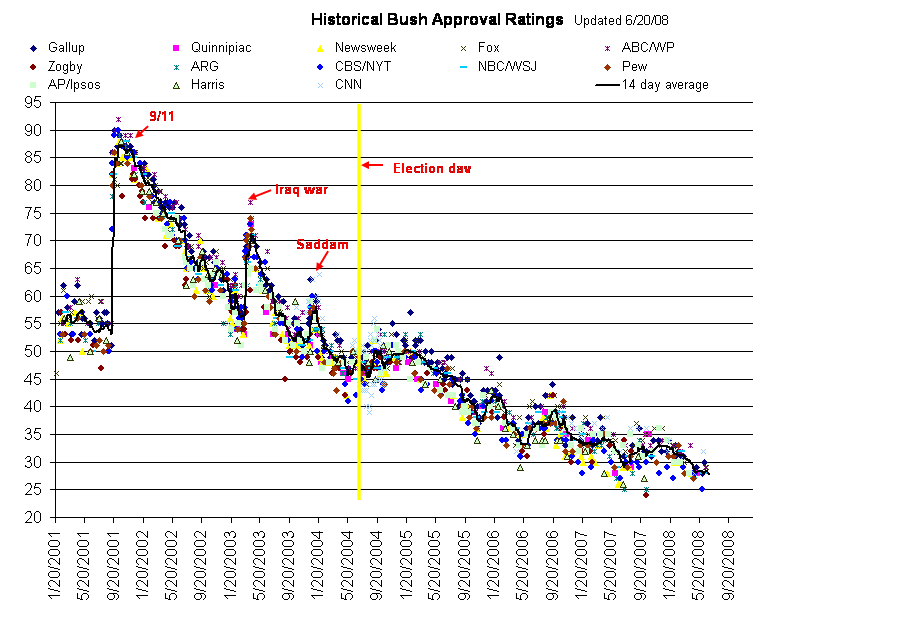
I don't think Bush went to war for votes.  If anything I think he used excess "poltical capital" from 9/11 to invade Iraq.

I mean, the Iraq invasion support was at highest 60%  AFTER inspections WITH a UN Manda

http://en.wikipedia.org/wiki/Popular_opinion_in_the_United_States_on_the_invasion_of_Iraq#January_2003te.

I literally can't tell you why Bush invaded Iraq, just why he didn't.


Best theory i can come up with is a dangerous combination of black and white idealsim and wanting to one up his Dad combined with a bit of cognitive dissonance to where he actually believed he was justified and that the questionable reports were the right ones due to his gut.


I think he did it because he thought he could swoop in, take out Saddam, put in a Democracy, stick it to his Dad for not finishing the job in his presidency (back when cheney was against occupation) and in general going down as the President who started the US' big push for democratic change in the world by coming to the opressed's aid.


I know it sounds completely ludicris and laeves you thinking "How could someone who is president think that way?"  However honestly, it fis the best.


His approval spiked hugely as soon as he went to war, didn't last as long as he would have hoped though.


Rath said:
Naninho said:
Rath said:
Naninho said:
What still amaze me today is how fast the british struck back. Obviously Thatcher didn’t give a fuck about her people. It seems she wasn't very different from our dictators. Stuff like this, is far more important than any debate we could have about any particular conflict. The sad part is, no matter what we do, it will always happen again...


I find this bit interesting. How does Thatcher striking back make her alike to a dictator? Even democratic countries have militaries and they often use them at far less provocation than they got.

We assume that democracies try to avoid getting involved in wars. Democratic leaders must answer to the voters for war, and therefore have an incentive to seek alternatives. Still, this is completely illusory, and serve only to mask the reality of elite rule.

Thatcher's willingness to sacrifice the lives of others is undeniable.

Whilst the Argentineans, under the leadership of Dictator General Galtieri were being whipped up into a patriotic fervor, the UK Government seized at the chance to whip up the same patriotic fervor in there. The media took up the cause, and the Argentineans were portrayed as blood thirsty opportunists who would destroy the British way of life on the Islands. Despite the Islanders having to rely on Argentina for post and supplies, the British were fooled into accepting that they must claim for some islands they never heard of.

Thatcher, was also going through a massive loss of domestic support and elections were looming. She knew the patriotic cheer leading would lead to death, but politicians are more than willing to sacrifice others so that they can hold onto power. She played the same game as Galtieri.

As crazy as it seems, democracy and dictatorship are two faces of the same coin...


I have no problem with believing that democractic leaders will go to war for votes (modern example - Bush in Iraq). When you think about it the fact that the war won her so much popularity (and essentially the next election) meant that her decision was upheld by democratic principles - she answered to the British voters for the war in the next election and won by a landslide.


Oh, I totally agree with that. Democratic principles like participation, right? Which means that citizens have an obligation to express their opinions. But governments often induce their own opinion on people, using fear or brainwashing through the media. That way, consensus is easy to achieve...