




By using this site, you agree to our Privacy Policy and our Terms of Use. Close

Forums - Gaming - Android nears 50% mark in the US, comScore reports

famousringo said:
Wow. If NPD is correct, the 4S has given Apple a massive surge in US smartphone sales:

http://gigaom.com/2012/01/09/iphone-breathing-down-the-neck-of-android-in-u-s/

I think this surge is just a little too big to be sustainable, and I wouldn't be surprised if Apple settles down to a little under 40% in a quarter or two (i.e., a lot of these sales are upgraders, rather than new users), but it sure demonstrates that the powerful position Android has quickly seized is not unassailable.

The other interesting mobile sales news of the past week is that while Samsung continues to grow rapidly, other Android OEMs such as HTC and Motorola are actually shrinking. If this trend continues, Google may find their power over the Android platform will start slipping into Samsung's hands.

Also, remember that NPD's numbers are unit sales, while comScore's numbers are installed base. So don't be surprised if it takes a few months for a dramatic shift in the former to be seen in the latter.

One issue, though, is that your comparing apples to oranges in some cases, especially in regards to the iOS user base. NPD tracks hardware, but not install base, which is more likely to be indicative by ComScore's report. Apple generally has huge amount of users who upgrade constantly. So your right in that the sales pace is likely unsustainable - Apple only launches a new iPhone every year, which boosts their sales.

Here's their chart of unit sales by quarter:
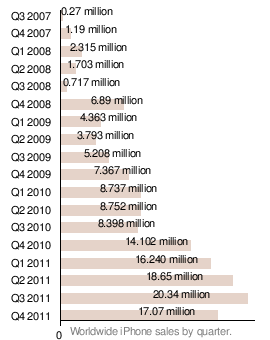
Now correlate quarterly sales to the launch of subsequent iPhones (mind you, the list is on Apple's fiscal quarters, so I adjusted launch date to correlate with their handset reporting):

iPhone: Q3 2007

iPhone 3G: Q4 2008

iPhone 3GS: Q3 2009 (last 7 days of quarter, FYI)

iPhone 4: Q3 2010 (last day of quarter, FYI)

iPhone 4S: Q1 2012

Point being, there is a direct correlation to handset spikes, with significant decreases. That would suggest you have a huge number of sales to current users upgrading, rather than new users. That isn't to suggest that the iOS user base is decreasing, it is certainly growing, but handset sales aren't the best barometer of sales for the iOS.


Back from the dead, I'm afraid.

Around the Network
mrstickball said:

One issue, though, is that your comparing apples to oranges in some cases, especially in regards to the iOS user base. NPD tracks hardware, but not install base, which is more likely to be indicative by ComScore's report. 

Oh really? That's news to me. Wait... from my two posts in this very thread:


famousringo said:

Just so everybody is clear, comscore tracks installed base, not unit sales. 

famousringo said:

Also, remember that NPD's numbers are unit sales, while comScore's numbers are installed base. 
But why aren't handset sales a good indication of iOS' success?
For Apple, there is no better metric for success.
For developers, neither comScore nor NPD are good metrics of success. They need to worry about ad impressions, app revenues, and usage levels. You might think installed base is a good proxy for these things, and there's certainly a correlation, but various factors completely outweigh Android's massive installed base advantage. Despite Android's install base, Google itself sees two thirds of mobile searches coming from iOS.
In the crazy bizarro world of mobile, it's quite possible that Google makes more money from iOS than from Android, and Microsoft makes more money from Android than Windows Phone 7.
The only stakeholders I can think of who would find comScore a definitively better metric than NPD are the carriers, and they seem willing to bend over backwards for the iPhone anyway.


"The worst part about these reviews is they are [subjective]--and their scores often depend on how drunk you got the media at a Street Fighter event."  — Mona Hamilton, Capcom Senior VP of Marketing
*Image indefinitely borrowed from BrainBoxLtd without his consent.

famousringo said:
mrstickball said:

One issue, though, is that your comparing apples to oranges in some cases, especially in regards to the iOS user base. NPD tracks hardware, but not install base, which is more likely to be indicative by ComScore's report. 

Oh really? That's news to me. Wait... from my two posts in this very thread:


famousringo said:

Just so everybody is clear, comscore tracks installed base, not unit sales. 

famousringo said:

Also, remember that NPD's numbers are unit sales, while comScore's numbers are installed base. 
But why aren't handset sales a good indication of iOS' success?
For Apple, there is no better metric for success.
For developers, neither comScore nor NPD are good metrics of success. They need to worry about ad impressions, app revenues, and usage levels. You might think installed base is a good proxy for these things, and there's certainly a correlation, but various factors completely outweigh Android's massive installed base advantage. Despite Android's install base, Google itself sees two thirds of mobile searches coming from iOS.
In the crazy bizarro world of mobile, it's quite possible that Google makes more money from iOS than from Android, and Microsoft makes more money from Android than Windows Phone 7.
The only stakeholders I can think of who would find comScore a definitively better metric than NPD are the carriers, and they seem willing to bend over backwards for the iPhone anyway.


I'd say developers are more interested in the number of people actively using the platform. And since this is, you know, a game sales website, such a metric may be important here


Back from the dead, I'm afraid.

mrstickball said:


I'd say developers are more interested in the number of people actively using the platform. 


Yes, "actively" is the key word here. comScore shows cell phone subscriptions. But while Android subscribers have been growing relative to iPhone subscribers, Android app projects have been declining relative to iOS.

How can we reconcile this conflict? By accepting that the average iOS user is massively more active than the average Android user. I've already cited Google searches. The disparity in app revenue is well documented and mentioned in the link above. Web usage suggests iOS users are three times more active.

comScore doesn't show activity at all, it just shows contracts. Entire markets of mobile devices don't even show up in comScore's smartphone-only analysis. It's not an irrelevant data point, but developers sure don't seem to be making business decisions based on who's kicking ass in the comScore rankings.


"The worst part about these reviews is they are [subjective]--and their scores often depend on how drunk you got the media at a Street Fighter event."  — Mona Hamilton, Capcom Senior VP of Marketing
*Image indefinitely borrowed from BrainBoxLtd without his consent.

iOS is confined to only one brand of HW anyway. And quite an expensive one. I'm sure iPhone can still grow, and it will be the best seller phone for years, but it won't ever become the absolute majority of phones, so iOS has no chances to become absolute mobile OS leader, while it has little chances to even become relative majority, unlike its HW that can do it easily, unless Android get weaker enough and WP and RIM stronger enough to balance each other at a lower level than iOS.


Stwike him, Centuwion. Stwike him vewy wuffly! (Pontius Pilate, "Life of Brian")
A fart without stink is like a sky without stars.
TGS, Third Grade Shooter: brand new genre invented by Kevin Butler exclusively for Natal WiiToo Kinect. PEW! PEW-PEW-PEW! 


Around the Network
famousringo said:
mrstickball said:


I'd say developers are more interested in the number of people actively using the platform. 


Yes, "actively" is the key word here. comScore shows cell phone subscriptions. But while Android subscribers have been growing relative to iPhone subscribers, Android app projects have been declining relative to iOS.

How can we reconcile this conflict? By accepting that the average iOS user is massively more active than the average Android user. I've already cited Google searches. The disparity in app revenue is well documented and mentioned in the link above. Web usage suggests iOS users are three times more active.

comScore doesn't show activity at all, it just shows contracts. Entire markets of mobile devices don't even show up in comScore's smartphone-only analysis. It's not an irrelevant data point, but developers sure don't seem to be making business decisions based on who's kicking ass in the comScore rankings.


I wouldn't expect the users to be substantially different in how they use the device; and, after a decade of buying music at prices that were often more expensive than buying a CD, iTunes users have just been "trained" to be far more likely to pay for apps.


HappySqurriel said:
famousringo said:

Yes, "actively" is the key word here. comScore shows cell phone subscriptions. But while Android subscribers have been growing relative to iPhone subscribers, Android app projects have been declining relative to iOS.

How can we reconcile this conflict? By accepting that the average iOS user is massively more active than the average Android user. I've already cited Google searches. The disparity in app revenue is well documented and mentioned in the link above. Web usage suggests iOS users are three times more active.

comScore doesn't show activity at all, it just shows contracts. Entire markets of mobile devices don't even show up in comScore's smartphone-only analysis. It's not an irrelevant data point, but developers sure don't seem to be making business decisions based on who's kicking ass in the comScore rankings.


I wouldn't expect the users to be substantially different in how they use the device; and, after a decade of buying music at prices that were often more expensive than buying a CD, iTunes users have just been "trained" to be far more likely to pay for apps.

I agree. I would think that the web usage of one pocket computer with a good webkit browser would be quite similar to the usage of another, but metric afer metric shows that that the behavior of the average user is radically different between the two platforms.

And iTunes is an advantage, but not in the "training" you describe. It's an advantage in that Apple already had some 100 million plus accounts with credit card numbers, and a widespread gift card distribution network so people can pay without a credit card. Extending that payment system to apps and other content lowered the barrier to purchasing apps for anybody who had an iTunes account. iTunes users consider digital a discount over physical CDs because they can pay $2 for the two songs they want off an album rather than $8 for a pile of extra filler they don't want. Beyond the top sellers, obscure and imported material is easier to find, never goes out of print/stock, and tends to be around the same price as new albums rather than $20 an album.


"The worst part about these reviews is they are [subjective]--and their scores often depend on how drunk you got the media at a Street Fighter event."  — Mona Hamilton, Capcom Senior VP of Marketing
*Image indefinitely borrowed from BrainBoxLtd without his consent.

PizzaFaceGamer said:
It's Apple's fault for not making a keyboard iphone.
hell even an iphone that played flash would be a nice change

You are still on that?


http://www.guardian.co.uk/technology/2011/nov/09/adobe-flash-mobile-dead


It's pretty amazing how irrelevant you can be in US and still be market leader worldwide (Nokia). Even during the glory days of Nokia they were clear underdogs in US. I wonder why US has been always so hard market for Nokia to crack. Maybe with WP (together with MS advertising help) they start to appeal more to US consumers.