By using this site, you agree to our Privacy Policy and our Terms of Use. Close

Forums - General - Why renewable energy won't work.

mrstickball said:
Troll_Whisperer said:
Kasz216 said:
Troll_Whisperer said:

???

Let's try again:

http://es.wikipedia.org/wiki/Energia_renovable_en_Espana#Coste_de_las_energ.C3.ADas_renovables


Anyway, I found you a link in English:

http://dialogue.usaee.org/index.php?option=com_content&view=article&id=85:renewable-subsidies-do-they-create-or-destroy-jobs&catid=35:v17-no3&Itemid=78

'Professor Alvarez claims that Spain has spent over $36 billion (€25bn) so far to subsidize renewables'. That's from a guy who's actually critical of renewable energy and argues it destroys jobs. I can't tell whether that's true or not I have to admit.

Yeah.  Keep getting errors trying to translate it.

Also there is this

http://online.wsj.com/article/SB125193815050081615.html


200 million a year in subsidies.

until 2008 at 1 billion.

With no actual mention of how much this solar power costs outside of JUST subsidies.


For example how much the average consumer pays vs oil/coal/even wind.  Or how much they pay over those if you removed the price jacking on other energy to make solar attractive.

From what I understand: Maintaing wind power for 50 years is going to be much cheaper than buying fuel for 50 years. Even if it costs €350bn (a whole year's budget) to go 100% wind power, that pretty much means that you'll save huge amounts of money on fuel imports for ages. Once the investment is done, maintaining it is very cheap. What's expensive is building it.

Even on a yearly basis Spain was gaining when it was investing most, according to that Wikipedia article (from Babelfish, copy-pasted part of the text):

Thus, during the year the 2008 premiums to the renewable ones ascended to a total of 2,605 million of euros. Nevertheless, due to the use of native resources, this sector produces significant savings when not concerning fossil or nuclear fuels (2,725 million Euros in 2008), and in the wholesale market of the electricity (by the priority of this type of energies against the conventional ones, 4,919 million Euros in 2008).

Once no more new infrastructure is needed, costs will go dramatically down, also for the consumer. A few billion euros is really not much when we're talking of yearly budgets in developed countries.

I'm talking about wind, solar power is not that big even in Spain and I admit even I don't believe is feasible right now.

This is from what information I have available, nothing more. I know the wikipedia is not always the best source, but this is what I got.

Ah, but at what time do you not need any more capacity?

The problem is that if you balance out costs over the lifespan of a wind turbine, it is still marginally more expensive than something like Nuclear.

As per: http://nuclearfissionary.com/2010/04/02/comparing-energy-costs-of-nuclear-coal-gas-wind-and-solar/   cost per KWH of wind power is approximately $0.09. Comparatively, coal and nuclear are less than half the price. Also, this assumes that one can build wind power to their hearts content. Much like solar PV and solar thermal, I wonder if there is enough land to support enough turbines at the current costs.

Yeah, but nuclear is not as safe. Dealing with waste is also a problem. I care about that more a slight difference in cost.


No troll is too much for me to handle. I rehabilitate trolls, I train people. I am the Troll Whisperer.

Around the Network
Troll_Whisperer said:
mrstickball said:
Troll_Whisperer said:
Kasz216 said:
Troll_Whisperer said:

???

Let's try again:

http://es.wikipedia.org/wiki/Energia_renovable_en_Espana#Coste_de_las_energ.C3.ADas_renovables


Anyway, I found you a link in English:

http://dialogue.usaee.org/index.php?option=com_content&view=article&id=85:renewable-subsidies-do-they-create-or-destroy-jobs&catid=35:v17-no3&Itemid=78

'Professor Alvarez claims that Spain has spent over $36 billion (€25bn) so far to subsidize renewables'. That's from a guy who's actually critical of renewable energy and argues it destroys jobs. I can't tell whether that's true or not I have to admit.

Yeah.  Keep getting errors trying to translate it.

Also there is this

http://online.wsj.com/article/SB125193815050081615.html


200 million a year in subsidies.

until 2008 at 1 billion.

With no actual mention of how much this solar power costs outside of JUST subsidies.


For example how much the average consumer pays vs oil/coal/even wind.  Or how much they pay over those if you removed the price jacking on other energy to make solar attractive.

From what I understand: Maintaing wind power for 50 years is going to be much cheaper than buying fuel for 50 years. Even if it costs €350bn (a whole year's budget) to go 100% wind power, that pretty much means that you'll save huge amounts of money on fuel imports for ages. Once the investment is done, maintaining it is very cheap. What's expensive is building it.

Even on a yearly basis Spain was gaining when it was investing most, according to that Wikipedia article (from Babelfish, copy-pasted part of the text):

Thus, during the year the 2008 premiums to the renewable ones ascended to a total of 2,605 million of euros. Nevertheless, due to the use of native resources, this sector produces significant savings when not concerning fossil or nuclear fuels (2,725 million Euros in 2008), and in the wholesale market of the electricity (by the priority of this type of energies against the conventional ones, 4,919 million Euros in 2008).

Once no more new infrastructure is needed, costs will go dramatically down, also for the consumer. A few billion euros is really not much when we're talking of yearly budgets in developed countries.

I'm talking about wind, solar power is not that big even in Spain and I admit even I don't believe is feasible right now.

This is from what information I have available, nothing more. I know the wikipedia is not always the best source, but this is what I got.

Ah, but at what time do you not need any more capacity?

The problem is that if you balance out costs over the lifespan of a wind turbine, it is still marginally more expensive than something like Nuclear.

As per: http://nuclearfissionary.com/2010/04/02/comparing-energy-costs-of-nuclear-coal-gas-wind-and-solar/   cost per KWH of wind power is approximately $0.09. Comparatively, coal and nuclear are less than half the price. Also, this assumes that one can build wind power to their hearts content. Much like solar PV and solar thermal, I wonder if there is enough land to support enough turbines at the current costs.

Yeah, but nuclear is not as safe. Dealing with waste is also a problem. I care about that more a slight difference in cost.

Less then half isn't slight.

Also perhaps it's just the way it's translated... babelfish wouldn't translate it for me... but the bolded seems to mean the savings are counting the imposed taxes meant to make oil more expensive, to make oil more expensive.


Which would be like a Wal-mart saying Sony tvs are cheaper then Visios because they raised the price of visio's 500% and are making a way higher profit margin off of them.


I mean, lets think about common sense here.  If it really did save money... they wouldn't need ANY subsidies.


Kasz216 said:
Troll_Whisperer said:
mrstickball said:
Troll_Whisperer said:
Kasz216 said:
Troll_Whisperer said:

???

Let's try again:

http://es.wikipedia.org/wiki/Energia_renovable_en_Espana#Coste_de_las_energ.C3.ADas_renovables


Anyway, I found you a link in English:

http://dialogue.usaee.org/index.php?option=com_content&view=article&id=85:renewable-subsidies-do-they-create-or-destroy-jobs&catid=35:v17-no3&Itemid=78

'Professor Alvarez claims that Spain has spent over $36 billion (€25bn) so far to subsidize renewables'. That's from a guy who's actually critical of renewable energy and argues it destroys jobs. I can't tell whether that's true or not I have to admit.

Yeah.  Keep getting errors trying to translate it.

Also there is this

http://online.wsj.com/article/SB125193815050081615.html


200 million a year in subsidies.

until 2008 at 1 billion.

With no actual mention of how much this solar power costs outside of JUST subsidies.


For example how much the average consumer pays vs oil/coal/even wind.  Or how much they pay over those if you removed the price jacking on other energy to make solar attractive.

From what I understand: Maintaing wind power for 50 years is going to be much cheaper than buying fuel for 50 years. Even if it costs €350bn (a whole year's budget) to go 100% wind power, that pretty much means that you'll save huge amounts of money on fuel imports for ages. Once the investment is done, maintaining it is very cheap. What's expensive is building it.

Even on a yearly basis Spain was gaining when it was investing most, according to that Wikipedia article (from Babelfish, copy-pasted part of the text):

Thus, during the year the 2008 premiums to the renewable ones ascended to a total of 2,605 million of euros. Nevertheless, due to the use of native resources, this sector produces significant savings when not concerning fossil or nuclear fuels (2,725 million Euros in 2008), and in the wholesale market of the electricity (by the priority of this type of energies against the conventional ones, 4,919 million Euros in 2008).

Once no more new infrastructure is needed, costs will go dramatically down, also for the consumer. A few billion euros is really not much when we're talking of yearly budgets in developed countries.

I'm talking about wind, solar power is not that big even in Spain and I admit even I don't believe is feasible right now.

This is from what information I have available, nothing more. I know the wikipedia is not always the best source, but this is what I got.

Ah, but at what time do you not need any more capacity?

The problem is that if you balance out costs over the lifespan of a wind turbine, it is still marginally more expensive than something like Nuclear.

As per: http://nuclearfissionary.com/2010/04/02/comparing-energy-costs-of-nuclear-coal-gas-wind-and-solar/   cost per KWH of wind power is approximately $0.09. Comparatively, coal and nuclear are less than half the price. Also, this assumes that one can build wind power to their hearts content. Much like solar PV and solar thermal, I wonder if there is enough land to support enough turbines at the current costs.

Yeah, but nuclear is not as safe. Dealing with waste is also a problem. I care about that more a slight difference in cost.

Less then half isn't slight.

Also perhaps it's just the way it's translated... babelfish wouldn't translate it for me... but the bolded seems to mean the savings are counting the imposed taxes meant to make oil more expensive, to make oil more expensive.

There's no price for human life.

Even without those it's a positive balance.


No troll is too much for me to handle. I rehabilitate trolls, I train people. I am the Troll Whisperer.

Troll_Whisperer said:
mrstickball said:

Ah, but at what time do you not need any more capacity?

The problem is that if you balance out costs over the lifespan of a wind turbine, it is still marginally more expensive than something like Nuclear.

As per: http://nuclearfissionary.com/2010/04/02/comparing-energy-costs-of-nuclear-coal-gas-wind-and-solar/   cost per KWH of wind power is approximately $0.09. Comparatively, coal and nuclear are less than half the price. Also, this assumes that one can build wind power to their hearts content. Much like solar PV and solar thermal, I wonder if there is enough land to support enough turbines at the current costs.

Yeah, but nuclear is not as safe. Dealing with waste is also a problem. I care about that more a slight difference in cost.

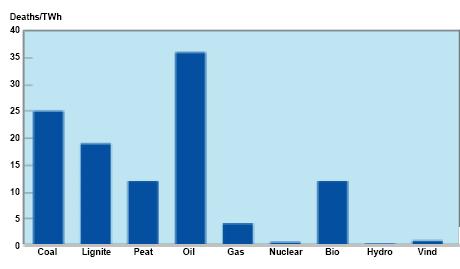
Nuclear is arguably the safest form of energy we have right now. Fewer people have died from nuclear energy than wind power (by a rate of about 2 to 1) when adjusting for power output. Meaning that, although nuclear has killed a few people due to Chernobyl, the amount of energy produced by plants around the world equate to about 0.004 deaths per terawatt hour. Comparatively, wind power yields about 0.011 deaths per terawatt hour (for reference, coal is about 200 deaths per TWH worldwide, and about 17 per TWH in western countries like the US). This accounts for all environmental factors as well, BTW.


Furthermore, the cost of power generation and safety goes far outside of just these factors. If energy is expensive, it means that people must face a reduction in their standard of living in all other areas, as they are having to pay more for the same energy. If energy costs more, can they afford food to live on? Rent/mortgage to live in a house? Money for health care? Education? Money can significantly adjust the life of human beings, and that is why I want to see the cheapest forms of energy available for people - regardless if it is wind, solar, nuclear or MSR thorium breeders. If people do not have to pay additional costs because their government is forcing subsidized electricity onto them, money can be spent elsewhere improving life. So your argument about safety is wrong from more than one factor - not only is nuclear safer in terms of health (less deaths due to the insane standards of nuclear), but in living standards (cheaper energy = less money spent on survival = more money spent on improving standard of living, health, longevity and R&D into future life-enhancing items).


Back from the dead, I'm afraid.

Troll_Whisperer said:
Kasz216 said:
Troll_Whisperer said:
mrstickball said:
 

A

Yeah, but nuclear is not as safe. Dealing with waste is also a problem. I care about that more a slight difference in cost.

Less then half isn't slight.

Also perhaps it's just the way it's translated... babelfish wouldn't translate it for me... but the bolded seems to mean the savings are counting the imposed taxes meant to make oil more expensive, to make oil more expensive.

There's no price for human life.

Even without those it's a positive balance.

Use common sense.

If it was a positive balance it wouldn't need subsidies... because the electircity would be cheaper...

and less people die in Nuclear related accidents and uranium mining then mining accidents related to Solar and Turbine power and don't forget the toxic waste.

So you've argued yourself in a corner here... and are basically forced to admit that Nuclear Energy would be the best way to go... being the safest form. 


Around the Network
sapphi_snake said:
mrstickball said:

So how did Microsoft prevent the enterance of other companies into the market, exactly?

Concerning monopolies, it is usually far better for industry to have heavy regulation to choke and destroy smaller businesses, than it is for free markets to grow and expand. The bigger the government, the more an industry can maneuver itself into a position to harm growth of smaller companies. Look at the US financial industry: many of the mega banks have poured millions into electing candidates that will push for their regulations that keep them afloat (the past few years are heavily evident of this concerning bailouts among banks and our auto industry).

Comparatively, a free market with fewer regulations ensure a level playing field for all. If a mega corporation cannot leverage the government to enact bills that will favor it, then it must compete against its peers.

Regulations are needed in the financial sector. The reason why they didn't work in your country was that you allow private companies to donate money to political parties, and lobby. Make donations and lobbying illegal and you solve your problem.

And I agree that corporations shouldn't lobby. There shouldn't be a government that can legislate changes to benefit one company and hurt another.

The ideea is that it's bad either way. In the case of a market with no regulations, companies can essentially do whatever they want, and at one point one company will  become powerfull enough to do whatever it wants. If the market's regulated, the big comapnies influence the Government, and make sure that there will be no laws preventing them to do whatever they want (in this case the solution, as I said above, is making it illegal for companies to influence politicians).

Define 'whatever it wants'. My belief is that government should exist to ensure that no person is forcing someone to do something against their will. That would mean that a company could never force someone into doing, living, or saying something against their will. Again, you can look at countries that have had systemic, heavy regulatory structures over many years and find that they are not the most beneficial for business. I have never said no regulations are needed - but we need to maintain the minimum standard to ensure that businesses can compete against eachother, and contracts can be enforced.

Also, the "level playing field far all" is an illusion of the capitalist system. There's no such thing as a level playing field.

It is an illusion of the socialist system as well. There will never be a level playing field. I believe, though, that the most level playing field comes from free markets - and the data will prove that. It is why a generally free state such as my own can have half the number of people in it as yours, with a similar geography, and produce far more goods, services, technology and products than yours and other socialist comparables. Likewise, it also shows why even more free nations with far less resources have done even better, such as New Zealand, Hong Kong and Singapore.


Back from the dead, I'm afraid.

Kasz216 said:
Troll_Whisperer said:
Kasz216 said:
Troll_Whisperer said:
mrstickball said:
Troll_Whisperer said:
Kasz216 said:
Troll_Whisperer said:

???

Let's try again:

http://es.wikipedia.org/wiki/Energia_renovable_en_Espana#Coste_de_las_energ.C3.ADas_renovables


Anyway, I found you a link in English:

http://dialogue.usaee.org/index.php?option=com_content&view=article&id=85:renewable-subsidies-do-they-create-or-destroy-jobs&catid=35:v17-no3&Itemid=78

'Professor Alvarez claims that Spain has spent over $36 billion (€25bn) so far to subsidize renewables'. That's from a guy who's actually critical of renewable energy and argues it destroys jobs. I can't tell whether that's true or not I have to admit.

Yeah.  Keep getting errors trying to translate it.

Also there is this

http://online.wsj.com/article/SB125193815050081615.html


200 million a year in subsidies.

until 2008 at 1 billion.

With no actual mention of how much this solar power costs outside of JUST subsidies.


For example how much the average consumer pays vs oil/coal/even wind.  Or how much they pay over those if you removed the price jacking on other energy to make solar attractive.

From what I understand: Maintaing wind power for 50 years is going to be much cheaper than buying fuel for 50 years. Even if it costs €350bn (a whole year's budget) to go 100% wind power, that pretty much means that you'll save huge amounts of money on fuel imports for ages. Once the investment is done, maintaining it is very cheap. What's expensive is building it.

Even on a yearly basis Spain was gaining when it was investing most, according to that Wikipedia article (from Babelfish, copy-pasted part of the text):

Thus, during the year the 2008 premiums to the renewable ones ascended to a total of 2,605 million of euros. Nevertheless, due to the use of native resources, this sector produces significant savings when not concerning fossil or nuclear fuels (2,725 million Euros in 2008), and in the wholesale market of the electricity (by the priority of this type of energies against the conventional ones, 4,919 million Euros in 2008).

Once no more new infrastructure is needed, costs will go dramatically down, also for the consumer. A few billion euros is really not much when we're talking of yearly budgets in developed countries.

I'm talking about wind, solar power is not that big even in Spain and I admit even I don't believe is feasible right now.

This is from what information I have available, nothing more. I know the wikipedia is not always the best source, but this is what I got.

Ah, but at what time do you not need any more capacity?

The problem is that if you balance out costs over the lifespan of a wind turbine, it is still marginally more expensive than something like Nuclear.

As per: http://nuclearfissionary.com/2010/04/02/comparing-energy-costs-of-nuclear-coal-gas-wind-and-solar/   cost per KWH of wind power is approximately $0.09. Comparatively, coal and nuclear are less than half the price. Also, this assumes that one can build wind power to their hearts content. Much like solar PV and solar thermal, I wonder if there is enough land to support enough turbines at the current costs.

Yeah, but nuclear is not as safe. Dealing with waste is also a problem. I care about that more a slight difference in cost.

Less then half isn't slight.

Also perhaps it's just the way it's translated... babelfish wouldn't translate it for me... but the bolded seems to mean the savings are counting the imposed taxes meant to make oil more expensive, to make oil more expensive.

There's no price for human life.

Even without those it's a positive balance.

Use common sense.

If it was a positive balance it wouldn't need subsidies... because the electircity would be cheaper...

and less people die in Nuclear related accidents and uranium mining then mining accidents related to Solar and Turbine power.

Wouldn't it be still be cheaper than fuel in the long run? Not initially of course.

About nuclear: one screw up in history is enough to fuck up really badly and that's enough for me. Japan was close.

Anyway, I don't think we'll agree here, and I have to go dinner. Let's leave the conversation here?


No troll is too much for me to handle. I rehabilitate trolls, I train people. I am the Troll Whisperer.

Troll_Whisperer said:
Kasz216 said:
Troll_Whisperer said:
 

There's no price for human life.

Even without those it's a positive balance.

Use common sense.

If it was a positive balance it wouldn't need subsidies... because the electircity would be cheaper...

and less people die in Nuclear related accidents and uranium mining then mining accidents related to Solar and Turbine power.

Wouldn't it be still be cheaper than fuel in the long run? Not initially of course.

About nuclear: one screw up in history is enough to fuck up really badly and that's enough for me. Japan was close.

Anyway, I don't think we'll agree here, and I have to go dinner. Let's leave the conversation here?


I have to disagree.  You seem to be just trying to gracefully back out of an issue you backed yourself in.  Afterall "There is no price for human life."

including cherynobal far less people die per year.  Do you know how many people are expected to die due to chernobyl?

4,050 or so.

Do you know how many people died due to chernobyl so far?

50.

http://www.who.int/mediacentre/news/releases/2005/pr38/en/index.html


How many people do you think die each year falling off roofs installing solar panels?  Or mining the ore that is needed to make solar panels.


Don't currently have the time to read all this, so I'm just going to throw this video in here. Watch it if you want, I highly recommend it.


@mrstickball:


And I agree that corporations shouldn't lobby. There shouldn't be a government that can legislate changes to benefit one company and hurt another.

It's not just laws that benefit one company over another, but laws that benefit companies over consumers as well. Where do you think all of the anti-litigious propaganda comes from? Big corporations, who spread misinformation in order to cheat consumers out of their rights. They actually fool consumers into lobbying their own rights away.

Define 'whatever it wants'. My belief is that government should exist to ensure that no person is forcing someone to do something against their will. That would mean that a company could never force someone into doing, living, or saying something against their will. Again, you can look at countries that have had systemic, heavy regulatory structures over many years and find that they are not the most beneficial for business. I have never said no regulations are needed - but we need to maintain the minimum standard to ensure that businesses can compete against eachother, and contracts can be enforced.

If the company ends up being the only one on the market (as is the dream of most capitalist business owners), they'll essentially be able to do whatever they want within an unregulated market (not to mention tha the lack of competition will lead to poor quality products at higher prices). The only way to maintain competition is to have a regulated market, else at one point you'll have companies eliminating their competition based on their resources (buying them out, having huge advertising campaigns that eclipse the competition), not on the quality of their products/services.

It is an illusion of the socialist system as well. There will never be a level playing field. I believe, though, that the most level playing field comes from free markets - and the data will prove that. It is why a generally free state such as my own can have half the number of people in it as yours, with a similar geography, and produce far more goods, services, technology and products than yours and other socialist comparables. Likewise, it also shows why even more free nations with far less resources have done even better, such as New Zealand, Hong Kong and Singapore.

You are aware that there's no socialism in Romania, no? Socialism, and the whole left wing for that manner, has pretty much disappeared from Romania since the fall of the Communist regime (doesn't surprise me., as Romanian's have been typically supporters of right wing conservative ideals, and were more sympathetic to the Nazis rather than the Communists).  Everything's been privatized. I'm not sure there are any significant regulations to the market. Laws meant to protect the consumer are useless. Health care isn't free etc.

Of the countries you mentione, I'm quite sure New Zealand is much more socialist than Romania is. Plus, deregulation didn't reallz helo Iceland, no?

Also, I had no ideea that the US has half the population of Romania.


"I don't understand how someone could like Tolstoy and Dostoyevsky, but not like Twilight!!!"

"Last book I read was Brokeback Mountain, I just don't have the patience for them unless it's softcore porn."

                                                                               (The Voice of a Generation and Seece)

"If you cant stand the sound of your own voice than dont become a singer !!!!!"

                                                                               (pizzahut451)